Dog Melatonin Dosage Calculator: How Much to Give & Charts

Canine Bible is reader-supported. We receive affiliate commissions via some of our links. Learn more.
Melatonin is sometimes used in dogs for sleep-wake problems, certain anxiety or stress situations, and specific hair-growth disorders. But the right amount cannot be determined from body weight alone, the reason for using melatonin, your dog’s health, other medications, and the exact product all matter. The Dog Melatonin Dosage Calculator below helps convert a veterinarian-recommended dose into milligrams, tablets, capsules, or liquid volume. This guide also covers weight-based calculations, published veterinary dosing examples, product safety, possible side effects, interactions, and when to call your veterinarian.
Always check the full ingredient list and contact your veterinarian or a pet poison control service if your dog may have ingested too much melatonin. If you can't reach your vet, you can chat live with a registered online veterinary professional via our online vet chat or video chat support (24 hours a day, 7 days a week). Or use Chewy's online vet services (6 a.m. - midnight ET).
How Much Melatonin Can I Give My Dog?
There is no single melatonin dose that is appropriate for every dog. Veterinary protocols vary substantially depending on whether melatonin is being considered for a sleep problem, behavioral condition, hair-growth disorder, or another reason.
Body weight may be part of the calculation, but it is only one factor. Published canine studies and veterinary references have used both fixed milligram doses and weight-based doses, sometimes on very different schedules. Those protocols should not be treated as interchangeable home-dosing instructions.
If your veterinarian has already given you a dose in mg/kg, the calculator can convert that instruction into the total number of milligrams your dog needs. If your veterinarian has prescribed a fixed amount, such as a certain number of milligrams per dose, use that amount directly rather than creating your own weight-based dose.
Is Melatonin Safe for Dogs?
Melatonin itself has a relatively wide margin of safety in dogs, but that does not make every melatonin supplement safe. Sleepiness, vomiting, lethargy, and unsteadiness can occur, and other ingredients in a human supplement may pose a greater risk than the melatonin.


Xylitol is especially important. This sweetener can cause a rapid drop in blood sugar in dogs and, at higher exposures, potentially severe liver injury. It may appear in gummies, chewable supplements, liquids, vitamins, and other sugar-free products.
What Is Melatonin Used for in Dogs?
Veterinarians may use melatonin for selected sleep or behavior disorders and certain types of non-allergic hair loss. It has also been studied for several other veterinary applications, but evidence and dosing protocols differ by condition. Melatonin should not be used simply to mask unexplained nighttime restlessness, severe anxiety, or hair loss. Those signs can have medical or behavioral causes that need to be identified first.
Dog Melatonin Dosage Chart
Because melatonin does not have one universal weight-based dose for dogs, the safest weight chart is a conversion chart for a dose your veterinarian has already provided.
Melatonin Dose Calculation Chart by Weight
Use the multiplier in the final column with the mg/kg dose prescribed by your veterinarian.
| Dog Weight | Weight in kg | Vet-Directed Calculation |
|---|---|---|
| 5 lb | 2.3 kg | 2.3 × prescribed mg/kg |
| 10 lb | 4.5 kg | 4.5 × prescribed mg/kg |
| 20 lb | 9.1 kg | 9.1 × prescribed mg/kg |
| 30 lb | 13.6 kg | 13.6 × prescribed mg/kg |
| 40 lb | 18.1 kg | 18.1 × prescribed mg/kg |
| 50 lb | 22.7 kg | 22.7 × prescribed mg/kg |
| 75 lb | 34.0 kg | 34.0 × prescribed mg/kg |
| 100 lb | 45.4 kg | 45.4 × prescribed mg/kg |
Important: This chart performs a mathematical conversion only. It does not tell you which mg/kg dose is appropriate for your dog.
Published Melatonin Doses Used in Dogs
The examples below show why a single universal “melatonin dosage by weight” can be misleading. Veterinary references and studies have used different amounts for different purposes.


| Context | Amount Studied/Used | Important Note |
|---|---|---|
| Hair-growth disorders | 3–6 mg per dog every 6–8 hours | Empirical dermatology protocol for selected conditions. |
| Veterinary-visit stress | 3–5 mg per dog | Studied as part of a multi-drug pre-visit protocol. |
| Healthy-dog research | 0.3 mg/kg every 24 hours | Research protocol, not general treatment guidance. |
| Alopecia X study | 0.1, 0.3, or 0.5 mg/kg twice daily | Experimental dose-response study in male Pomeranians. |
These figures describe specific veterinary or research protocols. They are not interchangeable recommended doses for sleep, anxiety, or routine home use.
Melatonin Product Safety Chart
Before calculating a dose, identify exactly what is in the bottle. Formulation can matter just as much as the number of milligrams.
| Product Type | Main Concern | What to Check |
|---|---|---|
| Plain tablet | Strength per tablet | Confirm milligrams and all inactive ingredients. |
| Liquid | Concentration and sweeteners | Check mg/mL and the complete ingredient list. |
| Gummy | Xylitol or added ingredients | Do not use until every ingredient is verified. |
| Combination sleep aid | 5-HTP, herbs, or other actives | Use only with veterinary approval. |
| Extended release | Different release pattern | Do not substitute without veterinary direction. |
| Veterinary product | Appropriate dose and indication | Follow the prescribed or labeled directions. |
Human melatonin products may contain xylitol, and sustained-release oral products should not simply be substituted for ordinary immediate-release melatonin in pets. Products containing 5-HTP also require particular caution because excessive exposure can produce serious neurologic and serotonin-related effects.
Melatonin Guidelines for Dogs
Melatonin is a naturally occurring hormone involved in regulation of circadian rhythms and sleep-wake cycles. Supplemental melatonin is also used off-label in veterinary medicine for selected behavioral, sleep, and dermatologic conditions.
The important point is that the condition being treated determines the protocol. A dose used for a hair-cycle disorder is not automatically appropriate for nighttime restlessness, and an experimental research dose should not become a home dosing rule.
Oral melatonin is considered relatively fast acting, with effects often beginning within roughly one to two hours. The timing and duration that matter clinically still depend on the dog, formulation, and purpose of treatment.
Melatonin for Dog Anxiety
Melatonin may be part of a veterinarian-directed plan for certain fear or anxiety situations, but it should not be viewed as a universal sedative. For example, one clinical trial used melatonin in dogs with anxiety, fearfulness, or aggression around veterinary visits, but melatonin was given as part of a protocol that also included gabapentin and acepromazine. That means the study does not establish melatonin alone as a complete treatment for canine anxiety.
Dogs with significant separation anxiety, noise phobia, panic, or aggression often benefit from a broader plan that may include behavior modification, environmental management, and prescription medication when appropriate.
Melatonin for Dogs That Cannot Sleep
Melatonin may be considered for selected sleep-wake disturbances, but a dog that suddenly starts pacing or waking repeatedly at night needs more than a sleep supplement. Pain, urinary problems, gastrointestinal discomfort, sensory changes, anxiety, neurologic disease, and canine cognitive dysfunction can all disturb sleep. This is especially important in senior dogs with a new change in nighttime behavior.
Melatonin for Hair Loss and Alopecia
Melatonin has been used for certain non-allergic hair-growth disorders, including some forms of hair-cycle arrest and recurrent flank alopecia. Published protocols exist, but a proper diagnosis matters because hair loss can also result from allergies, parasites, infections, endocrine disease, or other medical problems. Do not start melatonin solely because your dog has thinning hair. A veterinarian should first determine whether the pattern is consistent with a condition in which melatonin may actually be useful.
Factors That Can Affect Your Dog's Melatonin Results
Several factors can change whether a calculated dose is appropriate or how your dog responds.
| Factor | Why It Matters | What Owners Should Check |
|---|---|---|
| Reason for use | Protocols vary by condition. | Confirm why melatonin is being given. |
| Body weight | Weight matters when dosing is given in mg/kg. | Use a current, accurate weight. |
| Age | Young and older dogs may need extra assessment. | Tell your vet your dog's age and life stage. |
| Health conditions | Liver, kidney, and other disease can affect treatment decisions. | Review your dog's medical history. |
| Medications | Melatonin may interact with other drugs. | List all medicines and supplements. |
| Reproductive status | Melatonin can influence reproductive physiology. | Flag pregnancy, nursing, or breeding plans. |
| Product formulation | Strength and release type affect how products are used. | Check mg, ingredients, and release type. |
Melatonin has been shown to affect reproductive hormones in dogs, which is one reason breeding status and sexual maturity should be part of the discussion before supplementation. Extra caution is also appropriate in dogs with significant medical disease or those taking other medications.
Common Mistakes to Avoid
Most melatonin problems are preventable by checking the dose, units, and product before anything is given.
| Mistake | Why It Matters | Better Approach |
|---|---|---|
| Copying another dog's dose | The condition and health history may differ. | Use your own veterinarian's instructions. |
| Ignoring ingredients | Human products may contain xylitol or 5-HTP. | Check every active and inactive ingredient. |
| Confusing mg and mL | These measure different things. | Use the product's mg/mL concentration. |
| Wrong formulation | Extended-release products behave differently. | Use only the formulation your vet approved. |
| Increasing the dose | A poor response may have another cause. | Ask your veterinarian before changing it. |
| Ignoring symptoms | Unexpected signs may require assessment. | Contact a veterinarian when concerned. |
| Treating estimates as exact | The calculator only converts supplied inputs. | Use results as estimates, not prescriptions. |
| Waiting after xylitol exposure | Low blood sugar can develop quickly. | Contact veterinary help promptly. |
If you miss a scheduled dose, do not automatically double the next dose. Follow the instructions given by your veterinarian or pharmacist.
Safety Guidelines for Giving Melatonin to Dogs
Before giving any melatonin product, check five things: the amount of melatonin, the complete ingredient list, the release type, your dog's medical conditions, and all current medications or supplements.
A product labeled “natural,” “sleep support,” or “sugar-free” should never be assumed safe for dogs. Human supplements can combine melatonin with sweeteners, herbs, vitamins, 5-HTP, or other active ingredients.
Melatonin Side Effects in Dogs
Possible signs associated with melatonin exposure include sleepiness, lethargy, vomiting, and loss of coordination or unsteadiness. These effects are often related to central nervous system depression, although the exact response varies between dogs. Use this chart as a general guide rather than a substitute for veterinary assessment.
| Sign or Situation | What to Do |
|---|---|
| Mild sleepiness | Monitor your dog and follow veterinary instructions. |
| Vomiting | Contact your veterinarian if it is repeated or significant. |
| Marked lethargy | Call your veterinarian for guidance. |
| Unsteadiness | Prevent falls and contact your veterinarian. |
| Unknown amount eaten | Call a veterinarian or animal poison-control service. |
| Xylitol in product | Treat the exposure as potentially urgent. |
| Seizure or collapse | Seek emergency veterinary care immediately. |
When Should You Call a Veterinarian?
Contact a veterinarian promptly if your dog swallowed an unknown or unusually large amount of a melatonin product, if you cannot identify all the ingredients, or if the supplement contains xylitol or 5-HTP. You should also call if your dog develops repeated vomiting, pronounced sedation, weakness, significant unsteadiness, tremors, or other unexpected symptoms.
Collapse, seizures, severe weakness, loss of consciousness, or difficulty breathing require emergency veterinary care. Possible xylitol exposure deserves particular urgency. In dogs, xylitol can trigger profound hypoglycemia, with signs including vomiting, weakness, poor coordination, lethargy, seizures, and coma; significant exposures can also injure the liver.
What to Do If Your Dog Gets Too Much Melatonin
If your dog gets into a bottle or receives the wrong amount, first remove the product so no more can be eaten. Keep the original package or label available. Before calling for help, collect the information most useful for assessing the exposure:
Then contact your veterinarian, an emergency veterinary hospital, or an animal poison-control service. Do not induce vomiting or give home remedies unless a veterinary professional specifically tells you to. With substances such as xylitol, at-home attempts to cause vomiting may create additional risk or delay appropriate treatment.
Special Considerations for Certain Dogs
How to Calculate a Dog's Melatonin Dose Manually
Manual calculations are useful when your veterinarian has already supplied a dose in mg/kg or a fixed number of milligrams. They should not be used to choose a medical dose from scratch.
Step 1: Convert Pounds to Kilograms
- If your dog's weight is in pounds:
- Weight in kg = Weight in lb ÷ 2.2046
For example, a 22-pound dog weighs approximately: 22 ÷ 2.2046 = 10 kg
Step 2: Apply the Veterinarian-Directed mg/kg Dose
- If your veterinarian gives you an instruction in mg/kg:
- Total dose (mg) = Body weight (kg) × Prescribed dose (mg/kg)
- For a 10 kg dog, a veterinary instruction of D mg/kg would equal:
- 10 × D = 10D mg
The letter D is used intentionally here because this calculation does not choose the medical dose for you.
Step 3: Convert Milligrams to the Product Amount
- For tablets:
- Number of tablets = Required dose (mg) ÷ Strength per tablet (mg)
- For liquid:
- Volume (mL) = Required dose (mg) ÷ Concentration (mg/mL)
Do not split tablets unless the specific product can be divided accurately and your veterinarian or pharmacist has confirmed that doing so is appropriate.
Example Calculation
Suppose a dog weighs 33 lb and the veterinarian has already provided a weight-based melatonin instruction.
- First convert the weight:
- 33 ÷ 2.2046 ≈ 15 kg
- Then multiply:
- 15 kg × veterinarian-directed mg/kg dose = total milligrams per dose
Finally, compare that total with the strength printed on the product label. This process calculates the amount from an existing veterinary instruction. It does not establish whether that dose, frequency, or formulation is appropriate.
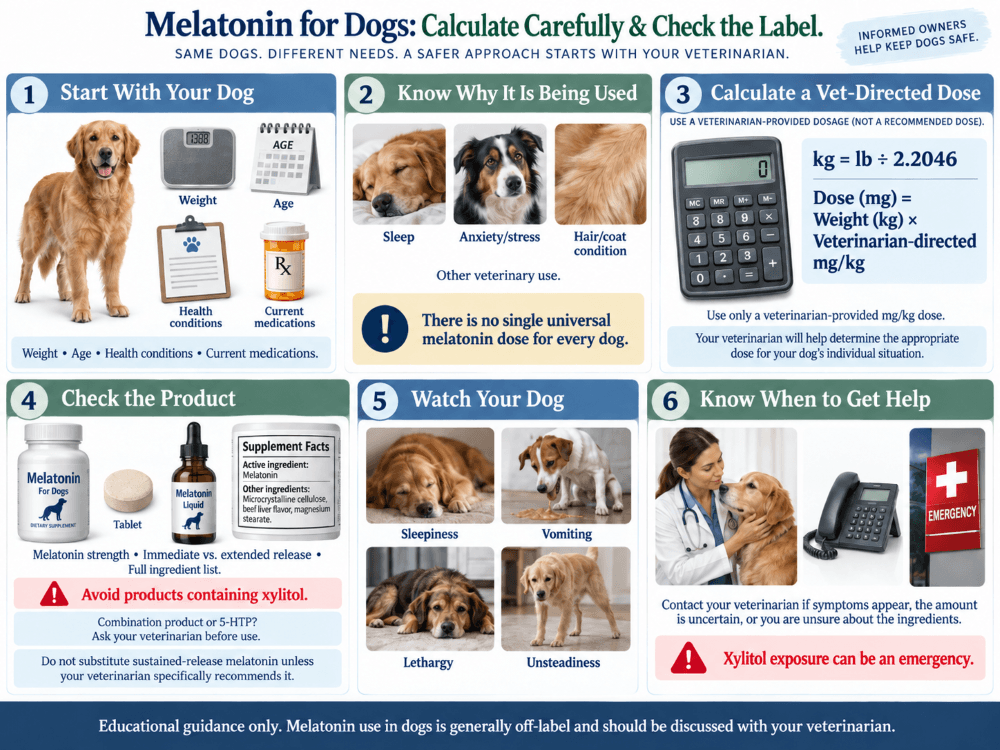
Melatonin for Dogs Infographic
Frequently Asked Questions
The Bottom Line
A dog melatonin dosage calculator is most useful for converting a dose that a veterinarian has already recommended. It should not be used to create a universal dose from your dog's weight because melatonin protocols differ depending on the condition being treated. Check the product just as carefully as the amount. Human melatonin supplements may contain xylitol, 5-HTP, extended-release ingredients, or other components that change the safety picture.
If your dog develops symptoms, receives an incorrect dose, eats an unknown amount, or consumes a product containing xylitol, contact a veterinarian or animal poison-control service promptly. For accidental toxin exposure, a related dog xylitol toxicity calculator, dog toxicity calculator, or dog caffeine toxicity calculator can provide additional context, but it should never delay professional care.