Big Dog Age Calculator: Compare Large Dog Years to Human Years


Canine Bible is reader-supported. We receive affiliate commissions via some of our links. Learn more.
Whether you have a Great Dane, Mastiff, Saint Bernard, Labrador Retriever, or another large breed, understanding your dog’s age is not as simple as multiplying by seven. Big dogs tend to age faster than small dogs, especially once they reach adulthood, which means their life stage, health needs, and senior care timeline can be very different. That’s why we created this Big Dog Age Calculator—to help you estimate your large dog’s age in human years based on their size and life stage. In this guide, you’ll also find age charts, breed-size comparisons, aging signs to watch for, and practical tips to help your big dog stay healthy, comfortable, and happy at every stage of life.
How Old Is My Big Dog in Human Years?
A big dog’s age in human years depends on their actual age, adult weight, and whether they fall into a large or giant breed category. Large and giant dogs usually mature quickly in the first two years, then age faster through adulthood than smaller dogs.
The old “multiply by 7” rule is too simple. A 6-year-old Labrador Retriever may be a mature adult or early senior, while a 6-year-old Great Dane may already be considered senior because giant breeds often reach older life stages sooner.
As a general guide, many large dogs become seniors around 7–9 years old, while many giant dogs reach senior status around 6–8 years old. Use the calculator as an estimate, then ask your veterinarian about age-appropriate wellness checks, joint care, diet, and screening.


Big Dog Age to Human Years Chart
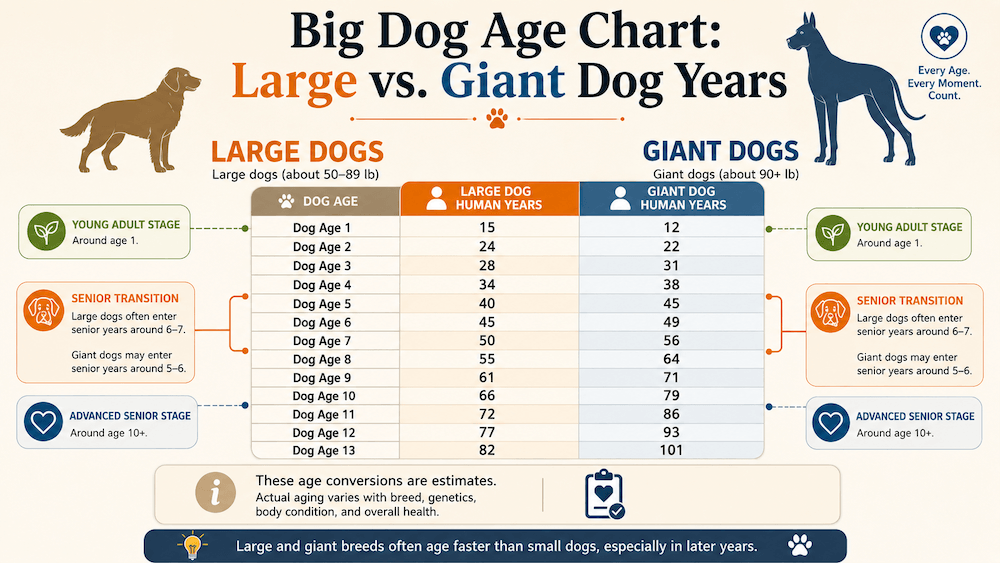
Use this chart to compare the ages of large and giant dogs in human years. These numbers are estimates, not exact medical measurements. Your dog’s breed, body condition, lifestyle, and health history can shift how old they feel and function.
Large vs. Giant Dog Aging
Large and giant dogs are often grouped, but they can age differently. A 75-pound Labrador Retriever and a 150-pound Mastiff are both “big dogs,” but their aging timelines, joint load, and average lifespan expectations may differ.
In general, larger dogs tend to reach senior life stages earlier than smaller dogs. Dogs are often considered senior when they reach the last 25% of their estimated lifespan, rather than at one universal age. That is why a size-based dog age calculator is more useful than the old 7-year rule.
| Age of Dog | Large Dog 51–100 lbs | Giant Dog 100+ lbs |
|---|---|---|
| 1 Year | About 15 human years. | About 12 to 15 human years. |
| 2 Years | About 24 human years. | About 22 to 24 human years. |
| 3 Years | About 28 human years. | About 31 human years. |
| 4 Years | About 32 human years. | About 38 human years. |
| 5 Years | About 36 human years. | About 45 human years. |
| 6 Years | About 45 human years. | About 49 human years. |
| 7 Years | About 50 human years. | About 56 human years. |
| 8 Years | About 55 human years. | About 64 human years. |
| 9 Years | About 61 human years. | About 71 human years. |
| 10 Years | About 66 human years. | About 79 human years. |
| 11 Years | About 72 human years. | About 86 human years. |
| 12 Years | About 77 human years. | About 93 human years. |
| 13 Years | About 82 human years. | About 100 human years. |
Why the 7-Year Rule Does Not Work for Big Dogs
The “multiply by seven” rule is easy to remember, but it does not reflect how dogs actually age. Dogs mature quickly during their first two years, and aging speed varies with size, breed, genetics, and health.


For big dogs, this matters because age-related care may need to start earlier. A giant breed may be entering senior years, while a smaller dog of the same calendar age still appears middle-aged.
This does not mean every large dog ages poorly, or every giant dog becomes unhealthy early. It means owners should use age estimates as a guide for proactive care, not as a reason to panic.
Factors That Can Affect Your Dog’s Age Result
Your dog’s estimated human age is only one part of the picture. Two dogs can be the same age and size but have very different energy levels, health risks, and daily needs. Body condition and muscle condition are important parts of pet health assessment, especially as animals age or develop disease.
| Factor | How It Affects Aging | What Owners Can Do |
|---|---|---|
| Breed | Some large breeds age faster than others. | Learn your breed’s common health risks. |
| Genetics | Inherited traits can influence lifespan and disease risk. | Share family history with your veterinarian. |
| Weight | Extra weight can strain joints and mobility. | Keep your dog at a healthy body condition. |
| Diet | Nutrition supports growth, muscle, and senior health. | Choose food for size, age, and health needs. |
| Exercise | Activity supports muscle, joints, and weight control. | Use low-impact exercise as your dog ages. |
| Health History | Chronic disease can affect comfort and function. | Follow your vet’s monitoring and treatment plan. |
| Vet Care | Screening can catch problems earlier. | Schedule regular wellness exams and lab checks. |
What to Do If Your Dog’s Result Seems Older Than Expected
First, check that you entered the correct age and size category. A 95-pound dog and a 130-pound dog may both seem “large,” but the calculator may place them in different aging categories if one falls into the giant-breed range.
Next, focus less on the exact human-age number and more on the life-stage guidance. A senior result does not mean something is wrong; it simply means your dog may benefit from closer monitoring and more proactive care.
If the calculator suggests your dog is entering their senior years, ask your veterinarian about wellness exams, dental health, weight management, joint comfort, bloodwork, diet, exercise, lumps, appetite changes, thirst changes, behavior, and sleep. Senior dogs often need more frequent veterinary care because age-related health problems become more common.
Common Mistakes to Avoid When Using the Calculator
A big dog age calculator is simple to use, but the result can be misunderstood. Avoid these common mistakes when entering your dog’s details or interpreting the answer.
| Mistake | Why It Matters | Better Approach |
|---|---|---|
| Using the 7-Year Rule | It oversimplifies big dog aging. | Use age and size together. |
| Wrong Size Category | Large and giant dogs age differently. | Use your dog’s healthy adult weight. |
| Using Current Weight | Overweight dogs may be misclassified. | Use ideal weight when possible. |
| Ignoring Breed | Breed can affect lifespan and risks. | Compare results with breed expectations. |
| Treating It as Diagnosis | The calculator cannot assess health. | Ask your vet about medical concerns. |
| Dismissing Symptoms | Illness can look like aging. | Check sudden changes with your vet. |
Signs Your Older Big Dog Should See a Vet
Some age-related changes happen gradually, but sudden or severe changes should not be ignored. Limping, trouble rising, difficulty with stairs, reduced play, and stiffness can be signs of osteoarthritis or other mobility problems.
| Sign | Why It Matters | What to Do |
|---|---|---|
| Limping | Pain or joint disease may be present. | Schedule a veterinary exam soon. |
| Weight Loss | Hidden illness can cause sudden loss. | Call your vet for guidance. |
| Appetite Change | Dental or internal problems may exist. | Track meals and contact your vet. |
| Coughing | Heart or airway disease may contribute. | Seek veterinary advice promptly. |
| Confusion | Cognitive changes or illness are possible. | Discuss behavior changes with your vet. |
| Collapse | This can be an emergency sign. | Seek urgent veterinary care immediately. |
| New Lumps | Growths need proper identification. | Have your vet examine them. |
Special Considerations for Big Dogs
Large and giant dogs need age-aware care because their growth, weight, joints, and senior timeline can be different from smaller dogs.
| Dog Group | Special Consideration | Owner Tip |
|---|---|---|
| Large-Breed Puppies | Growth should be steady and controlled. | Feed growth food made for large breeds. |
| Giant-Breed Dogs | Senior changes may appear earlier. | Start wellness planning before old age. |
| Senior Big Dogs | Mobility and comfort need closer monitoring. | Ask your vet about joint support. |
| Overweight Dogs | Extra weight increases joint strain. | Use a vet-approved weight plan. |
| Athletic Dogs | Fitness can hide early discomfort. | Watch recovery after intense activity. |
| Chronic Conditions | Medical issues change care needs. | Follow your veterinarian’s care plan. |
How to Calculate a Big Dog's Age Manually
You can estimate your big dog’s age manually by using the chart above.
Manual Chart Method
- Find your dog’s calendar age.
- Choose the correct size category: large or giant.
- Match your dog’s age to the chart.
- Use the life-stage guidance to interpret the result.
Example Calculation
A 7-year-old, 80-pound German Shepherd falls into the large-dog category. On the chart, a 7-year-old large dog is roughly equivalent to a 50-year-old human.
This suggests the dog may be entering a mature-to-senior stage. The owner should pay closer attention to joint health, body weight, dental care, stamina, and routine veterinary screening.
Can You Use a Formula Instead?
Some dog age formulas use logarithms or biological-age models, but they may not account for the difference between large and giant breeds. That is why a practical size-based chart is usually easier for owners to use.
For big dogs, the most helpful result is often not the exact human-age number. It is the life-stage reminder that helps you adjust care before problems become advanced.
Frequently Asked Questions
The Bottom Line
The Big Dog Age Calculator helps you estimate your large or giant dog’s age in human years and better understand their current life stage. Because big dogs often age faster than smaller dogs, this estimate can help you plan smarter care around nutrition, exercise, joint health, weight management, dental care, and senior wellness. Use the calculator as a guide, not a diagnosis. If your dog’s result suggests they are entering their senior years, or if you notice changes in mobility, appetite, behavior, weight, breathing, or comfort, talk to your veterinarian.
Your dog’s age is just one aspect of their overall health and care plan. If you want to assess the life stage of your large or giant dog, check out our general Dog Age Calculator. To learn about the factors that influence lifespan, refer to our article, "How Long Do Dogs Live?" You can also compare size expectations in our guide on the largest dog breeds. For nutritional support as your dog ages, explore our recommendations for the best large breed dog food and top senior dog foods.