Dog Food Cost Calculator: Estimate Daily, Monthly & Yearly Budgets

Canine Bible is reader-supported. We receive affiliate commissions via some of our links. Learn more.
Whether you’re budgeting for a new puppy, comparing kibble and fresh food prices, or trying to understand how much your dog’s diet really costs each month, food expenses can add up quickly. The amount you’ll spend depends on your dog’s size, daily serving amount, food type, price per bag or package, and how long each purchase lasts. That’s why we created this Dog Food Cost Calculator—to help you estimate your dog’s daily, monthly, and yearly feeding costs based on their food price and portion size. In this guide, you’ll also find cost examples, budgeting tips, and answers to common questions so you can plan your dog’s meals more confidently without overspending.
How Much Does Dog Food Cost Per Month?
Most dog owners spend about $20 to $100+ per month on dry dog food, but the total can be much higher for large dogs, fresh food, raw diets, wet food, prescription diets, or specialty formulas. Monthly cost depends mainly on your dog’s daily feeding amount, the food’s calories per serving, and the price per pound, can, pouch, meal, or subscription plan.
Small dogs usually cost far less to feed because they eat fewer calories. A 10-pound dog eating dry kibble may only need a small bag each month, while a 70-pound dog may go through several times more food. For example, a 20-pound dog eating standard dry food may cost around $30 to $60 per month, while a 75-pound dog eating fresh, wet, or prescription food may cost $150 to $400+ per month, depending on the brand and portion size.
The most accurate way to estimate your dog’s food budget is to calculate the cost per day, then multiply it by 30.4 for monthly cost or 365 for yearly cost. For example, if your dog’s food costs $2.50 per day, that equals about $76 per month and $913 per year before treats, toppers, supplements, taxes, shipping, or delivery fees.


Dog Food Cost Chart by Dog Size
Dog size is one of the biggest factors affecting food cost. Larger dogs usually need more calories and larger portions, which means food runs out faster.
These ranges are rough budgeting examples, not feeding recommendations. Actual costs depend on brand, food type, serving amount, calorie density, location, and purchase method.
| Dog Size | Example Weight | Estimated Monthly Cost | Cost Notes |
|---|---|---|---|
| Toy Dog | Under 10 pounds. | $10 to $75+ monthly. | Small portions usually lower total cost. |
| Small Dog | 10 to 25 pounds. | $20 to $150+ monthly. | Premium formats can raise costs quickly. |
| Medium Dog | 26 to 50 pounds. | $35 to $300+ monthly. | Food type strongly affects monthly cost. |
| Large Dog | 51 to 90 pounds. | $55 to $500+ monthly. | Bulk buying may reduce daily cost. |
| Giant Dog | Over 90 pounds. | $90 to $800+ monthly. | Serving size drives most expenses. |
Dog Food Cost by Food Type
Different food types can vary widely in cost because they differ in moisture content, calorie density, packaging, storage needs, preparation, and shipping. For fair comparisons, Tufts Clinical Nutrition Service recommends comparing pet foods by cost per kilocalorie rather than only by cost per pound, cup, or can.


| Food Type | Estimated Cost | Typical Cost Pattern | Budget Note |
|---|---|---|---|
| Dry Kibble | $25–$90/month | Usually the lowest daily cost. | Compare cost per pound and calorie. |
| Wet Food | $120–$350+/month | Usually costs more than kibble. | Cans and trays add up quickly. |
| Fresh Food | $100–$450+/month | Often priced as a premium option. | Shipping and portions affect cost. |
| Raw Food | $120–$500+/month | Often costs more than kibble. | Freezer space and waste matter. |
| Freeze-Dried Food | $180–$600+/month | Expensive when used as full meals. | Often cheaper as a topper. |
| Air-Dried Food | $100–$400+/month | Usually priced above standard kibble. | Small bags can raise daily cost. |
| Homemade Food | $80–$300+/month | Costs vary by recipe and ingredients. | Include supplements and formulation help. |
| Prescription Food | $80–$250+/month | Often costs more than standard diets. | Change only with veterinary guidance. |
Dog Food Cost by Feeding Style Chart
These are broad monthly budgeting ranges; actual costs vary by dog size, calories, brand, location, and package price. Generally, dry food is typically cheaper per day than wet, fresh, air-dried, and freeze-dried options.
| Feeding Style | Estimated Cost | Cost Impact |
|---|---|---|
| 100% Dry Kibble | $25–$90/month | Lowest cost for most dogs. |
| Dry + Wet Topper | $45–$150/month | Adds moderate monthly cost. |
| Dry + Fresh Topper | $60–$180/month | Higher than kibble-only. |
| 100% Wet Food | $120–$350+/month | Cans and trays add up fast. |
| 100% Fresh Food | $100–$450+/month | Premium cost, especially for large dogs. |
| 100% Raw Food | $120–$500+/month | Highly variable by protein and portion size. |
| Freeze-Dried Full Meals | $180–$600+/month | One of the highest-cost options. |
| Homemade Cooked Food | $80–$300+/month | Varies by recipe, ingredients, and supplements. |
| Prescription Diet | $80–$250+/month | Often costs more; change only with vet guidance. |
What Affects Dog Food Cost?
Dog food cost is not determined by price alone. The same bag price can produce very different monthly costs depending on how much your dog eats and how calorie-dense the food is.
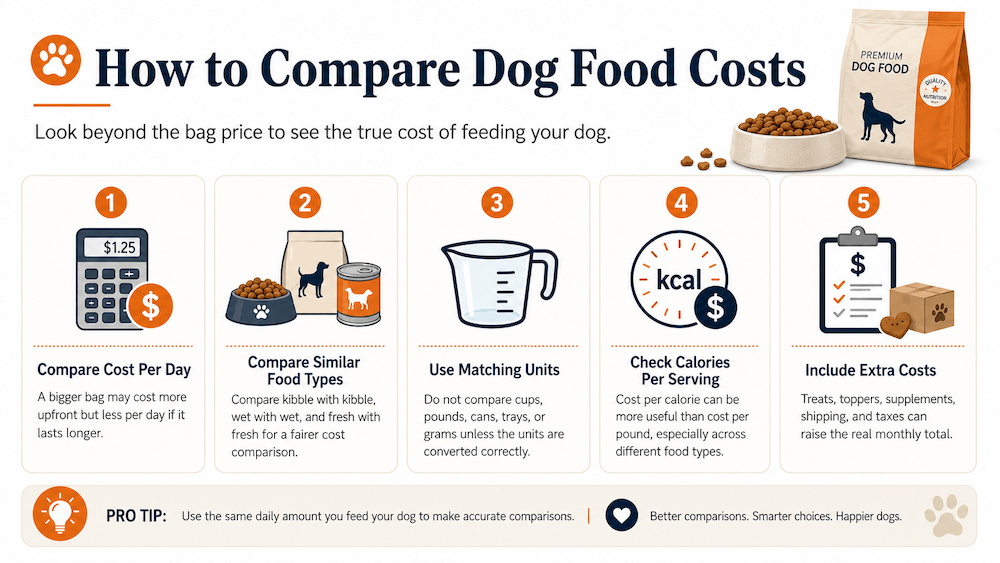
How to Compare Dog Food Costs Accurately
Comparing dog food costs is more accurate when you look beyond the package price. Cost per day, food type, serving size, calorie density, and extra expenses like treats, toppers, shipping, and taxes all affect the true monthly cost of feeding your dog.
Common Mistakes to Avoid When Using the Food Cost Calculator
Small input mistakes can make the food cost calculator less accurate. For the best estimate, enter only your dog’s daily serving amount, match the correct units, include extras, and compare foods by total value—not package price alone.
| Mistake | Why It Skews Results | What to Do Instead |
|---|---|---|
| Entering the Full Package | It treats the whole bag as one day’s food. | Enter only the daily amount your dog eats. |
| Mixing Up Units | Wrong units can change the cost estimate dramatically. | Match pounds, ounces, grams, cups, or cans carefully. |
| Using Label Amounts Only | Feeding guides may not match your dog’s needs. | Use your dog’s actual daily serving amount. |
| Ignoring Extras | Treats, toppers, and supplements raise real costs. | Add extras for a more realistic monthly budget. |
| Choosing Only by Price | Cheap food may require larger portions. | Compare cost, calories, quality, and tolerance. |
| Assuming Expensive Is Better | Higher price does not always mean better nutrition. | Check adequacy, life stage, and your dog’s response. |
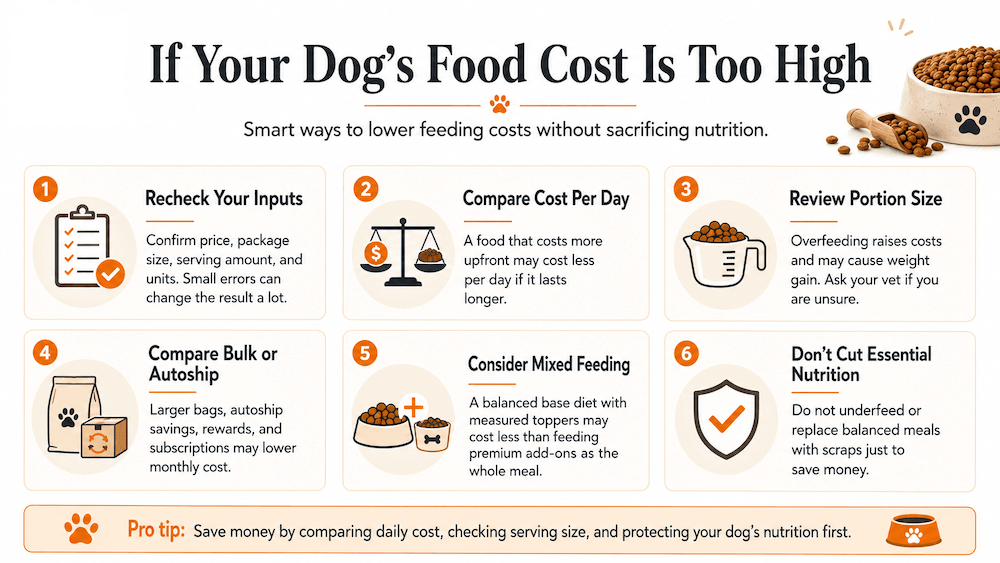
What to Do If Your Dog Food Cost Seems Too High
If your dog’s food cost seems too high, start by checking your inputs, daily cost, and portion size before switching foods. Bulk buying, autoship savings, and measured mixed feeding may help lower costs, but your dog’s nutrition should stay complete, balanced, and appropriate for their needs.
Special Considerations for Certain Dogs
Some dogs need extra budgeting because their food needs can change with age, size, activity level, digestion, or medical conditions. Puppies, senior dogs, large breeds, sensitive dogs, active dogs, and dogs on prescription diets may require specialized food, larger portions, or veterinary guidance before switching diets.
| Dog Type | Cost Consideration | Owner Guidance |
|---|---|---|
| Puppies | Growth diets may cost more than adult food. | Choose food formulated for puppy growth. |
| Senior Dogs | Health-focused diets may increase monthly costs. | Ask your vet before switching foods. |
| Large Breeds | Bigger portions raise daily feeding costs. | Compare cost per calorie and bulk options. |
| Sensitive Dogs | Special diets can be more expensive. | Switch slowly and monitor digestion closely. |
| Medical Needs | Prescription diets often cost more monthly. | Follow your veterinarian’s diet recommendation. |
| Active Dogs | Higher calorie needs can increase costs. | Budget for larger or specialized portions. |
How to Calculate Dog Food Cost Manually
You can calculate dog food cost manually if you know the food price, package size, and your dog’s daily serving amount.
Dog Food Cost Formula
Use this formula:
1. Food price ÷ package size = cost per unit
2. Cost per unit × daily amount fed = daily food cost
3. Daily food cost × 30 = monthly food cost
4. Daily food cost × 365 = yearly food cost
Example Calculation
A 30-pound bag of dog food costs $60. Your dog eats 0.75 pounds per day.
| Step | Calculation | Result |
|---|---|---|
| Cost Per Pound | $60 divided by 30 pounds. | $2 per pound. |
| Daily Cost | $2 multiplied by 0.75 pounds. | $1.50 per day. |
| Monthly Cost | $1.50 multiplied by 30 days. | $45 per month. |
| Yearly Cost | $1.50 multiplied by 365 days. | $547.50 per year. |
| Days Per Bag | 30 pounds divided by 0.75 pounds. | 40 days per bag. |
Frequently Asked Questions
The Bottom Line
The Dog Food Cost Calculator helps estimate how much it costs to feed your dog per day, month, and year. It is useful for comparing kibble, wet food, fresh food, raw food, homemade food, prescription diets, and multi-dog feeding budgets. Use the result as a budgeting estimate, not as a nutrition decision by itself. The best dog food for your dog should fit your budget while also being complete, balanced, life-stage appropriate, and suitable for your dog’s health needs.
Food price is only one part of your dog’s overall nutrition plan. If you are comparing diets, review our guide to budget-friendly dog food, check your dog’s daily calorie needs with our Dog Calorie Calculator, or compare raw feeding portions with our Raw Dog Food Calculator. If you are considering home-cooked meals, see our homemade dog food recipes. For food-type comparisons, review our guides to best wet dog foods, best large breed dog food, best dog food for small dogs, and best dog food toppers.
With this calculator, cost charts, food-type comparisons, and budgeting tips, you now have a clearer way to estimate your dog’s daily, monthly, and yearly food expenses.