Dog BMI Calculator: Is Your Dog Overweight or at an Ideal Weight?

Canine Bible is reader-supported. We receive affiliate commissions via some of our links. Learn more.
A number on the scale can tell you how much your dog weighs, but it cannot tell you whether that weight is appropriate for your dog’s build. A lean Greyhound, muscular working dog, compact Bulldog, and long-bodied Dachshund can all carry weight very differently. This Dog BMI Calculator provides a canine BMI-style estimate using your dog’s weight and body measurement. For a more useful picture, the result should be considered alongside your dog’s Body Condition Score (BCS), muscle condition, breed, age, and overall health.
Remember to contact your veterinarian if your dog has unexplained weight gain or loss, an abnormal body condition score, muscle loss, or other concerning symptoms. If you can't reach your vet, you can chat live with a registered online veterinary professional via our online vet chat or video chat support (24 hours a day, 7 days a week). Or use Chewy's online vet services (6 a.m. - midnight ET).
What Is a Healthy BMI for a Dog?
There is no single universally accepted healthy BMI range for every dog. Dogs vary too much in skeletal structure, leg length, chest shape, muscle mass, and overall proportions for one BMI cutoff to work equally well across all breeds.
One published canine BMI study developed a dog-specific version of BMI and found that values of 11.8 to 15 kg/m² corresponded with ideal body condition in medium-sized dogs averaging about 10 to 25 kg (22 to 55 lb). The researchers studied 246 adult dogs and compared the calculated index with physical body-condition assessments.
That range should not be treated as a universal diagnostic standard. The study itself found important differences associated with dog size and muscularity, and modern veterinary nutritional assessment relies primarily on Body Condition Score and Muscle Condition Score, not BMI alone. For most owners, the most useful question is therefore not simply, “Is my dog’s BMI normal?” It is: Does the BMI estimate agree with what I can feel and see on my dog’s body?
Why Dogs Don’t Have Human-Style BMI Cutoffs
Human BMI uses body weight divided by height squared. Dogs present a much harder problem because canine body shape varies dramatically.


A Great Dane and a French Bulldog may both be healthy adults, but their limb length, chest depth, bone structure, and proportions are completely different. A heavily muscled dog can also produce a relatively high BMI-style value without carrying excessive body fat. For that reason, human BMI categories such as 18.5, 25, or 30 should never be applied to dogs.
Body Condition Score Is the Better Cross-Check
A dog’s Body Condition Score, usually measured on a 1-to-9 scale, is a more established way to assess body fat. An ideal dog generally scores around 4 or 5 out of 9.
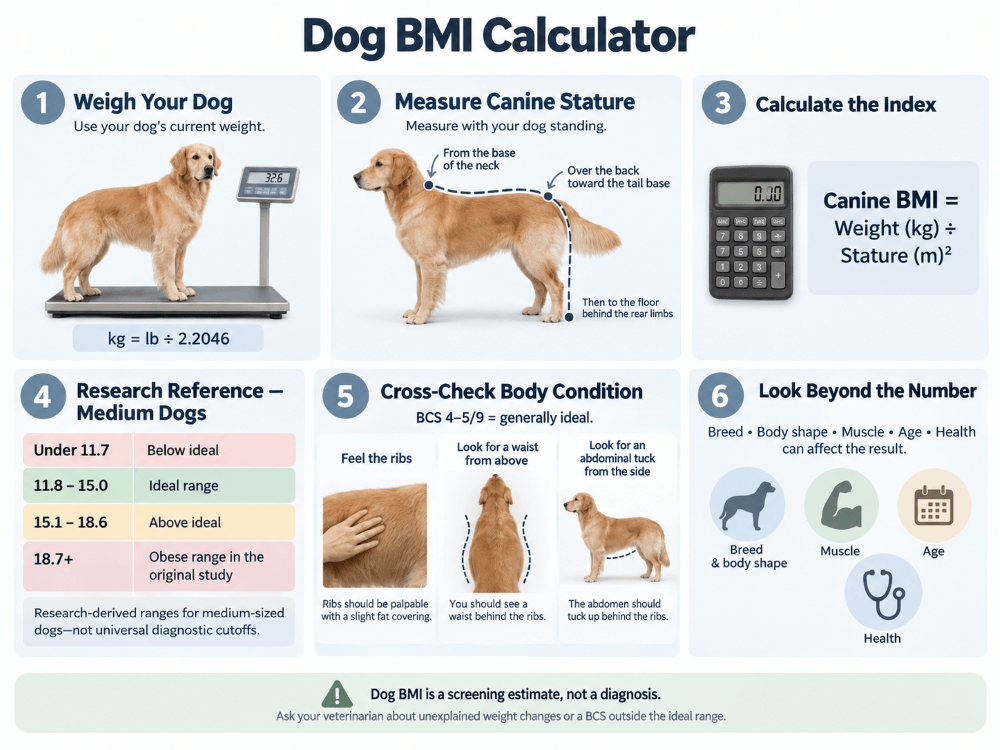
At ideal condition, you should usually be able to feel the ribs without pressing through a thick layer of fat. From above, there should be a noticeable waist behind the ribs, and from the side, the abdomen should tuck upward toward the hind legs. BMI can add a numerical reference, but BCS gives important information the formula cannot see.
Dog BMI Chart
The following canine BMI bands come from published research and are most directly applicable to medium-sized dogs. They should be treated as screening references rather than universal clinical cutoffs.
| Canine BMI | Research Category | How to Use It |
|---|---|---|
| Below 11.8 | Below ideal | Cross-check with BCS and recent weight history. |
| 11.8–15.0 | Ideal range | Reported as ideal for medium-sized dogs in the original research. |
| 15.1–18.6 | Above ideal | Check rib cover, waist, abdominal tuck, and muscle. |
| 18.7+ | Obese range in study | Does not by itself diagnose obesity in an individual dog. |
The key phrase here is research category. A high or low number is a reason to look more closely at your dog, not a substitute for examining body condition.
Dog BMI by Weight and Size
The original canine BMI work found that body size affected the index. Its reference bands were developed primarily around dogs whose typical body weight fell between about 10 and 25 kg.


| Dog Size | Approx. Weight | BMI Guidance |
|---|---|---|
| Small | Up to about 10 kg / 22 lb | Use BMI cautiously and rely heavily on BCS. |
| Medium | About 10–25 kg / 22–55 lb | The published 11.8–15 range is most directly relevant here. |
| Large | Over about 25 kg / 55 lb | Body proportions can shift the BMI value substantially. |
The original researchers proposed mathematical adjustments for very small and large dogs, but these should not be mistaken for broadly accepted modern diagnostic standards. Breed shape, muscle mass, and individual build still need to be considered.
Dog Body Condition Score Chart
For everyday weight assessment, a 9-point BCS chart is generally more useful than BMI alone. BCS evaluates body-fat condition through both visual inspection and palpation.
| BCS | General Condition | What You May Notice |
|---|---|---|
| 1/9 | Emaciated | Ribs and other bony structures are extremely prominent. |
| 2/9 | Very thin | Very little fat covers the ribs and bones. |
| 3/9 | Thin | Ribs are easy to feel with a pronounced waist and tuck. |
| 4/9 | Ideal | Ribs are easy to feel and the waist is clearly visible. |
| 5/9 | Ideal | Ribs have light fat cover with a visible waist and abdominal tuck. |
| 6/9 | Above ideal | Ribs are harder to feel and the waist is less obvious. |
| 7/9 | Overweight | Fat cover is noticeable and the waist may be difficult to see. |
| 8–9/9 | Obese | Ribs are difficult to feel and substantial fat deposits are present. |
On the 9-point system, 4-5/9 is generally considered ideal for dogs. Scores above 5 represent progressively increasing body fat, while very low scores indicate inadequate fat reserves.
Dog BMI and Body Condition Guidelines
The most useful weight assessment looks at your dog from several angles rather than relying on one calculation. Body weight shows whether the scale is moving. BCS helps estimate body fat. Muscle Condition Score helps identify muscle loss that can be hidden by normal or excess body fat.
That distinction matters. A senior dog, for example, can remain overweight while simultaneously losing muscle. A scale or BMI result alone may miss that change.
What Does an Ideal Body Condition Look Like?
Run your hands gently over your dog’s rib cage. In a dog at an ideal body condition, the ribs should usually be easy to locate beneath a light layer of tissue rather than buried under thick fat. Next, look down from above. There should be some narrowing behind the rib cage rather than a straight or outward-bulging body outline.
Finally, view your dog from the side. The underside of the abdomen should generally rise toward the hind legs instead of hanging at the same level as the chest. These observations work best together rather than in isolation.
Why Muscle Condition Matters Too
Body Condition Score focuses mainly on fat stores. It does not tell you whether your dog is maintaining healthy muscle.
Muscle condition is assessed by looking at and feeling areas such as the spine, shoulder blades, skull, and pelvis. A dog can have excess fat while still losing important lean tissue, particularly with aging or chronic disease.
Dog BMI vs. Body Condition Score
These tools answer different questions, which is why they work better together.
| Feature | Canine BMI | Body Condition Score |
|---|---|---|
| Main input | Weight and body measurement. | Visual assessment and palpation. |
| Measures fat directly? | No. | Estimates fat condition clinically. |
| Breed/build effects | Can substantially affect the result. | Still relevant but easier to account for during assessment. |
| Muscle effects | High muscle can raise the index. | Muscle should be scored separately with MCS. |
| Clinical use | Supplemental screening measure. | Widely used nutritional assessment tool. |
| Best use at home | Track a consistent numerical estimate. | Check ribs, waist, and abdominal tuck. |
Veterinary nutritional screening commonly combines body weight, BCS, MCS, diet history, activity, and physical examination, rather than relying on a single body-size index.
Factors That Can Affect Your Dog’s Results
Several factors can change how meaningful a canine BMI number is. Consider these before treating the result as a target.
| Factor | Why It Matters | What Owners Should Check |
|---|---|---|
| Breed and build | Dogs vary widely in frame and body proportions. | Compare BMI with BCS rather than breed weight alone. |
| Muscle mass | Muscular dogs may produce a higher index without excess fat. | Assess rib cover and muscle condition. |
| Age | Growth and aging change body composition. | Consider life stage and recent weight trends. |
| Activity | Exercise influences energy needs and lean tissue. | Note meaningful changes in daily activity. |
| Health | Illness can cause weight, fluid, or muscle changes. | Investigate unexplained changes with a veterinarian. |
| Diet | Calories from meals, treats, and extras affect body condition. | Track total daily intake, not meals alone. |
| Measurement | A small length error changes the squared calculation. | Measure a standing dog carefully and consistently. |
Breed can make a particularly large difference. Even dogs with similar BCS values may have different percentages of body fat, reinforcing why no single formula perfectly describes every canine body type.
Common Mistakes to Avoid
A dog BMI calculation is simple mathematically, but inaccurate inputs or the wrong interpretation can make the result misleading.
| Mistake | Why It Matters | Better Approach |
|---|---|---|
| Using human BMI cutoffs | Human ranges were not designed for canine anatomy. | Use canine references and BCS instead. |
| Wrong units | Mixing pounds, kilograms, inches, or meters changes the result. | Convert units before calculating. |
| Wrong body measurement | The canine formula uses a specific stature path. | Follow the measurement diagram carefully. |
| Ignoring breed or build | Leg length, frame, and muscle affect the index. | Cross-check the result with BCS. |
| Treating BMI as exact | The index cannot distinguish fat from muscle. | Use it as one screening measure. |
| Using adult ranges for puppies | Growing dogs are changing rapidly in size and composition. | Use growth and body-condition assessment. |
| Ignoring weight changes | An unexplained trend may matter more than one BMI result. | Track weight over time and ask your vet about unexplained changes. |
The biggest mistake is chasing a number while ignoring the dog in front of you. If the calculator says “ideal” but your dog has lost muscle, has no visible waist, or has been losing weight unexpectedly, those findings deserve more attention than the index.
How to Use Your Dog’s BMI Result Responsibly
Think of canine BMI as an additional data point. It can be useful for recording changes consistently, especially when you combine it with photographs, body weight, and BCS over time. Do not reduce food sharply simply because a calculator produces a high result. Safe weight management should account for your dog’s current diet, calorie intake, body condition, health status, activity, and realistic target weight.
Likewise, a low result is not automatically solved by feeding substantially more. Unexplained thinness can occur because of inadequate calorie intake, dental disease, gastrointestinal problems, parasites, chronic illness, or other conditions that need to be identified first.
When Should You Contact a Veterinarian?
A veterinary assessment is especially worthwhile if your dog has a BCS below 4/9 or above 5/9, visible muscle loss, or unexplained weight change. These findings are recognized nutritional risk factors that may justify a more detailed evaluation.
Contact your veterinarian sooner if weight change occurs with loss of appetite, increased thirst or urination, persistent vomiting or diarrhea, abdominal enlargement, weakness, unusual lethargy, breathing difficulty, or reduced ability to exercise. A calculator cannot determine whether a medical condition is causing a body-weight change.
What to Do If Your Dog Is Overweight or Underweight
If your dog appears overweight, begin by confirming the body condition rather than choosing a target weight from BMI alone. Record your dog’s current weight, BCS, daily food amount, treats, chews, table food, and other calorie sources. A veterinary weight-management plan can then set an appropriate calorie target and rate of weight loss. Calorie needs vary between individual dogs, so feeding amounts should be adjusted by following body weight and BCS rather than assuming a generic equation is exact.
If your dog appears underweight, check whether appetite and food intake have changed, but avoid simply doubling meals without considering why weight has been lost. Unexpected thinness, especially with gastrointestinal signs, increased thirst, weakness, dental problems, or muscle loss, deserves veterinary evaluation. A stable dog who is mildly above or below ideal body condition usually needs a thoughtful feeding and activity plan, not a crash diet or rapid weight-gain program.
Special Considerations for Certain Dogs
How to Calculate Dog BMI Manually
The published canine BMI method adapts the familiar weight-divided-by-height-squared concept to canine anatomy. Instead of ordinary standing height at the shoulder, the method uses a canine stature measurement taken with a flexible tape from the base of the neck, along the back over the base of the tail, and down to the ground immediately behind the hind limbs.
The formula is:
- BMI = body weight (kg) ÷ canine stature (m)²
First, obtain an accurate body weight. If your scale gives pounds, convert the value to kilograms:
- Weight in kg = weight in lb ÷ 2.2046
Next, measure the dog while standing naturally and squarely. Follow the same anatomical path each time, because a small change in the stature measurement affects the result twice when that measurement is squared.
If you measured in centimeters:
- Meters = centimeters ÷ 100
Then square the stature and divide your dog’s weight in kilograms by that number.
Example Calculation
Suppose an adult medium-sized dog weighs 18 kg and has a measured canine stature of 1.15 meters.
- Square the stature:
- 1.15 × 1.15 = 1.3225
- Then divide the weight by that value:
- 18 ÷ 1.3225 = 13.6 kg/m²
A result of 13.6 kg/m² falls inside the 11.8-15 range reported as ideal for medium-sized dogs in the original canine BMI research. It still should be checked against the dog’s ribs, waist, abdominal tuck, muscle condition, and health rather than being treated as proof of ideal body composition.
Dog BMI & Body Condition Infographic
Frequently Asked Questions
The Bottom Line
A dog BMI calculator can help put your dog’s weight into context, but the number should never be interpreted the way human BMI is. Dogs vary too much in size, shape, and muscle mass for one cutoff to work for every breed. For most dogs, Body Condition Score is the more useful practical check. An ideal dog generally has a BCS around 4-5/9, ribs that are easy to feel beneath a light covering, a visible waist from above, and an abdominal tuck from the side. Use BMI as one piece of the picture alongside weight trends, BCS, muscle condition, life stage, and health. If your dog is clearly overweight or underweight, or their weight is changing without an obvious reason, ask your veterinarian to help establish an appropriate target and feeding plan.
For the next step, a dog calorie calculator or dog feeding calculator can help you track weight and nutrition more consistently.