Dog Protein Calculator: How Much to Give & Charts

Canine Bible is reader-supported. We receive affiliate commissions via some of our links. Learn more.
Whether you are choosing a new dog food, comparing wet and dry formulas, or checking whether your dog’s current diet provides enough protein, understanding the numbers on a pet food label can be confusing. That’s why we created this Dog Protein Calculator—to help you estimate your dog’s daily protein intake based on weight, calorie needs, life stage, and food information. In this guide, you’ll also find protein charts, dry matter calculations, label-reading tips, and answers to common questions so you can evaluate your dog’s diet more confidently and responsibly.
How Much Protein Does My Dog Need Per Day?
There is no single number of protein grams that applies to every dog of a particular weight. Protein intake depends on the dog’s calorie needs, life stage, activity, body and muscle condition, health, and the digestibility and amino acid balance of the food.
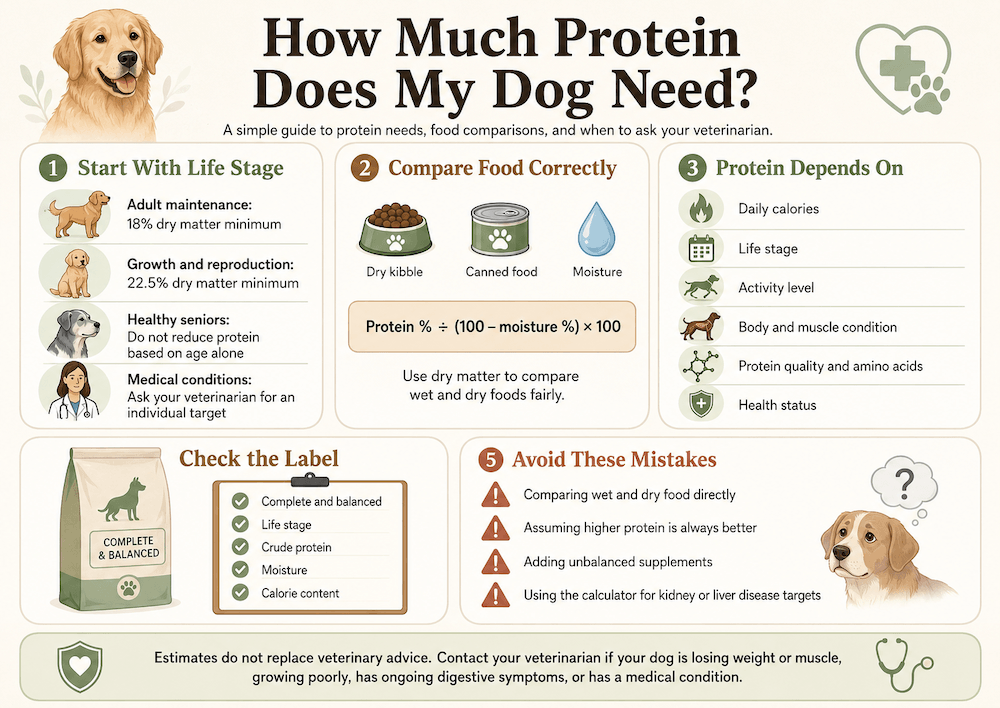
For complete dog foods formulated to meet established nutrient profiles, the minimum crude protein concentration is 18% on a dry matter basis for adult maintenance and 22.5% for growth and reproduction. Expressed relative to calories, those benchmarks are approximately 45 grams per 1,000 kcal for adults and 56.3 grams per 1,000 kcal for growth and reproduction.
These figures are formulation benchmarks, not personalized daily prescriptions. A healthy adult eating 600 calories per day would receive about 27 grams of protein from food providing 45 grams per 1,000 calories, while a growing puppy eating the same number of calories would receive about 34 grams at the growth benchmark.
Protein quality matters as much as the number on the bag. Dogs need an appropriate balance of essential amino acids from protein they can digest and use, along with sufficient calories and the rest of the nutrients required for a complete diet.


Dog Protein Requirements Chart
The following charts show how weight, calorie intake, life stage, and food moisture affect estimated protein intake.
Dog Protein Chart by Weight
This chart uses an illustrative calorie estimate for healthy, neutered adult dogs at ideal body condition.
| Dog Weight | Estimated Calories per Day | Protein at 45 g per 1,000 kcal |
|---|---|---|
| 5 lb | 207 kcal | 9 g per day |
| 10 lb | 348 kcal | 16 g per day |
| 20 lb | 585 kcal | 26 g per day |
| 30 lb | 794 kcal | 36 g per day |
| 40 lb | 985 kcal | 44 g per day |
| 60 lb | 1,335 kcal | 60 g per day |
| 80 lb | 1,656 kcal | 75 g per day |
| 100 lb | 1,958 kcal | 88 g per day |
*These values use 1.6 × RER to estimate maintenance calories and assume protein is supplied at the adult-maintenance benchmark of 45 grams per 1,000 kcal. Individual calorie needs can vary considerably, so adjust feeding based on weight trends, body condition, and veterinary guidance rather than the chart alone.
Dog Protein Requirements by Life Stage
The correct nutritional profile depends more on life stage and health than on breed alone.
| Dog Category | Dry Matter Benchmark | Per 1,000 kcal | Practical Guidance |
|---|---|---|---|
| Healthy adult | 18% minimum | 45 g | Choose food labeled for adult maintenance. |
| Puppy | 22.5% minimum | 56.3 g | Feed a complete growth diet through skeletal maturity. |
| Pregnant or nursing | 22.5% minimum | 56.3 g | Use a diet formulated for growth and reproduction. |
| All life stages | Growth profile | Growth benchmark | Check suitability for large-breed puppy growth. |
| Healthy senior | No separate senior profile | Individualized | Base the choice on health and muscle condition. |
| Medical condition | Veterinarian-directed | Individualized | Do not use a general calculator as a treatment target. |
*The adult and growth figures are minimum concentrations for complete foods formulated to the relevant nutrient profile. They should not be interpreted as the maximum safe amount or as proof that one food is better merely because its protein percentage is higher.


Dry Food vs. Wet Food Protein Chart
Label percentages can be misleading when foods contain very different amounts of water.
| Example Food | Protein as Fed | Moisture | Dry Matter Protein |
|---|---|---|---|
| Dry kibble | 24% | 10% | 26.7% |
| Canned food | 8% | 78% | 36.4% |
| Fresh food | 12% | 70% | 40% |
*Although the canned and fresh foods appear lower in protein on their labels, they contain more protein after moisture is removed from the comparison. These are hypothetical examples, not product recommendations
How to Compare Protein in Dog Food
| Protein Measurement | What It Shows | Best Used For | Main Limitation |
|---|---|---|---|
| As-Fed Protein % | Protein with moisture included. | Comparing similar food types. | Wet food may appear lower. |
| Dry Matter Protein % | Protein after moisture is removed. | Comparing wet, dry, and fresh foods. | Does not reflect calorie density. |
| Grams per 1,000 kcal | Protein supplied relative to calories. | Comparing foods with different energy levels. | Does not show digestibility. |
| Estimated Grams per Day | Approximate daily protein intake. | Reviewing an individual dog’s diet. | Depends on accurate feeding data. |
*For the clearest comparison, use dry matter percentage and grams per 1,000 kcal together.
Dog Protein Guidelines and Safety
Protein provides amino acids used to maintain muscle, skin, hair, organs, enzymes, hormones, antibodies, and many other tissues and body processes. A dog therefore needs more than a particular percentage of crude protein—the diet must supply the right amino acids in forms the dog can digest.
For a generally healthy dog, the safest starting point is a complete and balanced food formulated for the correct life stage. The Dog Protein Calculator can estimate protein concentration and intake, but it cannot determine protein quality, diagnose a deficiency, or prescribe a therapeutic diet.
During illness, protein and other nutrient amounts may need to be increased, restricted, or provided in a different form. These decisions depend on the diagnosis, disease stage, laboratory results, appetite, calorie intake, and body and muscle condition.
When to Contact a Veterinarian
Arrange a veterinary evaluation if your dog has unexplained weight loss, visible muscle loss, poor growth, persistent appetite changes, repeated vomiting or diarrhea, weakness, marked lethargy, increased thirst or urination, abdominal swelling, or a known kidney or liver condition.
Do not use a diet change to delay an examination. Several unrelated medical conditions can affect appetite, weight, muscle mass, skin, or coat and may require diagnosis rather than nutritional adjustment alone.
Remember to ALWAYS consult with your vet before making any changes that could affect your dog’s health, nutrition, or well-being. If you can't reach your vet, you can chat live with a registered online veterinary professional via our online vet chat or video chat support (24 hours a day, 7 days a week). Or use Chewy's online vet services (6 a.m. - midnight ET). Additionally, at-home dog gut health tests can analyze your dog’s microbiome, offering insights into which nutrients their diet should include. Similarly, at-home dog allergy testing kits can identify ingredients that may not be suitable for your dog, enabling you to choose the right diet and care plan to support optimal digestion, nutrition, and health.
Factors That Can Affect Your Dog’s Results
Several factors can change the amount of food and protein an individual dog needs. Body condition measures body fat, while muscle condition evaluates lean tissue. A dog can be overweight and still lose muscle, so both should be considered when assessing a diet.
| Factor | Why It Matters | What to Check |
|---|---|---|
| Daily calories | Protein intake rises or falls with the amount of food eaten. | Use known calories when available. |
| Life stage | Puppies and nursing dogs need a growth and reproduction diet. | Read the adequacy statement. |
| Activity | Working dogs may eat substantially more calories. | Match intake to actual workload. |
| Body condition | Excess body fat can inflate weight-based estimates. | Assess ideal or target weight. |
| Muscle condition | Muscle loss may occur despite stable body weight. | Check the spine, shoulders, skull, and hips. |
| Food digestibility | The label cannot show how much protein is absorbed. | Consider the complete formulation. |
| Moisture | Wet and dry label percentages are not directly comparable. | Convert both foods to dry matter. |
| Health status | Disease can change nutrient needs and restrictions. | Ask a veterinarian before adjusting. |
Common Mistakes to Avoid
Most misleading results come from incorrect units, incomplete label information, or treating an estimate as a prescription. Recalculate whenever your dog’s weight, activity, diet, health, or life stage changes.
| Mistake | Why It Matters | Better Approach |
|---|---|---|
| Comparing wet and dry labels | Moisture makes the percentages look very different. | Compare them on a dry matter basis. |
| Using the wrong calorie unit | kcal per cup and kcal per kilogram are not interchangeable. | Copy the unit exactly from the label. |
| Treating a minimum as exact | The actual protein level may be higher than the guarantee. | Request a typical analysis when precision matters. |
| Assuming higher is better | Protein percentage alone does not measure diet quality. | Check balance, calories, and life-stage suitability. |
| Ignoring body condition | Excess weight can overstate calorie and protein estimates. | Use target calories when appropriate. |
| Adding protein supplements | Extras can add calories and unbalance the diet. | Change the complete feeding plan instead. |
| Using results as medical advice | Disease-specific diets require more information. | Follow a veterinarian-directed plan. |
| Ignoring symptoms | Weight or muscle loss can signal illness. | Arrange a veterinary examination. |
What to Do If the Protein Result Seems Too High or Too Low
1. Check the units. Confirm that weight is entered in the correct unit and that the calorie value is listed as kcal per kilogram, cup, can, serving, or day.
2. Confirm whether the calculator needs an as-fed percentage or a dry matter percentage. The guaranteed analysis on a package is normally presented as fed, meaning water is still included.
3. Review how much food your dog actually eats. Measure the total daily amount, including meals, treats, toppers, chews, and food used for medication or training.
4. Read the nutritional adequacy statement. A food labeled only for supplemental or intermittent feeding should not be judged as though it were a complete daily diet.
5. Contact the manufacturer when only guaranteed minimums are available, and you need a closer estimate. Ask for the food’s typical protein content, moisture, metabolizable energy, and protein in grams per 1,000 kcal.
6. Do not correct a low result by immediately adding meat, eggs, cheese, or protein powder. If the result remains unusual after checking the inputs—or your dog has symptoms—review the full diet with your veterinarian.
Special Protein Considerations for Certain Dogs
Puppies, pregnant dogs, and nursing dogs should eat a complete diet formulated for growth or reproduction, with calories, calcium, and other nutrients carefully controlled. Avoid adding extra protein or mineral supplements unless recommended by a veterinarian. Senior dogs should not have protein reduced based on age alone; instead, monitor their weight, muscle condition, and overall health.
Working and athletic dogs need feeding adjusted to their workload, calorie use, hydration, performance, and body condition rather than protein percentage alone. Overweight dogs should follow a balanced weight-management diet based on appropriate target calories while preserving lean muscle.
Dogs with kidney or liver disease need individualized protein targets based on their diagnosis and test results, so a general calculator should not guide their diet. For suspected food allergies, the goal is to identify the specific trigger through a controlled novel-protein or hydrolyzed-protein diet, not simply reduce or increase total protein.
How to Calculate Your Dog’s Protein Intake Manually
There are two simple calculations: estimate protein from your dog’s calorie needs or calculate protein from the food label. These results are estimates, not exact feeding prescriptions.
Method 1: Estimate Protein From Calorie Needs
- Convert your dog’s weight to kilograms: Weight in kg = weight in lb ÷ 2.2046
- Estimate resting energy requirement: RER = 70 × body weight in kg^0.75
- Multiply RER by a starting factor:
- Neutered adult: 1.6
- Intact adult: 1.8
- Puppy under 4 months: 3
- Puppy over 4 months: 2
- Estimate protein supplied: Protein per day = daily calories × protein grams per 1,000 kcal ÷ 1,000
For example, a dog eating 585 kcal from food containing 45 grams of protein per 1,000 kcal receives about: 585 × 45 ÷ 1,000 = 26 grams of protein per day
Method 2: Calculate Protein From the Food Label
- To compare wet and dry foods, calculate protein on a dry matter basis: Dry matter protein % = crude protein % ÷ (100 − moisture %) × 100
- Example: 8% protein ÷ (100 − 78% moisture) × 100 = 36.4% dry matter protein
- To calculate how much protein your dog eats: Protein per day = food eaten in grams × crude protein % ÷ 100
- Example: 180 g of food × 25% protein ÷ 100 = 45 g of protein per day
Use the food’s grams-per-cup value when measuring portions by cups.
Frequently Asked Questions
The Bottom Line
The Dog Protein Calculator is designed to help you estimate how much protein your dog may need each day based on weight and life stage, then compare that estimate with the protein provided by their food. Use the result as a practical starting point rather than an exact feeding prescription. A food’s protein percentage alone does not account for protein quality, digestibility, calorie density, or whether the overall diet is complete and balanced. Puppies, pregnant or nursing dogs, highly active dogs, seniors, and dogs with medical conditions may have different requirements, so discuss significant protein changes with your veterinarian.
For a broader view of your dog’s nutritional needs, use our Dog Calorie Calculator to estimate daily energy requirements. If you are comparing protein-rich diets, explore our guide to the best high-protein dog foods. If your veterinarian has recommended protein restriction because of kidney, liver, or another medical condition, review our low-protein dog food guide before comparing options.