
Dog Cephalexin Dosage Calculator: How Much to Give & Charts

Canine Bible is reader-supported. We receive affiliate commissions via some of our links. Learn more.
Cephalexin is a prescription antibiotic used to treat certain bacterial infections in dogs, particularly skin infections. Getting the correct dose matters because giving too little may lead to ineffective treatment, while giving too much can increase the risk of side effects. Our Dog Cephalexin Dosage Calculator helps you check a veterinarian-prescribed dose based on your dog’s weight and medication strength. You can also use it to convert milligrams (mg) into liquid milliliters (mL) when your veterinarian has prescribed a liquid formulation.
Always consult your veterinarian before giving cephalexin to your dog or adjusting the prescribed dosage, especially if your dog is a puppy, senior, pregnant or nursing, has kidney disease, or takes other medications, and seek prompt veterinary advice if you notice vomiting, diarrhea, loss of appetite, allergic reactions, breathing difficulties, or other unusual symptoms. If you can't reach your vet, you can chat live with a registered online veterinary professional via our online vet chat or video chat support (24 hours a day, 7 days a week). Or use Chewy's online vet services (6 a.m. - midnight ET).
How Much Cephalexin Should I Give My Dog?
The correct cephalexin dosage for dogs depends on body weight, the type of bacterial infection, kidney function, and your veterinarian's prescription. Cephalexin is typically calculated in milligrams per kilogram of body weight (mg/kg), but the appropriate amount and dosing schedule must be determined by a veterinarian.
For reference, one FDA-approved canine cephalexin product, Rilexine, has a labeled dosage of 22 mg/kg (approximately 10 mg/lb) every 12 hours for a specific type of bacterial skin infection. This is not a universal dosage recommendation, and other clinical circumstances may require a different approach. For example, a 10 kg (22 lb) dog receiving a veterinarian-prescribed dose of 22 mg/kg would have a calculated amount of 220 mg per dose. However, the amount actually dispensed and administered must match the veterinarian's instructions and the available formulation.
What Is Cephalexin Used for in Dogs?
Cephalexin is a first-generation cephalosporin antibiotic that works by interfering with bacterial cell wall formation. It is used to treat infections caused by susceptible bacteria. Veterinarians may prescribe cephalexin for:
Not every skin irritation or wound needs an oral antibiotic. Many superficial bacterial skin infections can be managed with topical treatment, and some infections require testing before the most appropriate antibiotic can be selected. Cephalexin does not treat viral infections, fungal infections, or noninfectious skin conditions such as allergies.
How Often Do Dogs Take Cephalexin?
Cephalexin is commonly prescribed at regular intervals, often every 12 hours for certain bacterial infections. However, your veterinarian may provide different instructions based on the diagnosis, medication formulation, and your dog's medical history. If your dog's prescription says every 12 hours, that means the doses should be spaced approximately 12 hours apart, rather than simply given whenever convenient. Do not change the frequency or combine doses without veterinary guidance.


Dog Cephalexin Dosage Chart by Weight
A cephalexin dosage chart can help you understand how weight-based calculations work. However, weight alone cannot determine the correct prescription because different infections and medical conditions require different treatment decisions.
Cephalexin Dosage Chart for Dogs by Weight (lbs and kg)
The following chart illustrates the calculation for a reference dose of 22 mg/kg, which appears on the label of a specific canine cephalexin product for its approved skin-infection indication. These values are educational examples, not doses to administer without a veterinary prescription.
| Dog Weight (lbs) | Weight (kg) | Example at 22 mg/kg (mg/dose) |
|---|---|---|
| 5 lbs | 2.27 kg | 50 mg |
| 10 lbs | 4.54 kg | 100 mg |
| 20 lbs | 9.07 kg | 200 mg |
| 30 lbs | 13.61 kg | 299 mg |
| 40 lbs | 18.14 kg | 399 mg |
| 50 lbs | 22.68 kg | 499 mg |
| 60 lbs | 27.22 kg | 599 mg |
| 80 lbs | 36.29 kg | 798 mg |
Note: Amounts are rounded for illustration, not to available tablet sizes. Do not select, round, or adjust a dose from this chart without your veterinarian's instructions. Contact your veterinarian if the prescribed amount or your dog's reaction to treatment concerns you.
Cephalexin Tablet and Liquid Dosage Conversion Chart
Cephalexin comes in different strengths and formulations, including chewable tablets, capsules, and oral suspensions. The amount of medication in one tablet or milliliter depends on the exact product.
| Formulation | Example Strength | Medication Amount |
|---|---|---|
| Chewable tablet | 150 mg | 150 mg per tablet |
| Chewable tablet | 300 mg | 300 mg per tablet |
| Chewable tablet | 600 mg | 600 mg per tablet |
| Oral suspension | 125 mg/5 mL | 25 mg per mL |
| Oral suspension | 250 mg/5 mL | 50 mg per mL |
| Other formulations | Varies | Check the actual label |
These are examples of available strengths, not interchangeable dosing options. Other tablet, capsule, and compounded liquid strengths exist. Confirm the specific product before calculating a dose, and never substitute a different strength without veterinary or pharmacist approval.
Cephalexin Side Effects and Warning Signs Chart
Most dogs tolerate prescribed cephalexin, but side effects can occur. The following chart helps distinguish symptoms that may need monitoring from those requiring prompt veterinary attention.


| Symptom | Concern Level | Recommended Action |
|---|---|---|
| Mild stomach upset | Monitor | Contact your vet if it persists or worsens. |
| Reduced appetite | Caution | Call your vet if your dog eats poorly or seems unwell. |
| Repeated vomiting or diarrhea | Prompt attention | Contact your veterinarian promptly. |
| New rash or hives | Urgent | Stop the medication and seek immediate veterinary advice. |
| Facial swelling or breathing difficulty | Emergency | Seek emergency veterinary care immediately. |
| Collapse or severe weakness | Emergency | Go to an emergency veterinary clinic immediately. |
Note: Symptoms can have several causes, and a chart cannot determine whether your dog is experiencing a medication reaction. Contact your veterinarian whenever symptoms are unusual, severe, or concerning.
Cephalexin Dosage Guidelines for Dogs
Cephalexin treatment involves more than choosing an amount based on weight. Veterinarians consider the suspected bacteria, location of infection, medical history, and whether an oral antibiotic is necessary.
Understanding Cephalexin Dosage in mg/kg
The abbreviation mg/kg means milligrams of medication per kilogram of body weight. It describes how the medication amount relates to a dog's size. For example, a veterinarian-prescribed dose of 20 mg/kg represents 20 mg of medication for every kilogram of body weight. This is a mathematical illustration, not a recommendation to use that dose. It is also important to distinguish between:
Confusing these measurements can result in medication errors, particularly when the prescription specifies more than one dose per day.
Cephalexin Treatment Duration for Dogs
Treatment duration varies depending on the infection and how well the dog responds. Some skin infections require follow-up examinations, and the veterinarian may adjust treatment based on clinical improvement and diagnostic findings.
Current treatment approaches also emphasize avoiding unnecessary or excessively long antibiotic courses. For some superficial skin infections, topical treatment alone may be preferable, while deeper infections may require systemic antibiotics. Give cephalexin for the duration prescribed by your veterinarian. Do not stop early because your dog appears better, extend the course using leftover medication, or change treatment without veterinary advice.
Should Cephalexin Be Given With Food?
Cephalexin can generally be given with or without food. If it causes mild stomach discomfort, your veterinarian may recommend administering it with a small meal. For liquid cephalexin, shake the bottle as directed and measure the prescribed amount using an appropriate oral dosing syringe. Follow the storage and expiration instructions on the dispensed product, particularly if it has been reconstituted or compounded.
Factors That Can Affect Your Dog's Cephalexin Dosage
Several factors influence whether cephalexin is suitable and how a veterinarian determines the prescription. Understanding these differences can help you recognize when an existing dose needs professional review.
| Factor | Why It Matters | What Owners Should Check |
|---|---|---|
| Body weight | Weight determines mg/kg calculations. | Use a recent, accurate weight. |
| Infection type | Different infections need different treatment decisions. | Confirm the veterinary diagnosis. |
| Kidney health | Kidney disease can affect drug clearance. | Report existing kidney conditions. |
| Age and life stage | Puppies, seniors, and breeding dogs may need extra evaluation. | Share age and reproductive status. |
| Medication strength | Different products contain different amounts. | Read the exact label. |
| Other medications | Concurrent treatments may require review. | Provide a complete medication list. |
| Allergy history | Beta-lactam antibiotic allergies can affect safety. | Report previous reactions. |
| Treatment response | Poor improvement may signal ineffective treatment. | Follow up if symptoms persist. |
Note: Any change in weight, health, medication, or symptoms may warrant a prescription review. Contact your veterinarian rather than adjusting the amount yourself.
Common Cephalexin Dosage Mistakes to Avoid
Medication errors often happen when owners confuse dosage units, use the wrong formulation, or change treatment instructions after symptoms improve. A few simple checks can reduce these risks.
| Mistake | Why It Matters | Better Approach |
|---|---|---|
| Wrong weight units | Confusing lb and kg changes calculations. | Verify the unit before calculating. |
| Confusing mg and mL | Liquid volume depends on concentration. | Check mg/mL on the label. |
| Wrong formulation | Products may have different strengths. | Use the exact prescribed product. |
| Double dosing | Extra medication increases adverse-effect risks. | Never double a missed dose. |
| Changing the schedule | Incorrect intervals can affect treatment. | Follow the prescription timing. |
| Using estimates as advice | Math cannot establish a safe prescription. | Confirm doses with your veterinarian. |
| Stopping or extending treatment | Unapproved changes may compromise care. | Follow the prescribed treatment plan. |
| Ignoring symptoms | Adverse reactions may worsen. | Contact a vet promptly when concerned. |
If you discover a possible dosing mistake after giving cephalexin, contact your veterinarian promptly. Do not attempt to correct the mistake with an extra dose or an altered schedule.
Cephalexin Safety Guidelines for Dogs
Cephalexin is generally well tolerated when appropriately prescribed, but some dogs develop side effects or have medical conditions that make treatment more complicated. Monitoring your dog's behavior, appetite, digestion, and infection symptoms can help you identify problems early.
Is Cephalexin Safe for Dogs?
Cephalexin is a commonly used veterinary antibiotic with an established role in treating susceptible bacterial infections. However, it should not be given to dogs with a known allergy to cephalexin or other cephalosporin antibiotics. Dogs with a history of reactions to penicillins or other beta-lactam antibiotics also need veterinary evaluation before treatment. Tell your veterinarian about previous reactions, even if they occurred several years ago.
Common Side Effects of Cephalexin in Dogs
The most frequently reported side effects involve the digestive system. These may include:
Mild digestive upset may resolve, but repeated vomiting, significant diarrhea, or refusal to eat warrants veterinary advice. Do not assume severe symptoms are a normal part of antibiotic treatment.
When to Contact a Veterinarian
Contact your veterinarian if your dog develops persistent digestive symptoms, becomes unusually lethargic, or appears to be getting worse despite treatment. You should also call if a dose was administered incorrectly, a medication allergy is suspected, or your dog cannot keep the prescribed medicine down.
Emergency Warning Signs
Although uncommon, severe allergic reactions can be life-threatening. Seek emergency veterinary care immediately if your dog develops:
Do not give another dose while seeking urgent veterinary guidance for a suspected serious allergic reaction.
Important Antibiotic Precautions
Unnecessary or inappropriate antibiotic use contributes to antimicrobial resistance, which can make future infections more difficult to treat. Antibiotics should only be used when there is a suitable medical reason and a veterinarian has selected the treatment. Store cephalexin securely, especially flavored chewable tablets that dogs may eat voluntarily. Keep medication away from children and other pets, and never save leftover antibiotics to treat a new illness without veterinary approval.
What to Do If Your Dog Gets the Wrong Cephalexin Dose
If you suspect a medication error, the safest response depends on what happened, how much was given, and whether your dog has developed symptoms.
If Your Dog Receives Too Much Cephalexin
An accidental overdose may cause vomiting, diarrhea, or other adverse effects. Large ingestions, particularly involving flavored chewable tablets, require prompt professional assessment even if your dog initially seems normal. If an overdose is suspected:
- Contact your veterinarian, an emergency veterinary clinic, or an animal poison control service immediately.
- Have your dog's weight, medication packaging, strength, and estimated amount consumed available.
- Note when the medication was given or swallowed.
- Follow professional instructions and monitor for symptoms.
Do not induce vomiting or give home remedies unless a veterinarian or animal poison control expert specifically instructs you to.
If You Miss a Cephalexin Dose
If you forget a scheduled dose, follow the missed-dose instructions provided with your dog's prescription. In general, a missed dose may be given when remembered unless it is nearly time for the next scheduled dose. Never give two doses together to make up for a missed dose. If you are uncertain about the timing, contact your veterinarian before administering more medication.
If Your Dog Vomits After Taking Cephalexin
If your dog vomits shortly after receiving cephalexin, do not automatically repeat the dose. Some medication may already have been absorbed, making an additional dose potentially inappropriate. Contact your veterinarian to determine whether the dose should be repeated, skipped, or adjusted. Repeated vomiting should be evaluated rather than managed solely by changing medication timing.
If Your Dog Is Not Improving
Some infections take several days to show visible improvement, but worsening symptoms or a lack of expected progress should prompt veterinary reassessment. The veterinarian may recommend examining the affected area again, performing bacterial culture and susceptibility testing, or investigating another cause of the symptoms. Increasing the antibiotic dose without veterinary direction is not an appropriate way to address treatment failure.
Special Considerations for Certain Dogs
How to Calculate Cephalexin Dosage for Dogs Manually
Cephalexin dosage calculations use body weight and a prescribed amount expressed in mg/kg. Once your veterinarian provides the dose, you can check the arithmetic using a few simple formulas.
Step 1: Convert Your Dog's Weight to Kilograms
- If your dog is weighed in pounds, divide the weight by 2.20462.
- Formula:
- Weight (kg) = Weight (lbs) / 2.20462
- For example, a 22 lb dog weighs approximately 10 kg.
Step 2: Calculate the Prescribed Amount in Milligrams
- Multiply your dog's weight in kilograms by the mg/kg dose prescribed by your veterinarian.
- Formula:
- Dose (mg) = Weight (kg) x Vet-prescribed dose (mg/kg)
- This calculates the amount in milligrams for one dose when the prescription specifies mg/kg per administration.
Step 3: Convert Milligrams to Milliliters for Liquid Medication
For liquid cephalexin, you also need the concentration printed on the bottle. The concentration tells you how many milligrams of medication are contained in each milliliter.
- Formula:
- Liquid volume (mL) = Prescribed dose (mg) / Concentration (mg/mL)
- For example, a liquid containing 250 mg per 5 mL has a concentration of 50 mg/mL.
Example Calculation for a 10 kg Dog
Suppose a veterinarian has prescribed 22 mg/kg per dose for a 10 kg dog and confirmed the use of a liquid formulation containing 250 mg per 5 mL.
- First, calculate the prescribed milligrams:
- 10 kg x 22 mg/kg = 220 mg
- Next, convert the liquid concentration:
- 250 mg / 5 mL = 50 mg/mL
- Finally, calculate the corresponding volume:
- 220 mg / 50 mg/mL = 4.4 mL
- The mathematical result is 220 mg, equivalent to 4.4 mL of that specific liquid concentration.
This example demonstrates prescription arithmetic only. It is not an instruction to administer that amount to a 10 kg dog. The veterinarian must confirm the actual dose, product, concentration, and measurable volume.
Why Manual Calculations Can Be Inaccurate
Even correct arithmetic can produce an inappropriate result if the starting information is wrong. Common problems include inaccurate weight measurements, selecting the wrong medication concentration, or misunderstanding whether the prescription refers to each dose or the total daily amount. Tablet splitting and rounding liquid measurements introduce additional complications. If the calculated amount does not match the instructions on your prescription label, confirm it with your veterinarian or pharmacist instead of making adjustments yourself.
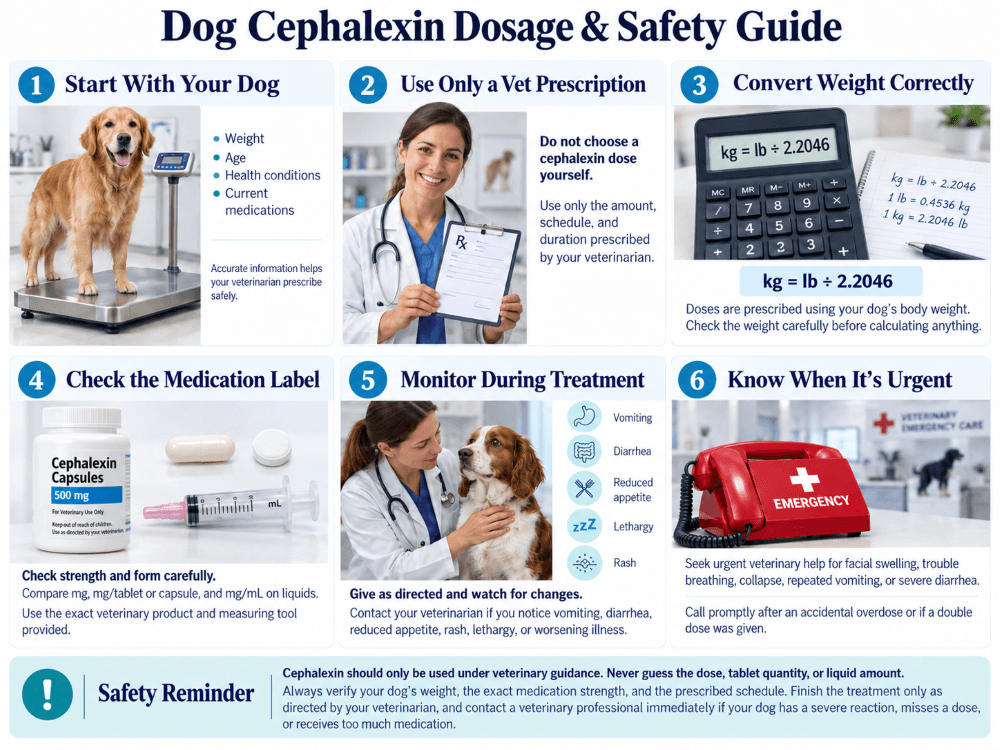
Dog Cephalexin Dosage and Safety Infographic
Frequently Asked Questions
The Bottom Line
The dog cephalexin dosage calculator helps dog owners check veterinarian-prescribed doses and convert medication amounts based on body weight and product concentration. The accompanying charts make it easier to understand mg/kg calculations, liquid strengths, and important medication-safety considerations. However, a correct mathematical result does not guarantee that a medication is appropriate or safe for a particular dog. Always use cephalexin under veterinary supervision, follow the prescribed treatment plan, and seek professional advice if dosing instructions are unclear or side effects occur.
For additional help understanding your dog's medication needs, explore our dog weight loss calculator, dog toxicity calculator, dog aspirin dosage calculator, and other Canine Bible medication guides.