How Long Should I Walk My Dog Calculator 2026

Canine Bible is reader-supported. We receive affiliate commissions via some of our links. Learn more.
How long should you walk your dog each day? There is no single number that works for every dog. A young, energetic herding dog may comfortably need far more activity than an older companion dog, while a puppy may need shorter, gentler outings even if they seem full of energy. The How Long Should I Walk My Dog Calculator gives you a practical starting range based on your dog’s age, size, energy level, current fitness, health, walking intensity, and environment. It can also help you decide how to divide daily walking time into manageable sessions.
Always consider your dog’s age, fitness, health, and weather conditions, and contact your veterinarian if your dog shows pain, unusual fatigue, breathing difficulty, limping, or other signs of exercise intolerance. If you can't reach your vet, you can chat live with a registered online veterinary professional via our online vet chat or video chat support (24 hours a day, 7 days a week). Or use Chewy's online vet services (6 a.m. - midnight ET).
How Long Should I Walk My Dog Each Day?
Many healthy adult dogs can comfortably manage at least a 20- to 30-minute daily walk, while active dogs may benefit from considerably more. Broad exercise guidance commonly places dogs somewhere around 30 minutes to two hours of total daily activity, depending on age, breed, health, fitness, and energy level.
That does not mean every dog should be walked for two hours. Walking is only one form of activity, and the appropriate amount can vary dramatically between dogs. A slow 45-minute sniff walk is also different from 45 minutes of brisk uphill walking. Duration, pace, terrain, temperature, and the dog's physical condition all change how demanding a walk is.
Quick Answer
- For a healthy adult dog, a practical starting point may look like this:
- Lower-energy dogs:
- about 20–30 minutes of walking per day.
- Moderately active dogs:
- about 30–60 minutes per day.
- High-energy dogs:
- about 60–90 minutes per day, sometimes with additional exercise and enrichment.
- Very active or working dogs:
- may need considerably more total daily activity, but that should not necessarily come entirely from leash walking.
Most dogs also benefit from regular opportunities to sniff, explore, play, train, and use their brains. Slow exploratory walks can provide valuable mental enrichment even when they cover less distance than brisk exercise walks.
Example
Suppose you have a healthy 4-year-old, moderately active 40-pound dog that already walks regularly. A reasonable starting estimate may be around 30–60 minutes of walking per day, perhaps divided into two 15- to 30-minute walks.
If your dog remains comfortable, recovers normally, and still seems eager for more activity, you may gradually work toward the higher end of the range. If your dog begins slowing down, becomes stiff afterward, or struggles to recover, the routine may need to be shortened or modified.


Dog Walking Time Chart
Energy level is usually more useful than weight alone when estimating walking time. The ranges below are practical starting points for healthy adult dogs rather than fixed veterinary prescriptions.
Dog Walking Time by Activity Level
| Energy Level | Starting Daily Range | Typical Approach |
|---|---|---|
| Low | 20–30 minutes | One or two relaxed walks may be enough. |
| Moderate | 30–60 minutes | Often split between one or two daily walks. |
| High | 60–90 minutes | Combine walks with play, training, and enrichment. |
| Very high / working | 60–120+ minutes total activity | Walking may be only part of the dog's daily exercise. |
A lively 15-pound terrier can need more exercise than a much heavier, lower-energy dog. Use weight as context rather than a minutes-per-pound formula.
Dog Walking Chart by Weight and Size
| Weight | Approx. Size | Walking Consideration |
|---|---|---|
| Under 10 lb | Toy | Short stride does not automatically mean low energy. |
| 10–25 lb | Small | Breed, age, and energy level matter more than pounds alone. |
| 26–50 lb | Medium | Use fitness and energy level to guide duration. |
| 51–90 lb | Large | Consider conditioning, joints, and orthopedic history. |
| Over 90 lb | Giant | Larger size does not automatically mean longer walks. |
Dog Walking Time by Life Stage
Walking routines should change as dogs grow, mature, and age.
| Life Stage | Best Walking Approach | Key Consideration |
|---|---|---|
| Puppy | Short, gentle outings | Let growing puppies rest and avoid forced endurance exercise. |
| Young adult | Build gradually | Increase distance and intensity as conditioning improves. |
| Healthy adult | Regular daily walks | Energy level and fitness usually drive the range. |
| Senior | Slower or shorter walks | Adjust for stamina, stiffness, and mobility. |
Growing puppies should not be pushed through long jogs, strenuous hikes, repeated jumping, or other demanding exercise before their bodies are ready. Growth plates and joints remain vulnerable during development, and maturity occurs later in many large and giant breeds. The commonly repeated “five minutes of walking per month of age” puppy rule should not be treated as a precise veterinary formula; there is little evidence supporting it as a universal prescription.
Dog Walking Guidelines
A calculator can give you a starting range, but the best walking plan is one your dog can perform comfortably and consistently.
Keep Exercise Consistent
Regular activity is usually more appropriate than doing very little during the week and suddenly attempting a long hike on the weekend. If your dog currently walks for 15 minutes comfortably, jumping immediately to a strenuous 90-minute outing can be too much. Build longer walks progressively so muscles, paws, joints, heart, and lungs have time to adapt.
Divide Walking Time When Needed
Your dog's daily target does not need to happen in one session. Many dogs do well with walking divided across the day, and most dogs ordinarily benefit from at least one or two walks unless their veterinarian has recommended otherwise.


For example, a 60-minute daily target could become two 30-minute walks or three 20-minute walks. Splitting exercise is especially useful for dogs that tire quickly, older dogs, puppies, or dogs returning to activity after a sedentary period.
Make Time for Sniffing
A walk does not need to be a nonstop march. Letting your dog stop, sniff, and explore provides mental stimulation alongside physical activity. A slow sniff-focused walk may cover less ground but still be valuable for your dog's overall well-being.
Increase Exercise Gradually
Start near what your dog already handles comfortably. If you increase duration, distance, hills, or walking pace, change one part of the routine gradually instead of suddenly making every aspect harder.
Your dog's behavior later that day and the following morning can be useful feedback. New stiffness, reluctance to walk, prolonged fatigue, or soreness suggests the previous session may have been too demanding.
Factors That Can Affect Your Dog's Results
The same walking time can be easy for one dog and exhausting for another. These are the main factors the calculator should consider.
| Factor | Why It Matters | What Owners Should Check |
|---|---|---|
| Age | Puppies and seniors may tolerate exercise differently. | Life stage, development, and stamina. |
| Energy level | Higher-energy dogs often need more activity. | Daily behavior and activity drive. |
| Fitness | Conditioned dogs usually tolerate longer walks. | Current routine and recovery. |
| Breed/build | Structure and working traits affect exercise needs. | Body type, muzzle shape, and breed traits. |
| Body condition | Extra weight can increase effort and joint load. | Weight trend and body condition. |
| Health | Joint, heart, or breathing problems may limit exercise. | Pain, lameness, and medical history. |
| Terrain | Hills and uneven ground increase effort. | Pace, slope, and walking surface. |
| Weather | Heat and humidity reduce safe exercise tolerance. | Temperature, humidity, shade, and surface heat. |
Health and mobility should override a generic calculator result when necessary. Dogs with significant orthopedic, heart, or respiratory problems may need exercise recommendations tailored by a veterinarian.
How Often Should You Walk Your Dog?
Many dogs benefit from one to two or more walks each day, but frequency alone does not tell you whether a dog is receiving enough activity. Two five-minute bathroom outings, for example, are not the same as two 30-minute enrichment walks.
Lower-energy dogs may do well with one main walk plus shorter outings. Moderate- and higher-energy dogs often benefit from spreading activity over multiple sessions. Puppies may need several short outings rather than one prolonged walk, while older dogs may also find shorter, more frequent walks easier to tolerate.
Remember that bathroom breaks and exercise walks serve different purposes. Your dog may need to go outside more frequently than their exercise schedule alone would suggest.
Is One Long Walk or Two Short Walks Better?
Neither option is automatically better. A fit, healthy adult dog accustomed to sustained walking may enjoy one longer outing. Other dogs may remain more comfortable when the same total walking time is divided into two or three sessions.
Shorter walks can be particularly useful for senior dogs, puppies, dogs with limited stamina, or dogs exercising during warmer weather. If your dog becomes tired halfway through a long walk, splitting that session into shorter outings may provide similar daily activity without pushing them beyond their comfortable tolerance.
How Far Should I Walk My Dog?
Distance can be useful for tracking progress, but it is usually less helpful than time, intensity, and your dog's response. Two dogs can walk for 30 minutes and cover very different distances. A small dog taking frequent sniff breaks may travel much less distance than a long-legged dog walking briskly beside its owner.
Terrain also matters. One mile on a flat sidewalk is not equivalent to one mile of steep hiking, sand, deep snow, or uneven trails. For most owners, minutes are therefore a better starting measurement than miles. Distance can be tracked as a secondary measure once you understand your dog's normal comfortable pace.
Walking Intensity Matters
Not every 30-minute walk provides the same exercise load.
| Walking Style | Typical Effort | Main Benefit |
|---|---|---|
| Slow sniff walk | Low to moderate | Combines gentle movement with mental enrichment. |
| Steady walk | Moderate | Useful everyday cardiovascular activity. |
| Brisk walk | Moderate to high | Provides more sustained physical exercise. |
| Hilly walk | Higher | Increases muscular and cardiovascular demand. |
| Run or jog | High | Requires appropriate health and gradual conditioning. |
Running and strenuous conditioning should be introduced gradually. Growing puppies should not be treated like adult running partners simply because they appear energetic.
Signs Your Dog May Need a Shorter Walk
Your dog cannot tell you that today's route is too demanding, so watch their pace and body language.
| Sign | What It May Mean | What to Do |
|---|---|---|
| Lagging behind | Your dog may be tiring. | Slow down and consider heading home. |
| Sitting or stopping | The walk may be exceeding current tolerance. | Stop and allow your dog to rest. |
| Limping | Pain or injury may be present. | Stop exercise and assess your dog. |
| Excessive panting | Heat or exertion may be excessive. | Move to a cooler area and stop activity. |
| Paw soreness | The surface or distance may be a problem. | End the walk and inspect the paws. |
| Next-day stiffness | The previous walk may have been too demanding. | Reduce future intensity and duration. |
Repeated attempts to sit or lie down, marked fatigue, or abnormal movement during or after exercise should not be ignored.
Common Mistakes to Avoid
A walking calculator works best when its result is combined with careful observation of your individual dog.
| Mistake | Why It Matters | Better Approach |
|---|---|---|
| Using weight alone | Dogs of similar weight can have very different needs. | Include age, energy, health, and fitness. |
| Jumping to the maximum | Sudden exercise increases fatigue and injury risk. | Build duration gradually. |
| Ignoring life stage | Puppies and seniors need different routines. | Adjust exercise for development and mobility. |
| Treating minutes as exact | Daily tolerance can change. | Use the result as a flexible range. |
| Ignoring weather | Heat and humidity increase exercise stress. | Walk during cooler conditions. |
| Forcing a tired dog | Stopping can signal fatigue, pain, or heat stress. | Rest and reassess instead of pulling forward. |
| Never updating results | Needs change with age, fitness, and health. | Recalculate when your dog changes. |
Dog Walking Safety Guidelines
Walking is usually a low-impact form of exercise, but the safest routine still depends on your dog's health and environment.
Avoid Sudden Overexertion
Do not assume that a dog who appears excited at the start of a walk can comfortably maintain that pace for the entire route. If your dog has been sedentary, begin with manageable walks and gradually build duration and intensity. Overweight dogs and dogs with orthopedic problems deserve extra caution because additional weight can increase stress on joints.
Be Careful in Hot Weather
Exercise tolerance can drop significantly as temperature and humidity rise. Choose cooler times of day, provide access to water, take breaks, and avoid very hot asphalt or other surfaces that can burn paw pads. Short-nosed dogs and overweight dogs are among those that may face greater problems during warm-weather exercise.
There is no single outdoor temperature that is equally safe for every dog. Humidity, direct sun, coat type, breed, fitness, health, pace, and access to shade all affect heat risk.
Know When to Stop Immediately
Stop exercising and move your dog to a safe environment if they develop unusual weakness, severe or rapidly worsening breathing difficulty, excessive panting, significant drooling, unsteadiness, or abnormal gum or tongue color. Collapse, marked unsteadiness, abnormal gum or tongue color, or severe heat-related symptoms require urgent veterinary attention.
When to Ask Your Veterinarian About Exercise
Talk with your veterinarian before making a major increase in exercise if your dog has heart disease, breathing problems, arthritis, significant obesity, ongoing lameness, recent surgery, an orthopedic injury, or another condition that may restrict activity.
New or unexplained exercise intolerance also deserves attention. A dog that suddenly struggles with walks they previously handled comfortably may have more going on than simple tiredness.
What to Do If Your Dog Gets Tired or Stops During a Walk
If your dog repeatedly slows down, stops, or sits, do not drag them forward simply to complete a planned distance. Stop in a safe place and give them time to recover. If the weather is warm, move into shade or a cooler environment and provide access to water.
Check the paws for cuts, burns, thorns, ice, gravel, or other irritation. Watch for limping, stiffness, weakness, unusual breathing, excessive panting, or signs that your dog is becoming less responsive. If your dog returns to normal quickly, head home at an easier pace and shorten the next walk.
Contact your veterinarian if exercise intolerance is new, keeps happening, or is accompanied by pain, lameness, coughing, abnormal breathing, or prolonged fatigue. Seek urgent veterinary care for collapse, severe breathing difficulty, marked weakness, unsteadiness, or concerning heat-stress signs.
Special Considerations for Certain Dogs
How to Calculate Your Dog's Walking Time Manually
There is no scientifically validated formula such as “X minutes for every pound of body weight.” A practical manual estimate works better when it combines several factors.
Step 1: Choose a Starting Range
For a healthy adult dog, begin with the dog's general energy level. A lower-energy dog may start around 20–30 minutes per day, a moderately active dog around 30–60 minutes, and a high-energy dog around 60–90 minutes. Very active or working dogs may need more total daily activity, but not all of it needs to come from continuous leash walking.
Step 2: Adjust for Life Stage
Do not apply an adult target directly to a growing puppy. For senior dogs, consider mobility, pace, stiffness, and recovery rather than reducing exercise simply because of chronological age.
Step 3: Consider Current Fitness
A dog that already walks for an hour comfortably is starting from a very different point than a mostly inactive dog. If your dog is unconditioned, start near their current comfortable tolerance and build progressively.
Step 4: Account for Health and Body Condition
Joint problems, obesity, respiratory disease, heart disease, recent injury, or surgery can change what is appropriate. In these situations, medical restrictions should take priority over a generic calculator estimate.
Step 5: Adjust for Intensity and Weather
A brisk uphill walk requires more effort than a relaxed sniff around a flat block. Warm and humid conditions can also turn a normally easy walk into a demanding one, so shorten, slow, or reschedule the session when needed.
Step 6: Divide the Time Into Sessions
If your estimated range is 60 minutes per day, you might choose two 30-minute walks rather than one continuous hour. Your dog's response should determine whether that schedule needs to move up or down.
Example Calculation
Consider a 4-year-old, 45-pound dog with moderate energy, normal body condition, no known exercise-limiting health condition, and an established walking routine.
- A starting estimate could be:
- 30–60 minutes per day
- A practical schedule might be:
- 25-minute morning walk + 25-minute evening walk = 50 minutes per day
Watch how the dog responds during the walks and afterward. If the dog remains comfortable and enjoys additional activity, other exercise and enrichment can be added gradually. A high-energy dog of the same weight could require substantially more activity. That is why weight alone should never be used as the walking-time formula.
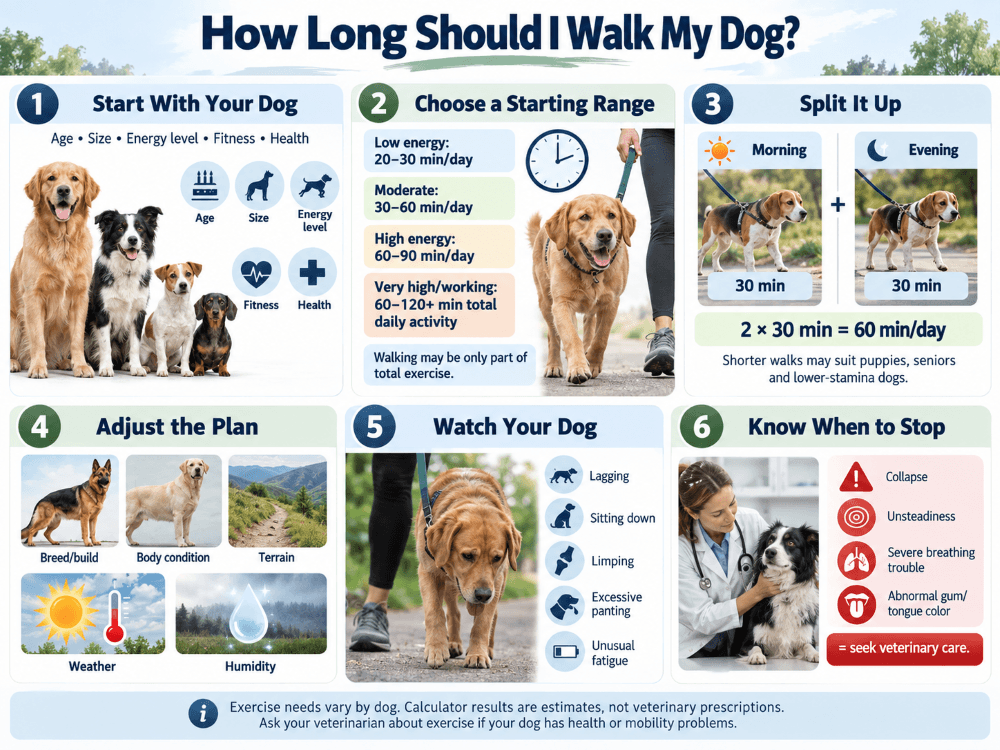
How Long Should I Walk My Dog Infographic
Frequently Asked Questions
The Bottom Line
There is no perfect number of walking minutes that applies to every dog. For healthy adults, daily walking may range from a relatively short 20- to 30-minute outing for some lower-energy dogs to 60–90 minutes or more for active dogs. High-energy working or sporting dogs may need additional physical and mental activity beyond ordinary leash walks. Use the How Long Should I Walk My Dog Calculator to find a practical starting range, then adjust it according to your dog's comfort, energy, conditioning, life stage, health, walking intensity, and weather. Do not chase a number on the clock if your dog is struggling. A comfortable, sustainable routine that matches your individual dog is more useful than reaching an arbitrary mileage or minute goal.
If your goal is also related to maintaining a healthy body weight, consider using Canine Bible's Dog BMI Calculator, Dog Weight Loss Calculator, or Dog Calorie Calculator alongside your walking plan.