What Kind of Dog Breed Is Snoopy? A Beagle? (The Truth)

Canine Bible is reader-supported. We receive affiliate commissions via some of our links. Learn more.
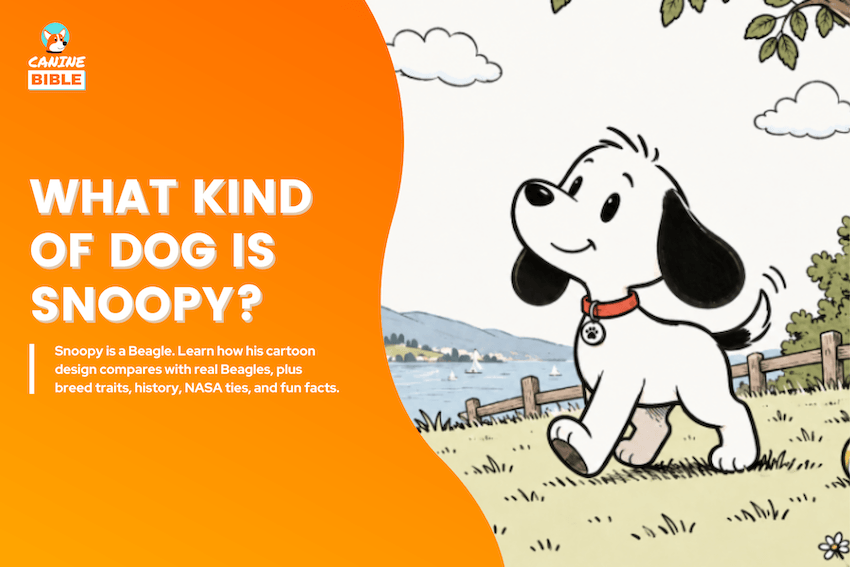
Snoopy is a small hound breed known for its keen sense of smell, floppy ears, and friendly personality. Creator Charles M. Schulz based the famous Peanuts character on a Beagle, although Snoopy’s cartoon appearance is much more stylized than a real one. His mostly white coat, black ears, and humanlike behavior can make his breed less obvious at first glance. So, how closely does Snoopy actually resemble a real Beagle? His appearance, personality, size, and unusual traits reveal some interesting similarities—and a few major differences. Understanding those details also explains why Snoopy became one of the most recognizable fictional dogs in the world.
What Kind of Dog Is Snoopy? History & Origin
Snoopy made his first appearance in the Peanuts comic strip on October 4, 1950, just two days after the strip debuted. Although Snoopy is officially a Beagle, creator Charles M. Schulz drew much of his inspiration from Spike, the black-and-white mixed-breed dog Schulz had as a child. Schulz even drew Spike for Ripley’s Believe It or Not! years before creating Peanuts.
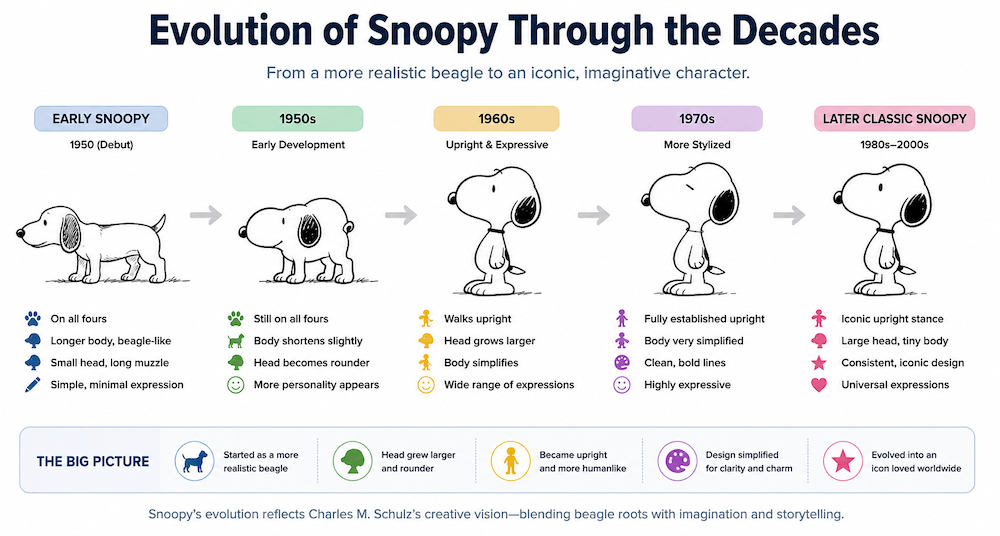
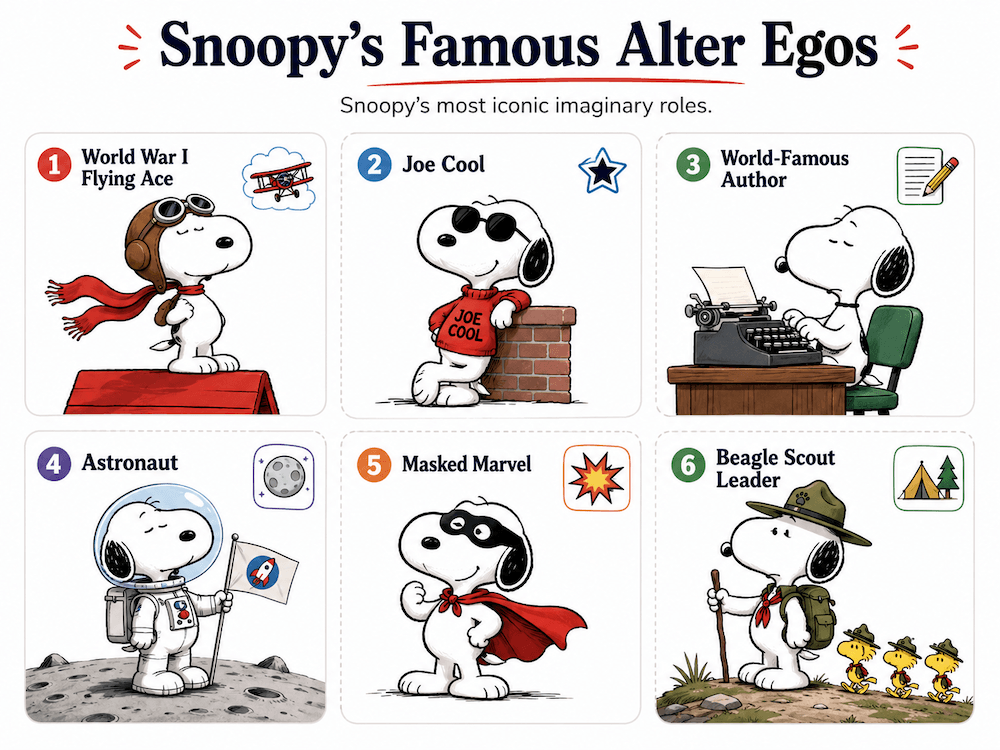
Early Snoopy looked much more like an ordinary dog. He walked on four legs, barked, played fetch, and had fewer of the humanlike qualities associated with the character today. As Schulz’s drawing style developed, Snoopy began walking upright, thinking more like a person, and escaping into elaborate imaginary roles such as the World War I Flying Ace, Joe Cool, and the World-Famous Author.
This evolution also explains why Snoopy does not closely match the anatomy or coloring of a typical modern Beagle. His design reflects a combination of Beagle identity, memories of Spike, and decades of artistic development rather than an attempt to portray the breed realistically.


How Snoopy’s Appearance Changed Over Time
Snoopy’s appearance changed gradually as Charles M. Schulz refined his drawing style over the decades. Early Snoopy looked more like a conventional four-legged dog, with a longer body, smaller head, and simpler expressions. By the 1960s and 1970s, his body had become shorter and more stylized, while his larger head, upright posture, and increasingly human-like expressions became defining features. These changes eventually produced the compact, highly expressive Snoopy design that became recognized around the world.
What Would Snoopy Look Like as a Real Beagle?
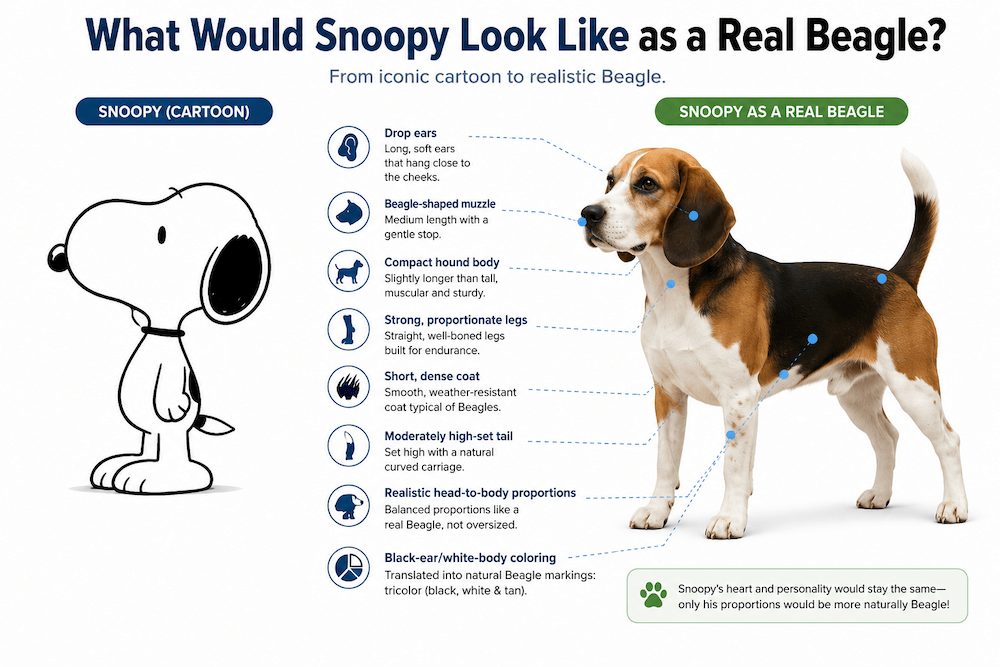
If Snoopy were translated into realistic canine anatomy, he would look like a small, compact Beagle with long drop ears, a proportionate hound muzzle, sturdy legs, and a short, dense coat. His body would be much less top-heavy than the cartoon version, with a broader chest, stronger limbs, and more natural head-to-body proportions.
His familiar black ears and mostly white body could still be represented in a real dog, although the exact cartoon pattern would be unusual. A realistic Snoopy would also carry a thicker, moderately high-set tail rather than the thin upright line seen in the comic strip, and his overall silhouette would look longer and more muscular.
Is Snoopy an Accurate Beagle?
Behaviorally, Snoopy shares several traits commonly associated with Beagles. He is curious, independent, playful, persistent, social, and highly interested in food, all of which can feel familiar to Beagle owners.


Where Snoopy differs most is in intelligence and imagination. Real Beagles are capable learners and problem-solvers, but their attention is often strongly influenced by scent, while Snoopy thinks, plans, writes, dances, and takes on elaborate human roles that belong entirely to fiction.
| Trait | Snoopy | Real Beagle |
|---|---|---|
| Curiosity | Constantly explores ideas, places, and adventures. | Typically curious about surroundings and new scents. |
| Independence | Frequently does things entirely on his own terms. | Often independent, especially when following scents. |
| Food motivation | Food is a frequent source of excitement. | Many Beagles respond strongly to food rewards. |
| Sociability | Enjoys friends, family, and group adventures. | Generally sociable with people and other dogs. |
| Playfulness | Highly playful and frequently mischievous. | Often energetic, playful, and enthusiastic. |
| Persistence | Pursues goals and imaginary roles enthusiastically. | Can be determined when something captures attention. |
| Exploration | Constantly seeks new adventures. | Strongly motivated to investigate the environment. |
| Scent drive | Only occasionally central to his behavior. | A major breed characteristic and daily influence. |
| Problem-solving | Shows exaggerated, human-level reasoning. | Capable learner with normal canine cognition. |
| Imagination | Creates elaborate identities and imaginary worlds. | Purely fictional as portrayed in Snoopy. |
| Human activities | Writes, dances, reads, skates, and flies planes. | Anthropomorphic cartoon behavior. |
Why Doesn’t Snoopy Look Like a Typical Beagle?
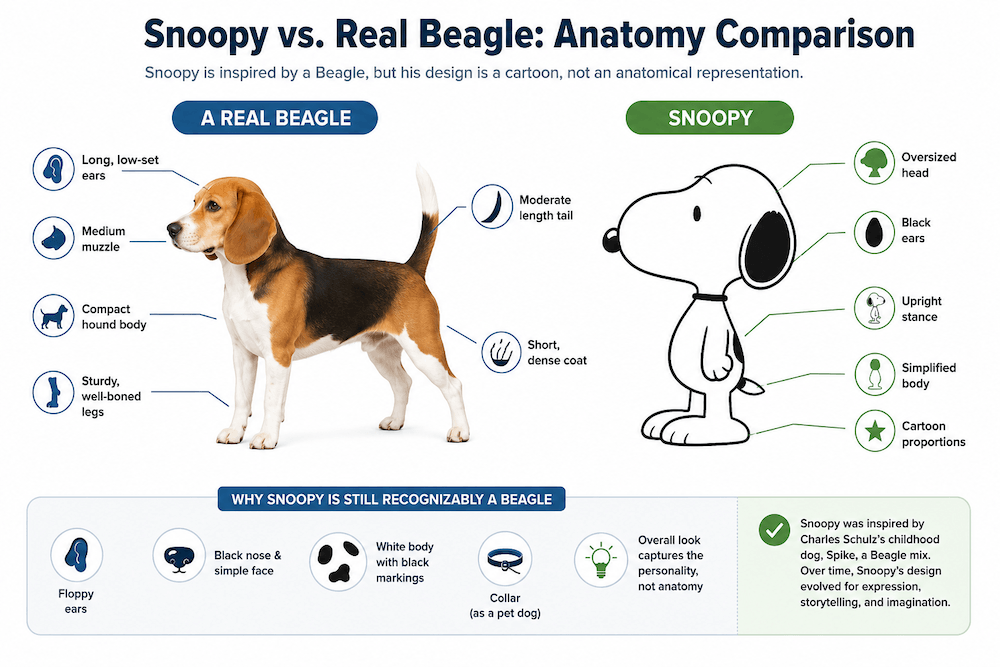
A real Beagle is a compact, sturdy hound with long, low-set ears, a close coat, and recognizable canine proportions. Snoopy retains a few broad Beagle cues, but his oversized head, simplified body, and mostly white appearance were shaped for an expressive comic-strip character rather than anatomical accuracy.
Snoopy, a Beagle, vs. Similar-Looking Breeds
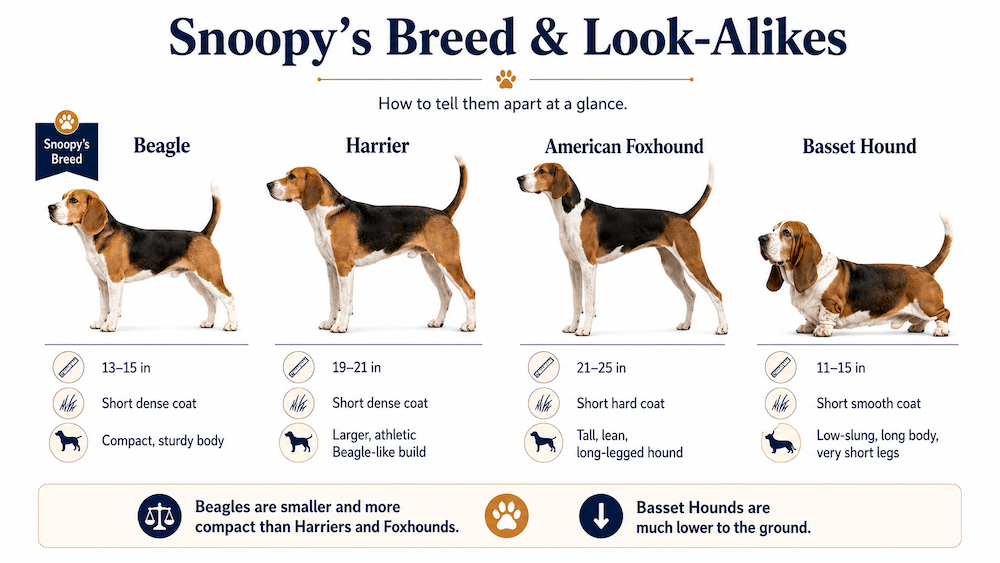
Snoopy is a Beagle, a compact scent hound known for long drop ears, a sturdy body, and a short coat. Similar hounds such as the Harrier and American Foxhound share many Beagle-like features but are noticeably taller and more athletic, while the Basset Hound is lower to the ground with much shorter legs and heavier ears. Size, leg length, body proportions, and head shape are some of the easiest ways to tell these breeds apart. Snoopy’s cartoon proportions are exaggerated, but the real breed behind the character is distinctly Beagle.
The Beagle Dog Breed: Everything You Need to Know
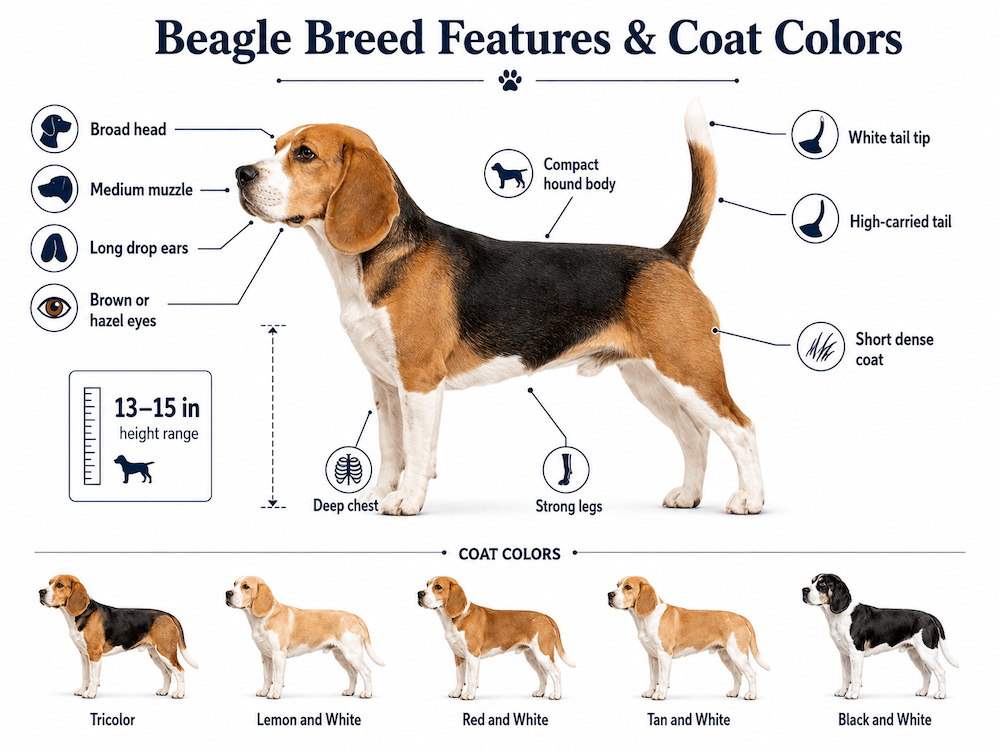
Beagles are small-to-medium scent hounds originally developed to pursue game such as hare and rabbit by following scent trails. Their combination of a powerful nose, stamina, sociability, and distinctive barking, baying, and howling reflects generations of working in the field, often alongside other hounds.
Today, Beagles are widely kept as companion dogs, but their scenting ability also makes them useful in tracking, detection, and other nose-based work. Understanding their physical traits, temperament, activity needs, and health considerations gives prospective owners a much clearer picture of what living with a real Beagle involves.
Is a Snoopy-Type Beagle a Good Family Dog?
For many households, a Beagle can make an affectionate and entertaining family companion. Beagles are typically friendly, social, curious, playful, and people-oriented, but they can also be independent when something—especially an interesting smell—captures their attention. Their pack-hound background generally makes companionship an important part of their lives.
| Category | Good Fit | May Be Less Suitable |
|---|---|---|
| Companionship | Wants a social, involved family dog. | Dog will regularly spend long periods alone. |
| Children | Can supervise and teach respectful interaction. | Expects children and dogs to need no supervision. |
| Other dogs | Enjoys a socially inclined, dog-friendly breed. | Strongly prefers a solitary companion. |
| Cats | Can manage gradual, supervised introductions. | Cannot accommodate possible chasing behavior. |
| Noise | Comfortable managing barking, baying, and howling. | Needs an especially quiet breed. |
| Shedding | Accepts routine brushing and loose hair. | Requires minimal shedding around the home. |
| Training | Enjoys patient, interactive dog training. | Wants effortless off-leash obedience. |
Beagle Exercise, Training & Mental Stimulation
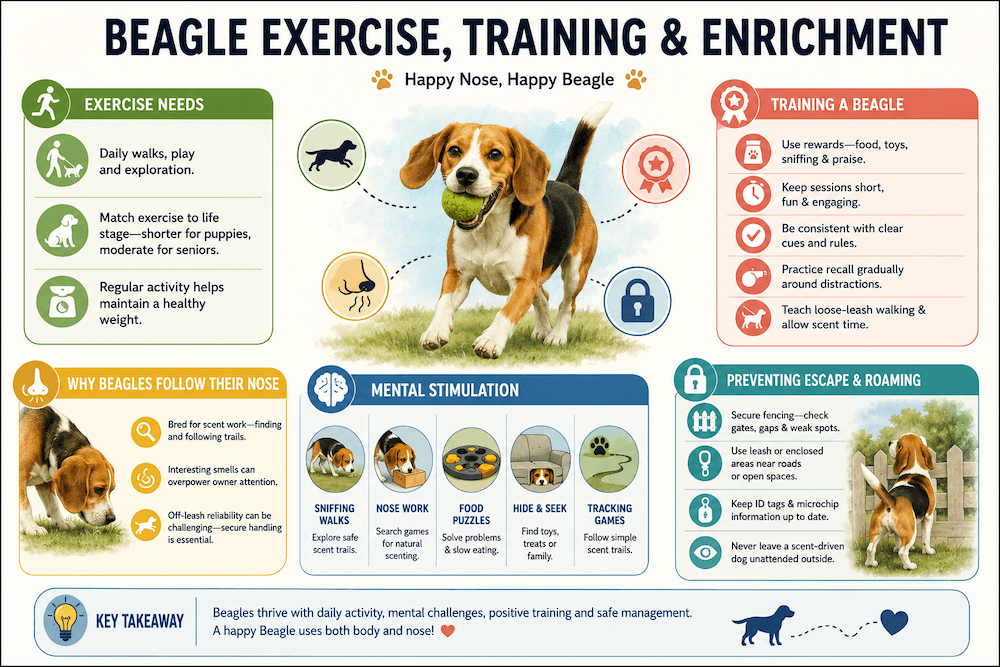
Beagles thrive when their exercise, training, and mental enrichment work together to satisfy both their physical energy and powerful sense of smell. Daily walks, play, sniffing opportunities, and scent-based games can help keep them engaged while supporting a healthy weight. Because Beagles can become highly focused on interesting scents, reward-based training, gradual recall practice, and secure leash or fencing management are especially important. A well-balanced routine of activity, nose work, and consistent training can help prevent boredom, roaming, and other unwanted behaviors.
Beagle Health, Lifespan & Responsible Breeding
Beagles are generally a healthy, long-lived breed, with many living well into their teens when supported by good genetics, appropriate nutrition, exercise, and preventive veterinary care. However, they can be predisposed to certain concerns, including obesity, ear disease, epilepsy, hypothyroidism, eye disorders, and some orthopedic or spinal problems. Prospective owners should choose breeders who complete recommended health screenings and provide clear records for both puppies and their parents. Responsible breeding, early socialization, and lifelong weight and wellness management can all help support a Beagle’s long-term health.
Typical Beagle Lifespan
A reasonable general expectation for a Beagle is roughly 10–15 years, although lifespan varies considerably among individuals. Recent large-scale veterinary data from UK companion Beagles found a median age at death of 11.28 years, with half of recorded deaths occurring between approximately 9.3 and 13.1 years.
Those figures are population averages, not a prediction for an individual dog. Genetics, body condition, preventive care, disease, accidents, and other factors can all influence longevity.
Common or Important Beagle Health Concerns
Beagles are not considered an extremely conformation-driven breed, but several health problems deserve attention. A recent veterinary population study found obesity and ear disorders among the more frequently recorded conditions, while breed-health guidance identifies several additional inherited or clinically important concerns.
Choosing a Healthy Beagle Puppy
Choosing a healthy Beagle puppy starts with finding a responsible breeder who prioritizes health testing, temperament, and early socialization. Look for appropriate screening for inherited conditions, including hip, eye, cardiac, thyroid, and MLS testing, along with a documented family health history. Puppies should also be raised in a clean, safe environment and come with verifiable veterinary and vaccination records. A CHIC number can be useful for confirming completed health testing, but owners should still review the actual results rather than assuming every test was normal.

How Snoopy Made Beagles Famous
Snoopy helped make the Beagle name familiar worldwide. At its peak, Peanuts appeared in roughly 2,600 newspapers across 75 countries and was translated into 21 languages, while television specials and films such as A Charlie Brown Christmas, Snoopy Come Home, and The Peanuts Movie introduced the character to generations of viewers.
Because Snoopy is repeatedly identified as a Beagle, he created a lasting cultural association between the character and the breed. It is reasonable to say he increased public familiarity with Beagles, although there is not enough evidence to claim that Snoopy directly caused changes in Beagle ownership or registration numbers.
Snoopy in Popular Culture
Together, comics, animation, movies, merchandise, licensing, and attractions transformed Snoopy from Charlie Brown’s pet into one of the world’s most recognizable fictional dogs. His popularity also gave the Beagle breed a permanent place in popular culture—even if the cartoon character is very different from the real scent hound behind the name.
Snoopy’s Association With NASA
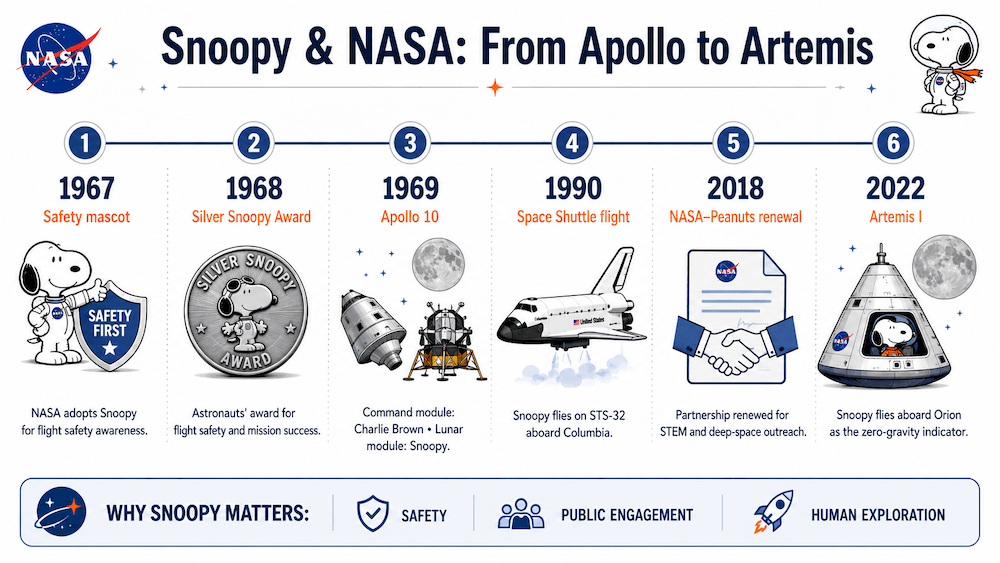
Snoopy has been connected with NASA for more than half a century, becoming an enduring symbol of human spaceflight safety and mission success. The relationship began during the Apollo era and continues today through astronaut awards, educational programs, and Artemis missions.
Famous Snoopy Characters and Alter Egos
One of Snoopy’s defining characteristics is his ability to escape ordinary life through elaborate imaginary identities. Charles M. Schulz eventually gave Snoopy more than 100 personas, allowing the character to become a pilot, student, writer, athlete, astronaut, and much more without ever leaving his familiar surroundings.
Interesting Facts About Snoopy
Frequently Asked Questions
The Bottom Line
Snoopy is officially a Beagle, even though his exaggerated cartoon appearance looks very different from a real member of the breed. Over decades of Peanuts, Charles M. Schulz transformed Snoopy from a fairly conventional four-legged dog into the expressive, upright character recognized around the world. Some of Snoopy’s curiosity, independence, sociability, playfulness, and enthusiasm for food resemble genuine Beagle tendencies, while his writing, flying, and elaborate imagination are purely fictional. Real Beagles are compact scent hounds with powerful noses, considerable stamina, and a strong drive to explore their surroundings. They can make affectionate family companions, but prospective owners should also be prepared for exercise, training, vocalization, shedding, and secure management. Snoopy’s enormous cultural reach—from comics and animation to merchandise and NASA—has helped keep both the character and the Beagle name familiar to generations of fans. Whether you love Snoopy for his personality or are considering a Beagle of your own, understanding the real breed behind the cartoon provides a much clearer picture of what makes these dogs distinctive.
Want to keep exploring famous dogs and the real breeds behind them? Read our complete Beagle breed guide for more on appearance, temperament, care, and ownership, or discover what kind of dog Scooby-Doo is and how another iconic cartoon dog compares with his real-world breed.