What Breed of Dog Was Spuds MacKenzie? (The Truth & Facts!)

Canine Bible is reader-supported. We receive affiliate commissions via some of our links. Learn more.
Spuds MacKenzie became one of the most recognizable advertising dogs of the 1980s, thanks to his unusual looks, confident persona, and instantly memorable commercials. But the real story behind the mascot is more surprising than the ads suggested. The dog who played Spuds had a different identity from the character viewers saw on screen, and even the mascot’s supposed sex was part of the fiction. His distinctive head shape, white coat, and dark eye patch also led many people to wonder what kind of dog he actually was. Beyond the advertising image, the breed itself has a very different set of traits, needs, and health considerations than the carefree “party animal” persona implied. So, what breed was Spuds MacKenzie, how closely did the mascot match the real breed, and what happened to the dog behind the character? This guide covers Spuds MacKenzie’s breed, history, physical traits, personality, and the facts behind one of advertising’s most memorable dogs.
What Breed of Dog Was Spuds MacKenzie? History & Origin
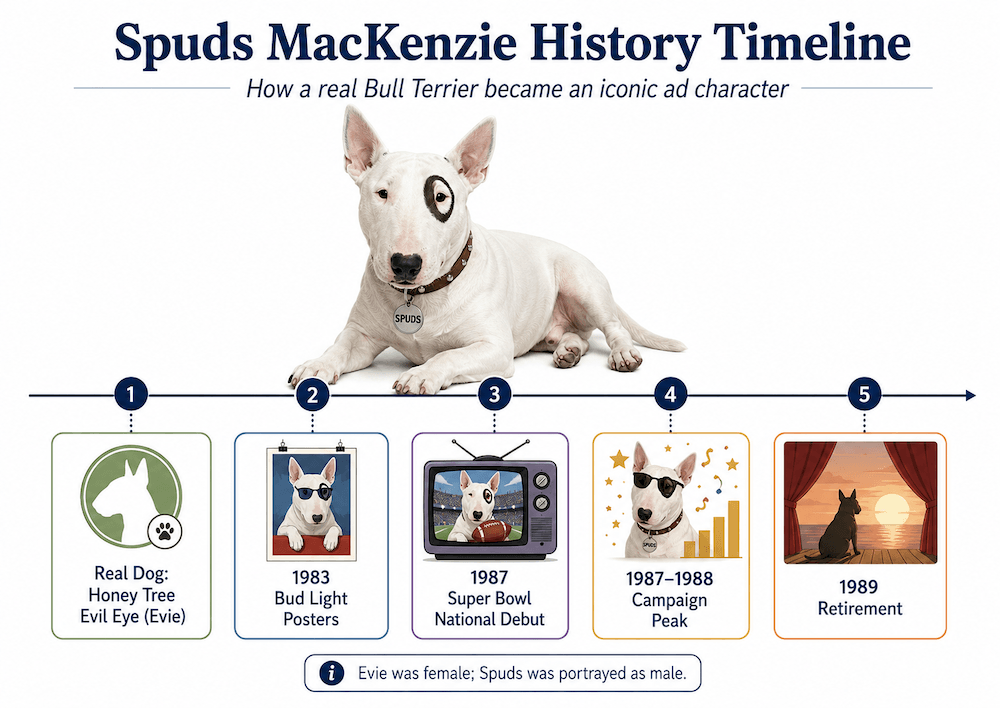
Spuds MacKenzie was a Bull Terrier, portrayed by a pedigreed female dog named Honey Tree Evil Eye, commonly called Evie by her owners, Stan and Jackie Oles. Although Spuds was consistently presented as a cool, confident male character, Evie was female—a fact that became widely known as the campaign grew in popularity.
Spuds’ advertising history actually began before the famous Super Bowl commercial. Evie appeared on Bud Light posters as early as 1983, the concept expanded into test markets by 1986, and Spuds was introduced to a national television audience during Super Bowl XXI in 1987, arriving by limousine at a nightclub. The campaign built an exaggerated fictional identity around Spuds as “The Original Party Animal”—a silent celebrity who supposedly transformed ordinary gatherings into major parties simply by showing up.
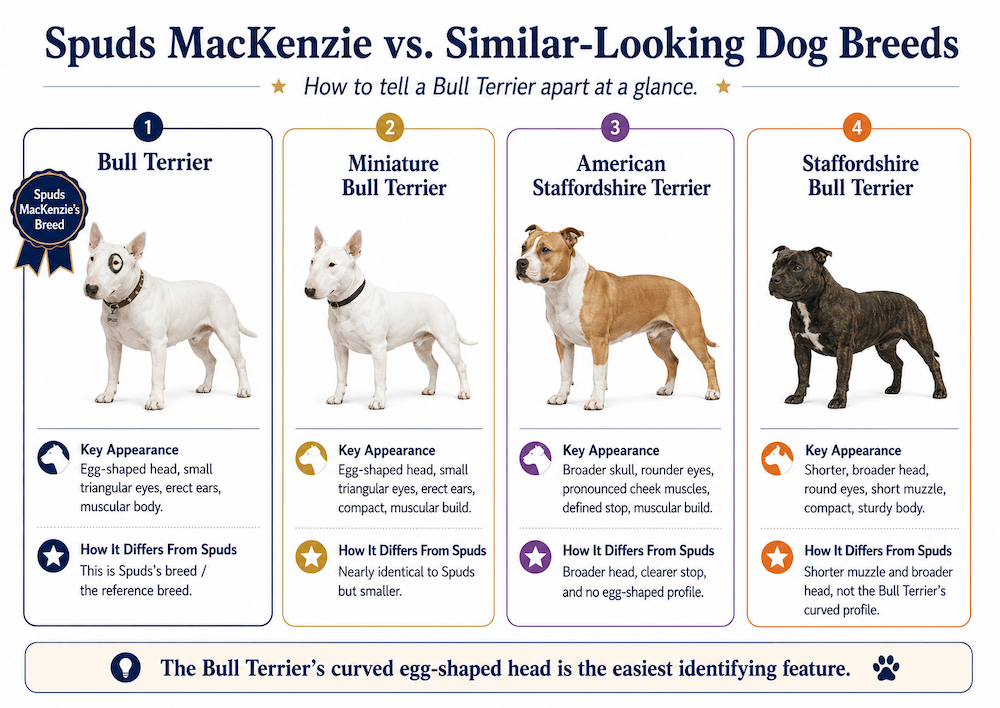
Spuds MacKenzie, a Bull Terrier, vs. Similar-Looking Breeds
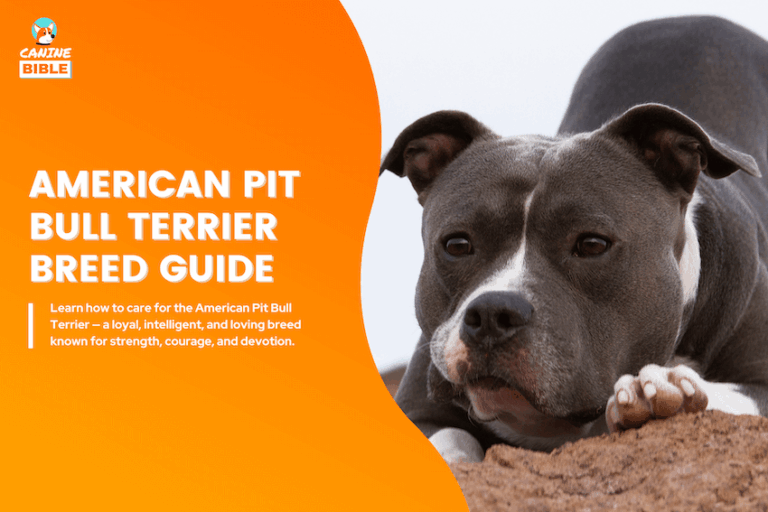
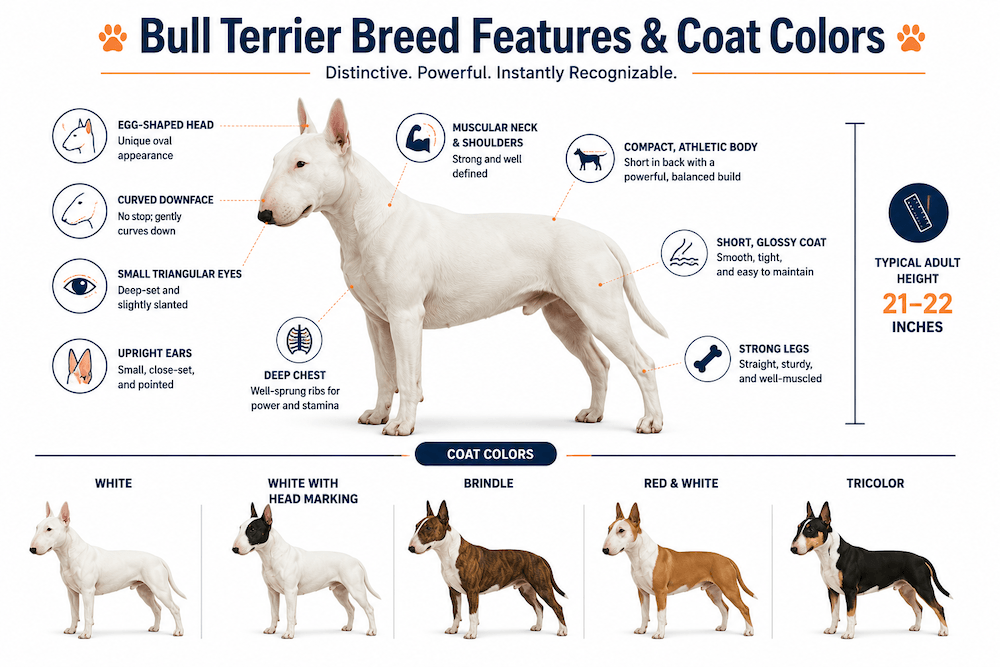
Spuds’ strongest breed identifier is the long, egg-shaped head with a continuously curved profile and small triangular eyes. Miniature Bull Terriers share almost the same distinctive head and body type, while Staffordshire Bull Terriers and American Staffordshire Terriers have broader skulls, more obvious stops between the forehead and muzzle, and different eye shapes.


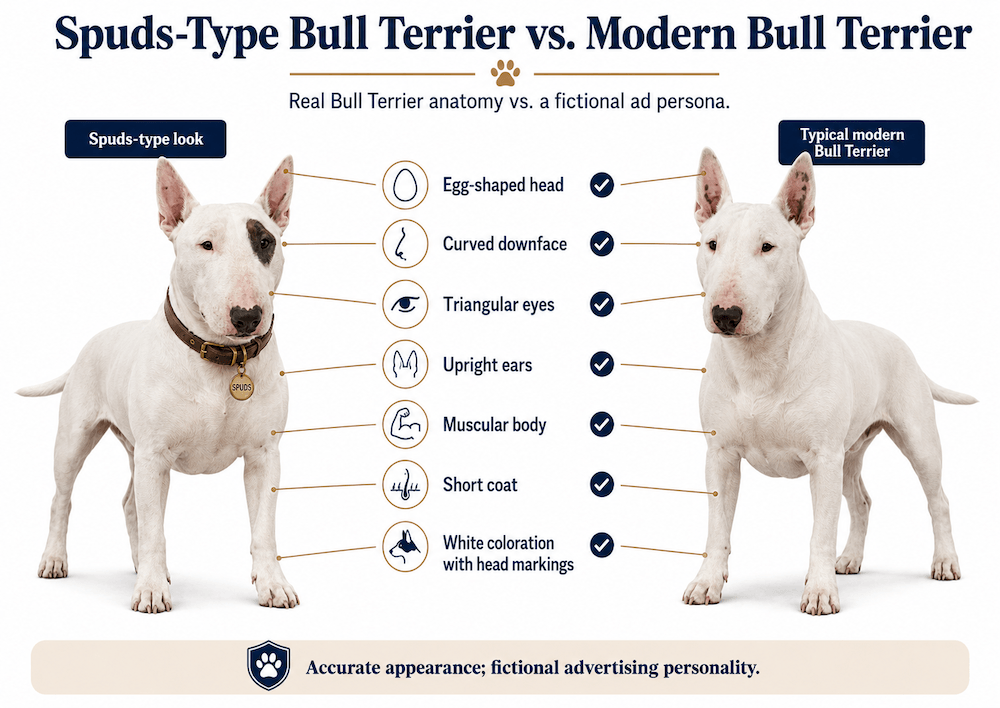
Was Spuds MacKenzie an Accurate Bull Terrier?
Physically, yes—Spuds was an excellent example of several instantly recognizable Bull Terrier characteristics. Evie’s appearance closely matched the breed’s distinctive head, eye, ear, body, and coat traits rather than representing an unusual advertising-created type.
Where advertising becomes misleading is personality. Spuds’ tuxedo-wearing, limousine-riding “party animal” persona was a fictional marketing character, not a temperament description for the breed. Individual Bull Terriers vary considerably, and behavior depends on genetics, socialization, training, environment, health, and individual experience—not which advertising mascot they resemble.
The Bull Terrier Dog Breed: Everything You Need to Know
Bull Terriers are medium-sized, muscular terriers originally developed in England from bull-and-terrier-type dogs and later refined into a more distinctive companion and show breed. Their unmistakable egg-shaped head, triangular eyes, upright ears, and powerful body make them one of the easiest dog breeds to recognize.
Is a Spuds MacKenzie-Type Bull Terrier a Good Family Dog?
A Bull Terrier can be an affectionate, entertaining, deeply involved family companion in the right household. The breed tends to be playful and people-oriented, but its strength, enthusiasm, independence, and tendency toward rambunctious play mean successful ownership depends heavily on training, supervision, exercise, and realistic expectations


| Category | Good Fit | May Be Less Suitable |
|---|---|---|
| Companionship | Wants an affectionate dog involved in family life. | Dog will regularly spend long periods alone. |
| Children | Can supervise interactions and teach respectful handling. | Wants unsupervised rough play with young children. |
| Other dogs | Can provide controlled introductions and ongoing supervision. | Expects automatic compatibility with every dog. |
| Cats & small pets | Can manage introductions and individual prey-drive differences. | Cannot safely separate animals when necessary. |
| Activity | Enjoys walks, play, training, and active companionship. | Wants a consistently low-energy dog. |
| Strength | Comfortable handling a muscular 50–70-pound dog. | Needs an especially easy dog to physically manage. |
| Training | Enjoys patient, reward-based, consistent training. | Wants effortless obedience with little practice. |
| Grooming | Accepts light brushing and routine shedding. | Requires a completely non-shedding breed. |
Bull Terrier Exercise, Training & Mental Stimulation
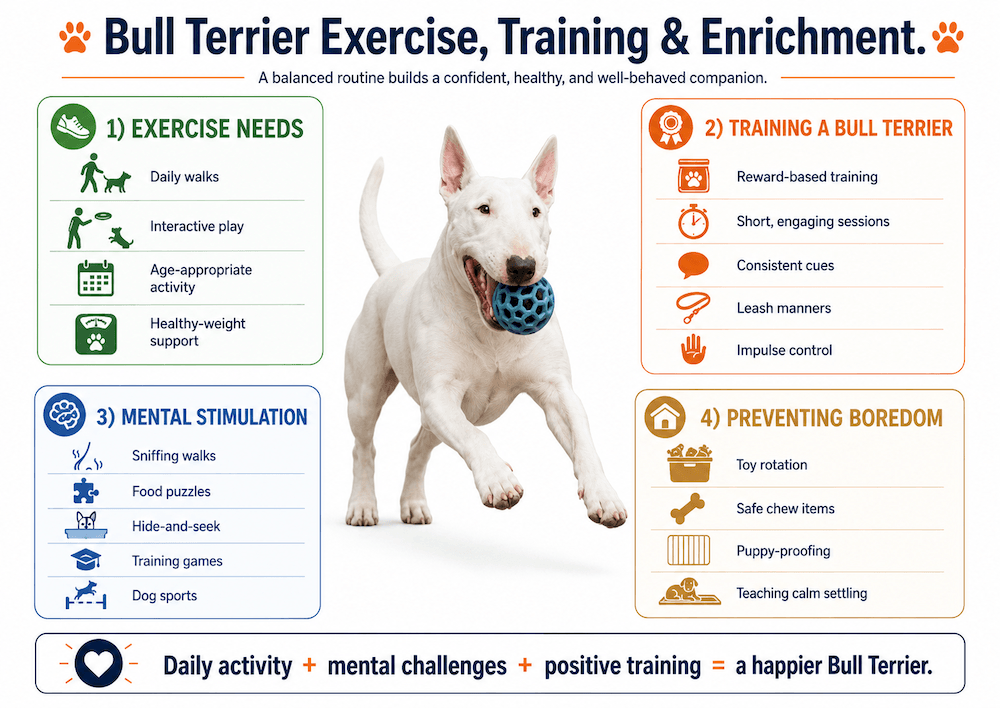
Bull Terriers generally do best when physical exercise, training, and mental enrichment work together. Simply giving one a yard is unlikely to satisfy an energetic dog that also wants interaction; daily walks, structured play, sniffing opportunities, training games, and appropriate dog sports can provide more complete outlets.
Bull Terrier Health, Lifespan & Responsible Breeding
Bull Terriers typically have a lifespan of around 12–13 years, although some individuals live considerably longer. Genetics, body condition, preventive veterinary care, nutrition, exercise, accidents, and acquired disease all influence how long an individual dog lives.
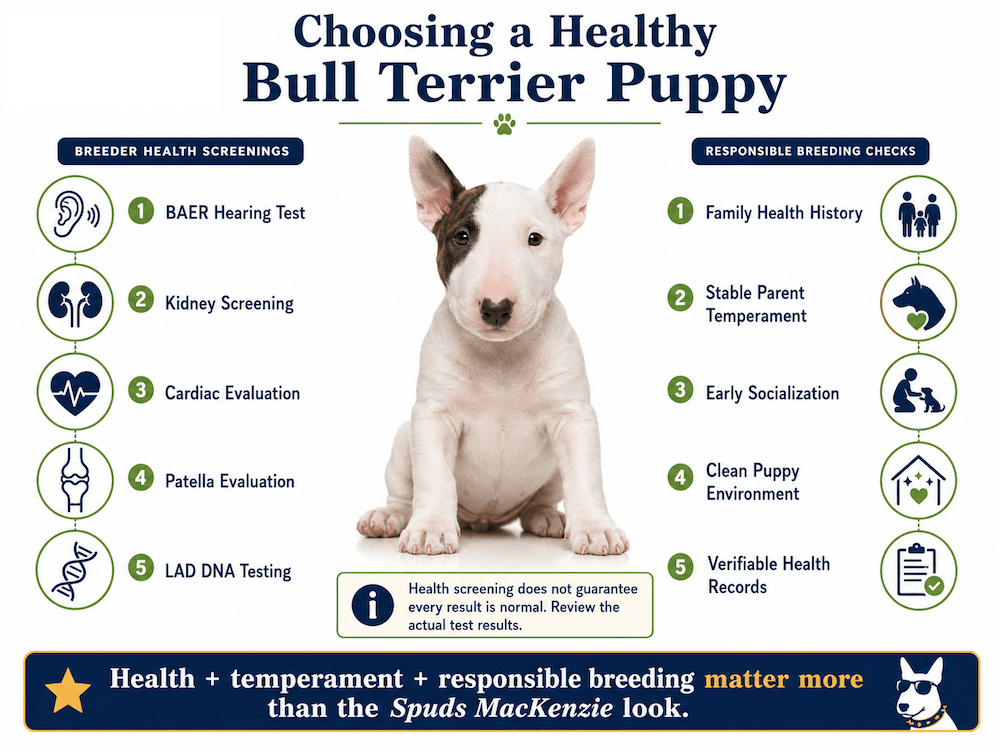
The breed has several inherited or breed-associated health conditions worth considering, which is why prospective owners should prioritize documented health testing rather than appearance alone. The Bull Terrier Club of America and OFA health program specifically identify screening related to hearing, kidneys, the heart, patellas, and lethal acrodermatitis.
Common or Important Bull Terrier Health Concerns
These risks do not mean that every Bull Terrier will become ill. They mean that health history and appropriate screening deserve as much attention as head shape, coat color, or Spuds-like markings.
Choosing a Healthy Bull Terrier Puppy
Choosing a healthy puppy begins with a breeder who prioritizes health, temperament, sound structure, and early socialization rather than producing dogs primarily for a fashionable appearance. Ask to see actual screening results for the puppy’s parents and verify records rather than accepting statements such as “health tested” without documentation.
Spuds MacKenzie and Bud Light: How the Mascot Became Famous
Spuds became much more than a dog appearing in beer commercials. After the 1987 Super Bowl national launch, Bud Light built an entertainment-driven campaign around a silent celebrity whose arrival supposedly turned ordinary gatherings into glamorous parties. Commercials commonly surrounded Spuds with crowds, nightlife, sports, beaches, and an entourage of women known as the Spudettes, reinforcing the fantasy that Spuds was the ultimate social celebrity.
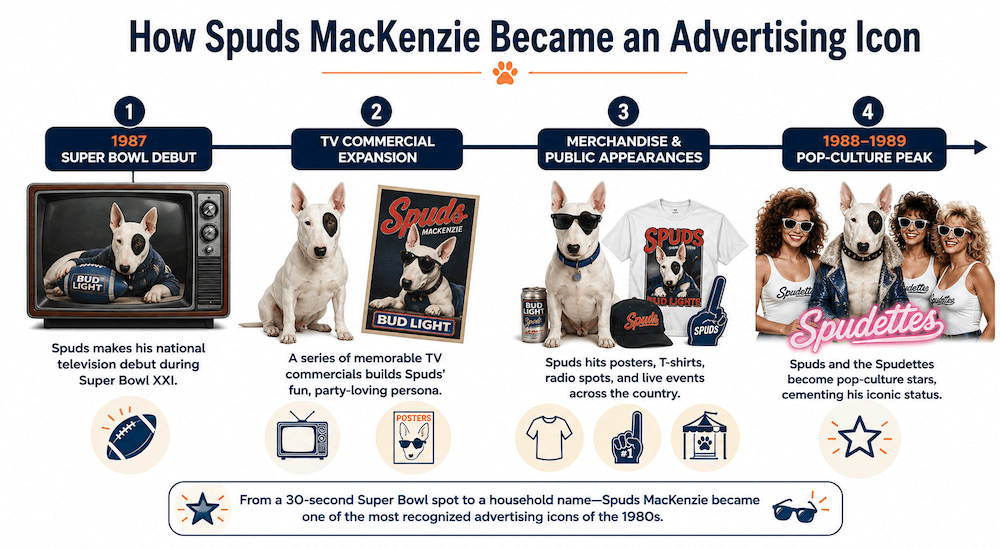
Merchandising expanded the character far beyond television. Contemporary reporting described more than 200 licensed Spuds products, dedicated boutiques in Macy’s stores, posters, shirts, jackets, mugs, calendars, toys, and other promotional items. By early 1989, Spuds remained one of America’s most memorable television advertising characters, while Bud Light sales had risen strongly during the campaign period—although advertising alone cannot establish exactly how much of that growth Spuds personally caused.
Why Was Spuds MacKenzie Controversial?
The same qualities that made Spuds memorable created the campaign’s biggest problem: a funny dog and collectible merchandise could appeal to people far below the legal drinking age. By late 1987, politicians, educators, parents, and alcohol-abuse organizations were publicly criticizing the campaign and questioning whether such a character was appropriate for marketing beer.
| Controversy | Main Concern | What Happened |
|---|---|---|
| Child Appeal | A humorous dog could attract underage audiences. | The campaign faced public and political criticism. |
| Stuffed Toys | Beer-branded plush dogs resembled children’s merchandise. | The toys became a major focus of criticism. |
| School Merchandise | Students wore Spuds-branded apparel. | Some schools restricted the clothing. |
| Sports Imagery | Ads associated beer with recreation and athletics. | Alcohol-awareness groups criticized specific commercials. |
| Advertising Response | Pressure grew for more responsible messaging. | Spuds appeared in moderation-themed advertising as well. |
In November 1987, the issue even reached the U.S. Senate, where Spuds merchandise was displayed while the campaign was criticized for allegedly encouraging youth interest in alcohol. Bud Light rejected the claim that its advertising was intended for children and said authorized merchandise was aimed at adults.
What Happened to Spuds MacKenzie?
Bud Light retired Spuds from its regular advertising in 1989. Historical accounts connect the decision to a combination of campaign saturation, the character becoming almost bigger than the product, and growing negative publicity surrounding the use of a highly appealing animal mascot to market alcohol. It is safer to view retirement as a marketing decision influenced by several factors rather than claiming one controversy alone forced Spuds off the air.
After retiring, Evie returned to a much quieter life with her owners in North Riverside, Illinois. She died at home in 1993 at about 10 years old after developing kidney failure and reportedly undergoing dialysis.
Spuds was not officially “killed off” as part of the original campaign. The character simply stopped appearing regularly. The many rumors during Spuds’ fame—including stories about fatal accidents—were false, something contemporary reports were already trying to correct while Evie was alive.
How Spuds MacKenzie Changed the Bull Terrier’s Popularity
Spuds exposed millions of viewers to a breed whose head shape was so unusual that people sometimes mistook Bull Terriers for other animals or entirely different dog breeds. The advertising campaign turned that silhouette into something instantly recognizable and created a strong association between white Bull Terriers with head markings and the Spuds look.
There is also credible contemporary evidence that fame created short-term demand for Bull Terrier puppies. In 1987, the president of the Bull Terrier Club of America reported a surge of inquiries from people wanting dogs that looked like Spuds, concern about increased backyard breeding, greater pet-shop demand, and markedly higher asking prices for some puppies.
That does not automatically prove a sustained nationwide increase in registered Bull Terrier ownership. The strongest documented conclusion is that Spuds dramatically increased breed visibility and created immediate consumer demand; claims about a long-term registration boom require actual registration data.
For prospective owners, that distinction matters. Famous appearance is not the same as responsible breed selection. A Bull Terrier should be chosen for compatible temperament, exercise needs, health, breeder practices, and household fit—not simply because a puppy has Spuds-like markings.
Interesting Facts About Spuds MacKenzie
Spuds became enough of a celebrity that the campaign developed its own vocabulary, promotional identity, entertainment appearances, and even a revival decades later.
Frequently Asked Questions
The Bottom Line
Spuds MacKenzie was a Bull Terrier, portrayed by a female dog named Honey Tree Evil Eye, or Evie, despite the advertising character being presented as male. Her white coat, dark eye patch, egg-shaped head, triangular eyes, and muscular build made the Bull Terrier instantly recognizable to millions of viewers. The Bud Light campaign turned Spuds into one of the most memorable advertising mascots of the 1980s while also generating controversy over the use of an appealing animal character to market alcohol. Beyond the fictional “party animal” persona, real Bull Terriers are energetic, affectionate, powerful dogs that require consistent training, exercise, socialization, and responsible ownership. Prospective owners should pay particular attention to temperament and documented health screening rather than choosing a puppy solely for Spuds-like markings. The campaign eventually ended, but Spuds helped cement the Bull Terrier’s unusual appearance in American pop culture. Decades later, the answer remains unmistakable: Spuds MacKenzie was a Bull Terrier.
Want to learn more about Bull Terriers and similar breeds? Read our complete Bull Terrier breed guide, compare them with the Staffordshire Bull Terrier and American Pit Bull Terrier, or discover another famous canine character in our guide to what kind of dog Scooby-Doo is.