What Kind of Dog Breed is Lassie? Rough Collie? (The Truth)


Canine Bible is reader-supported. We receive affiliate commissions via some of our links. Learn more.
Lassie has been one of the most recognizable canine characters in books, movies, and television for generations. Known for her loyalty, intelligence, courage, and striking appearance, she helped shape the public image of the devoted family dog and became a lasting icon in popular culture. One of the biggest questions surrounding Lassie is what breed she actually was and how closely the fictional character matched the real dog behind the image. There is also more to the story than most people realize, from the real Collies that portrayed Lassie on screen to the differences between Lassie and similar-looking breeds. We’ll break down her breed, history, appearance, temperament, and the real-life dogs that helped make the character famous.
What Kind of Dog Breed Was Lassie? History & Origin
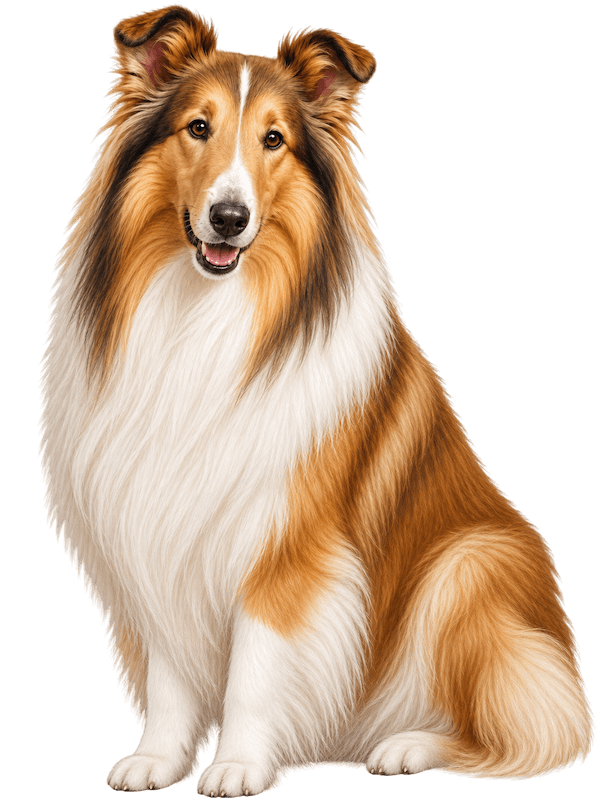
Lassie is a fictional female Rough Collie, the long-haired Collie variety recognizable by its abundant double coat, narrow head, and prominent neck ruff. Although many people simply call her a “Collie,” Lassie’s classic appearance is specifically associated with the Rough Collie.
Author Eric Knight introduced Lassie in a 1938 story published in The Saturday Evening Post. He expanded the story into the 1940 novel Lassie Come-Home, which follows the devoted Collie on a difficult journey to reunite with the boy she loves.
The character became so closely identified with her breed that Rough Collies are still sometimes informally called “Lassie dogs.” That familiar image, however, represents one specific type of Collie rather than Border Collies, Shetland Sheepdogs, or every dog carrying the Collie name.
Was Lassie Based on a Real Dog?
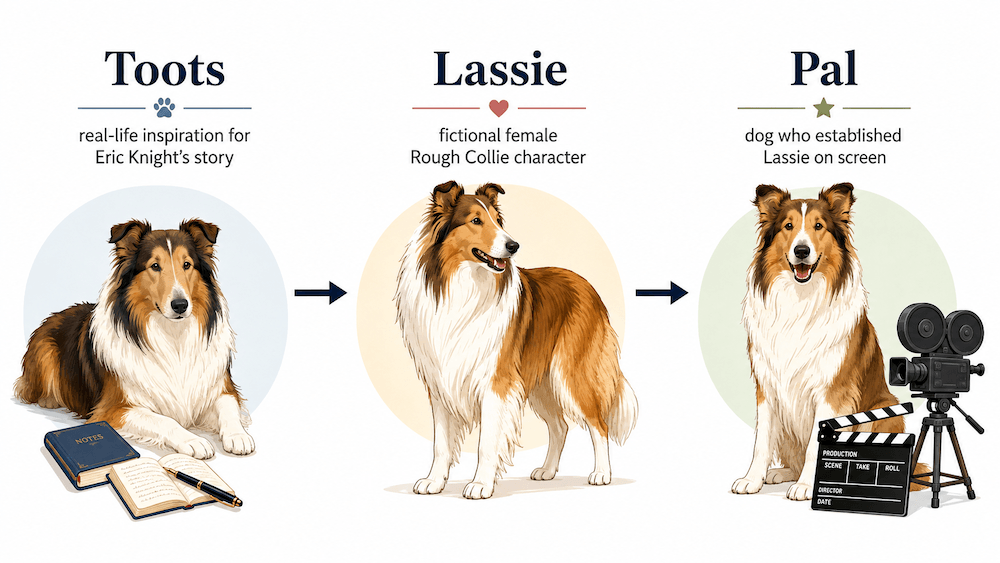
Yes, Lassie was partly inspired by a real Collie named Toots, who belonged to author Eric Knight. Knight’s affection for Toots helped shape the emotional core of the story, especially the ideas of loyalty, attachment, and a dog determined to return home.


It is important not to blur the roles of the dogs connected to Lassie. Toots helped inspire Knight’s original fictional story; Lassie is the fictional female Rough Collie character created from that idea, and Pal is the Rough Collie who later established Lassie’s famous screen image in the 1943 film. Keeping those three roles separate helps avoid one of the most common points of confusion around Lassie’s history.
Lassie, a Rough Collie, vs. Similar-Looking Breeds
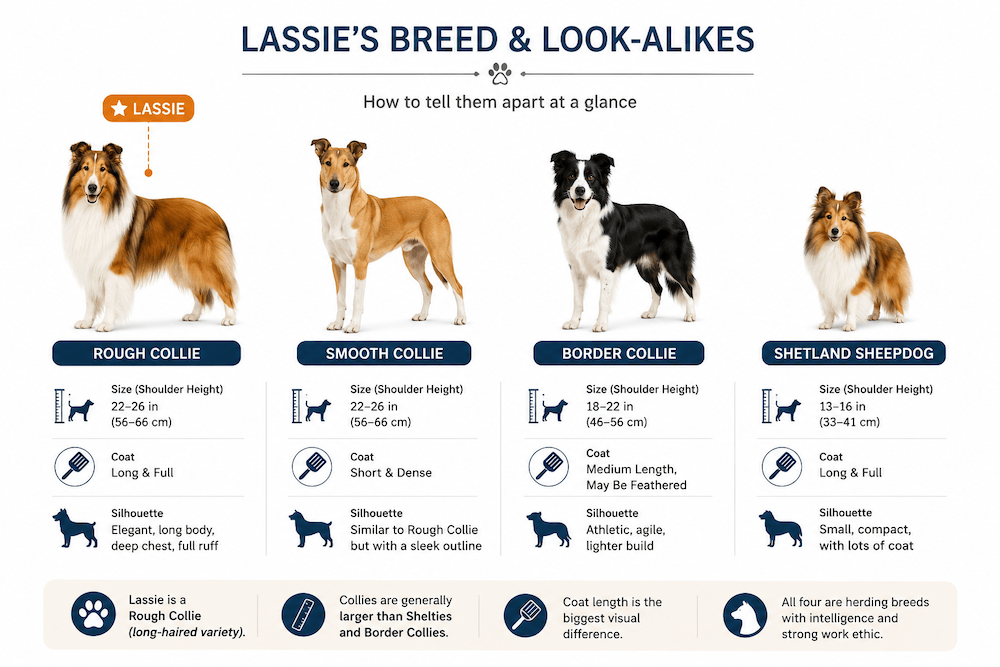
Lassie is a Rough Collie, recognizable by her long, full coat and distinctive Collie silhouette. Smooth Collies are similar in size but have much shorter coats, while Border Collies typically look more athletic and compact. Shetland Sheepdogs can closely resemble Rough Collies but are considerably smaller. These differences make coat, size, and overall build the easiest ways to tell them apart.
Who Was the Original Dog That Played Lassie?
The original dog who established Lassie on screen was Pal, a male Rough Collie owned and trained by Hollywood animal trainer Rudd Weatherwax. Pal starred as Lassie in MGM’s 1943 film Lassie Come Home, creating the canine screen character that audiences would recognize for decades.
Pal brought together the appearance and performance filmmakers wanted from Lassie. His distinctive sable-and-white coat, prominent white markings, and expressive face became the visual template later canine actors were expected to resemble.
How Pal Got the Role of Lassie
Pal was initially used for demanding action and stunt work during Lassie Come Home. His ability to handle challenging scenes and respond convincingly to Weatherwax’s training impressed the filmmakers, and he ultimately took over the starring role.


The decision proved important beyond a single movie. Pal’s performance helped transform Lassie from a successful literary character into one of Hollywood’s best-known canine figures.
The Famous “Lassie Look” Pal Established
Pal’s appearance became closely associated with the character and influenced how later Lassie dogs were selected.
This recognizable appearance became so closely linked with Lassie that a sable-and-white Rough Collie with similar markings may still remind people immediately of the famous character.
How Many Dogs Have Played Lassie?
Lassie has been portrayed by multiple canine actors, with the role famously passed through generations of Rough Collies descended from Pal. Pal himself appeared in the pilot episodes of the 1954 television series before his descendants took over the role.
For the original Lassie television series, the Pal-line succession was:
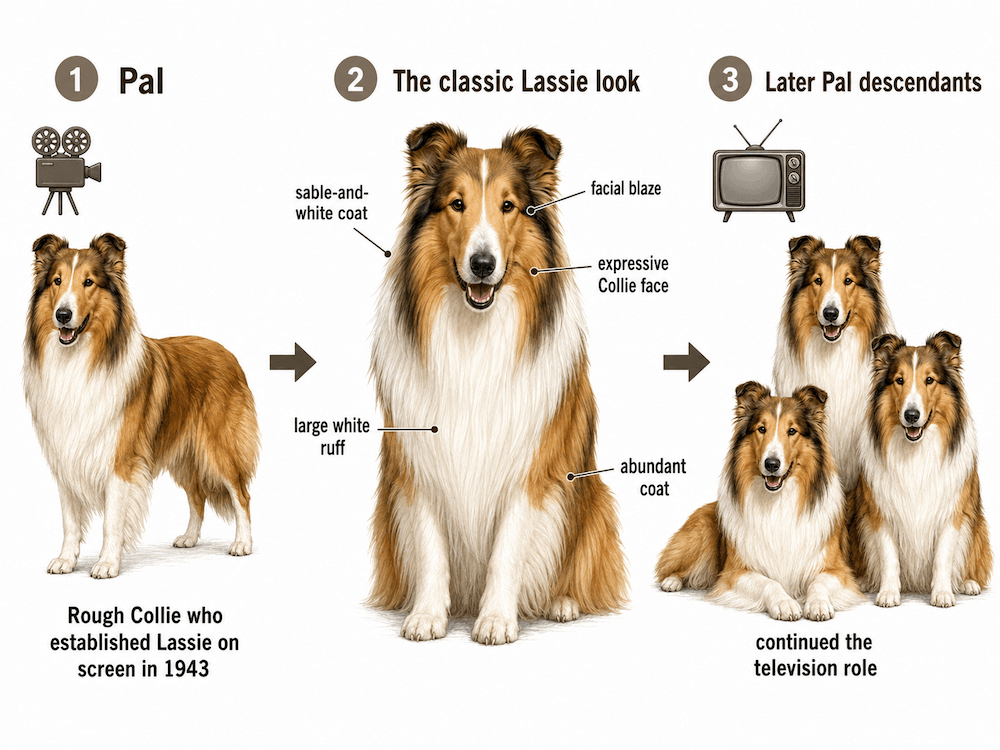
Pal’s family line also continued in later Lassie productions. Boy portrayed Lassie in the 1978 film The Magic of Lassie, while a later descendant known as The Old Man portrayed the character in The New Lassie television series. Howard, an eighth-generation descendant of Pal, starred in the 1994 film Lassie and later appeared in the 1997 television revival. Hey Hey II, a ninth-generation Pal descendant, subsequently portrayed Lassie during the final 13 episodes of that revival.
This long family connection helped filmmakers preserve the recognizable appearance and screen presence established by Pal, although not every dog to portray Lassie has descended from Pal. Later productions have sometimes used Rough Collies from other bloodlines.
Why Was Lassie Played by Male Dogs?
Lassie is a female character, but the dogs portraying her were usually male. Male Rough Collies can have a larger frame and fuller coat, which helped create the substantial, heroic appearance filmmakers wanted on screen. Pal established that visual standard in the 1943 film Lassie Come Home.
Using male dogs also made it easier for producers to preserve that established screen presence across later productions. The choice was primarily about appearance and continuity, not because the character herself was male.
Lassie vs. a Real Rough Collie: How Accurate Was the Character?
Lassie’s personality was not invented from nothing. Rough Collies are generally responsive, attentive, and people-oriented dogs, so the character’s loyalty and trainability have some basis in real breed tendencies. What television exaggerates is Lassie’s ability to interpret complex human situations, independently solve emergencies, and repeatedly carry out elaborate rescues.
| Trait | Lassie | Real Rough Collie |
|---|---|---|
| Loyalty | Extraordinary devotion in almost every situation | Often affectionate and strongly people-oriented |
| Intelligence | Understands remarkably complex situations | Intelligent, attentive, and responsive |
| Alerting | Frequently warns people of danger | Can be naturally alert and vocal |
| Trainability | Performs highly complex, almost human-like tasks | Generally responsive to consistent training |
| Sensitivity | Appears exceptionally tuned to human emotions | Often sensitive and attentive to people |
| Problem-solving | Independently solves elaborate emergencies | Capable learner, but still limited by canine cognition |
| Rescue ability | Repeatedly performs complex heroic rescues | Television greatly exaggerates this ability |
The most believable parts of Lassie are her loyalty, attentiveness, sensitivity, and responsiveness to training. The fictional character takes those genuine Collie qualities much further, giving Lassie human-like reasoning and independent rescue abilities that should be understood as storytelling rather than normal dog behavior.
The Rough Collie Dog Breed: Everything You Need to Know
The Rough Collie is more than the familiar dog associated with Lassie. It is a medium-to-large herding breed with a distinctive long coat, people-focused temperament, and several breed-specific health considerations prospective owners should understand.
What Does a Real Rough Collie Look Like?
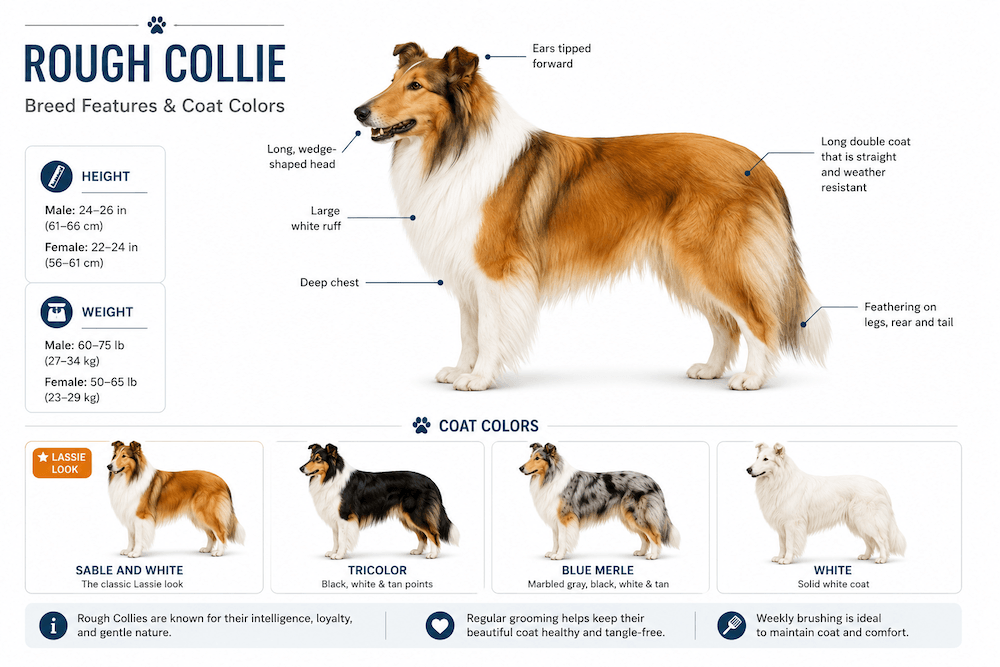
A Rough Collie is lithe, strong, and slightly longer than tall, with a deep chest and balanced proportions rather than a heavy or bulky build. The head is long and refined, forming a smooth, blunt wedge from the ears toward the nose, while the ears are carried mostly erect with the upper portion tipping forward when the dog is alert.
The breed’s most conspicuous feature is its long, abundant double coat, with especially heavy hair around the neck and chest and feathering along the legs and tail. Sable and white produces the classic “Lassie look,” but it is only one of four recognized Collie colors.
Is a Lassie-Type Rough Collie a Good Family Dog?
Rough Collies are generally affectionate, intelligent, responsive, and closely attached to their people. Their sensitive nature often makes calm, reward-based training a better match than harsh corrections, and they typically benefit from daily walks, play, training games, and other forms of mental engagement. They are active dogs, but most do not require the relentless workload associated with some higher-drive herding breeds.
Living with the long-coated variety also means accepting regular brushing, seasonal shedding, and some loose hair around the home. Collies can be naturally alert and vocal, so barking may need early management. Many live successfully with children, dogs, and cats, but early socialization, appropriate introductions, supervision around young children, and the temperament of the individual dog still matter.
| Category | Good Fit | May Be Less Suitable |
|---|---|---|
| Companionship | Wants an affectionate, involved family dog | Prefers a very independent dog |
| Training | Enjoys a responsive, trainable breed | Wants a dog needing little guidance |
| Exercise | Can provide daily activity and enrichment | Cannot meet regular activity needs |
| Grooming | Comfortable with brushing and coat care | Wants very low-maintenance grooming |
| Shedding | Can tolerate loose hair in the home | Needs a low-shedding breed |
| Barking | Okay with an alert, vocal dog | Needs a quieter breed |
| Children & Pets | Can supervise and socialize appropriately | Expects perfect behavior without management |
Rough Collie Health, Lifespan & Responsible Breeding
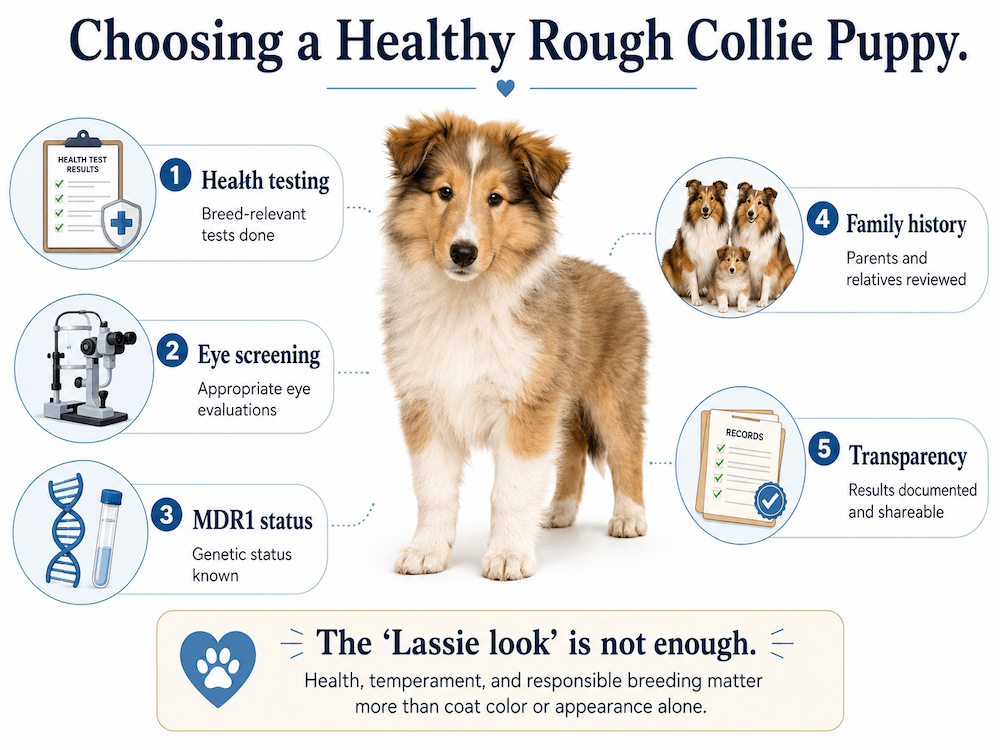
Rough Collies typically live about 10–14 years, with the breed club reporting a median around 12 years. Although Collies are generally considered healthy dogs, several inherited conditions are important enough that responsible breeding programs use eye examinations, DNA testing, pedigree information, and documented health results to make more informed breeding decisions.
Current Collie health programs specifically incorporate MDR1, PRA-rcd2, and DMS testing, while breed-health guidance also strongly emphasizes CEA assessment. Importantly, a health-test result is not simply a “pass or fail” label for every condition; responsible breeding involves understanding the results and pairing dogs appropriately while maintaining genetic diversity.
Before buying a Rough Collie puppy, ask the breeder for documented health results for both parents, not just verbal assurances that they are “healthy.”
How Lassie Made the Rough Collie Famous
Lassie transformed the full-coated Rough Collie into one of the most recognizable dog breeds in popular culture. Her sable-and-white coat, large white ruff, expressive face, and heroic screen presence became so familiar that generations of people began informally referring to Rough Collies as “Lassie dogs.”
The character also shaped how the public perceived the breed. Lassie became a symbol of loyalty, intelligence, courage, devotion, and the ideal family companion, qualities that remained strongly associated with Collies long after the character’s earliest films and television appearances. While some of Lassie’s abilities were clearly fictionalized, the cultural connection between the character and the Rough Collie became exceptionally strong.
Lassie’s influence extended well beyond dog enthusiasts. The character appeared across television, movies, books, comics, toys, and other merchandise and became recognizable internationally. Lassie’s enduring place in entertainment was further marked by a Hollywood Walk of Fame star in the Motion Pictures category, demonstrating how far the character had moved beyond being simply a famous fictional dog.
Interesting Facts About Lassie
Beyond the familiar movies and television programs, Lassie’s history includes several lesser-known connections to language, early cinema, and popular culture.
Frequently Asked Questions
The Bottom Line
Lassie was a fictional female Rough Collie, and the character helped turn the breed into one of the most recognizable dogs in popular culture. Eric Knight created Lassie as a symbol of loyalty and devotion, while Pal established the character’s famous sable-and-white appearance on screen. Although male Rough Collies usually portrayed Lassie, the character herself has always been female. Real Rough Collies can share some of Lassie’s attentiveness, sensitivity, intelligence, and trainability, but the extraordinary reasoning and rescue abilities shown on screen are fictional. Beyond their famous appearance, Rough Collies are affectionate family companions that require appropriate exercise, training, grooming, and socialization. Prospective owners should also understand breed-related health concerns and prioritize responsible breeding over simply finding a puppy with the perfect “Lassie look.” Ultimately, Lassie may have been a fictional hero, but the real Rough Collie remains an impressive breed in its own right.
Want to learn more about the dogs behind the Lassie look? Explore our complete Collie breed guide, compare Lassie with the highly energetic Border Collie, discover the smaller Lassie-like Shetland Sheepdog, or see where Collies appear in our guide to the smartest dog breeds.