
Why Do Dogs Have Whiskers? Do They Really Need Them?


Canine Bible is reader-supported. We receive affiliate commissions via some of our links. Learn more.
Dogs have whiskers because these specialized sensory hairs help them detect nearby objects, navigate their surroundings, and protect their eyes. Unlike ordinary fur, whiskers grow from specialized, nerve-rich follicles that help dogs detect touch and movement. Their position can also change with facial movements, offering subtle clues about a dog’s alertness and emotional state. Although whiskers generally grow back after trimming, removing them can temporarily reduce sensory input, while plucking them can cause pain. Understanding how whiskers work, why they matter, and what happens when they’re trimmed or shed can help you make better decisions about your dog’s grooming and overall well-being.
What Are Dog Whiskers and Where Are They Located?
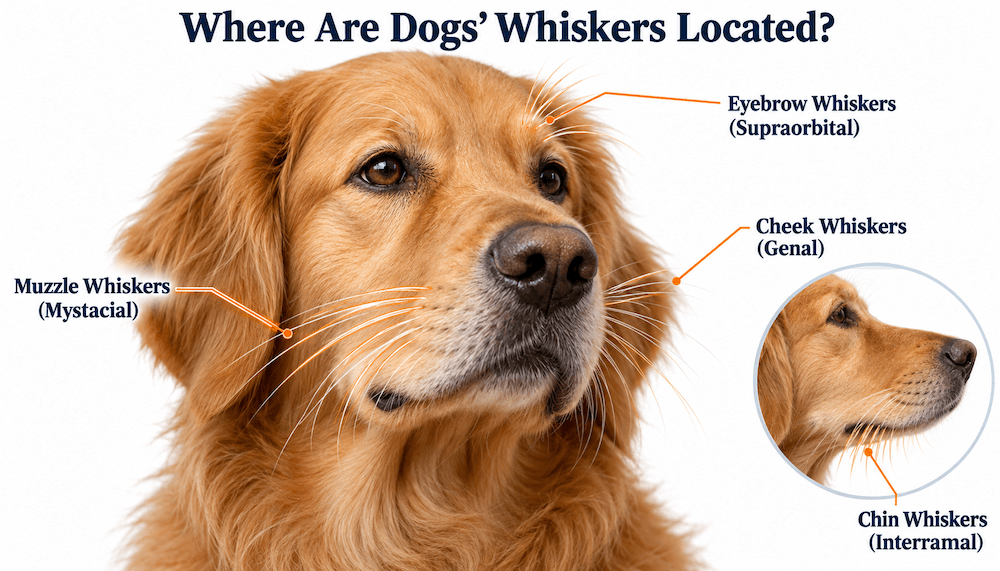
Dog whiskers, scientifically known as vibrissae, are specialized sensory hairs made of keratin, the same structural protein found in ordinary fur and nails. However, they are generally thicker, stiffer, and anchored in deeper, more complex follicles than regular coat hairs. Their arrangement across the face allows dogs to receive tactile information from several directions.
Different groups of whiskers have distinct anatomical names and locations. Recognizing these groups can help owners distinguish normal whisker growth from surrounding facial fur.
How Do Dog Whiskers Send Sensory Information to the Brain?
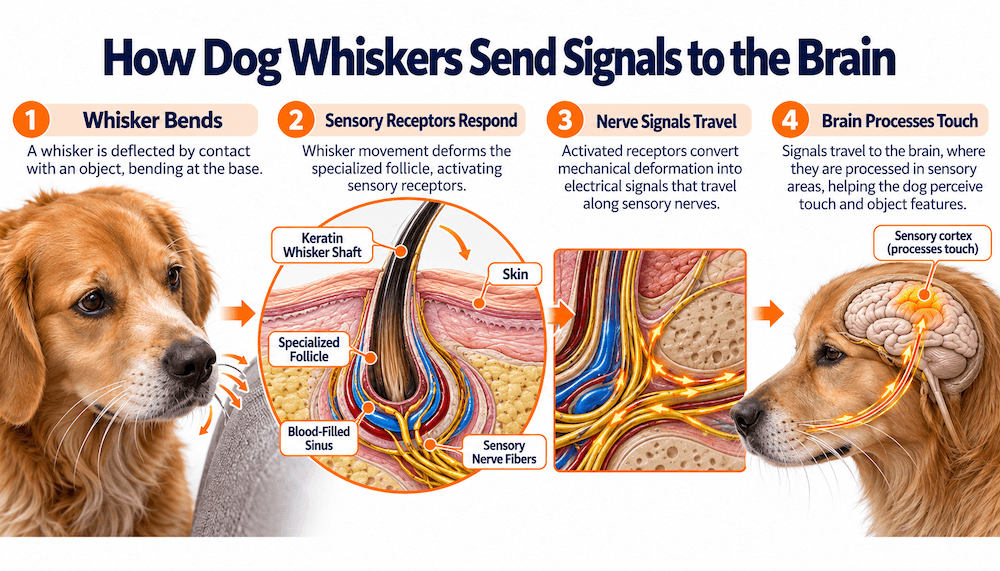
Whiskers work through mechanoreception, the process of detecting physical forces such as pressure, movement, and vibration. When a whisker bends, the movement is transferred to its follicle, where specialized sensory receptors respond to mechanical changes. Nerve signals then travel toward the brain, allowing the dog to process tactile information and respond when appropriate.


Unlike ordinary hair follicles, whisker follicles contain specialized blood-filled spaces and dense sensory innervation that support their sensitivity. The exposed whisker shaft itself does not contain nerves; the sensory structures are located beneath the skin. This distinction explains why touching or pulling a whisker can produce a noticeable response even though the hair shaft is not living tissue.
6 Important Functions of a Dog’s Whiskers
A dog’s whiskers serve several interconnected functions that support sensory awareness, physical protection, and everyday exploration. Their specialized structure allows dogs to gather information that vision, hearing, and smell cannot always provide on their own.
1. Detect Physical Contact and Touch
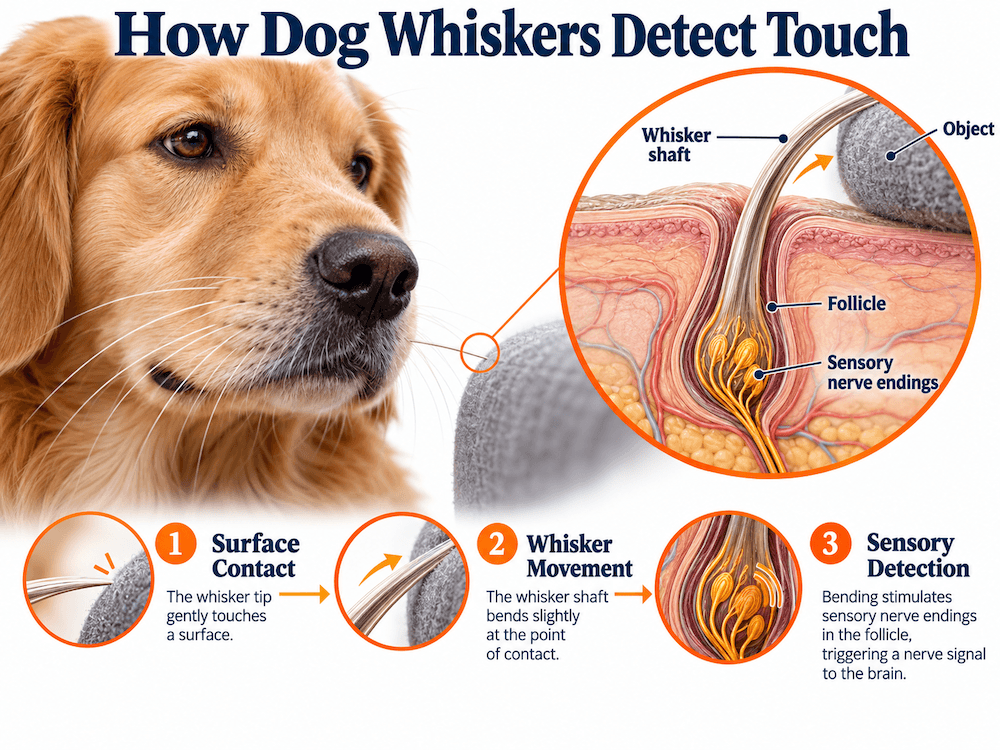
Dog whiskers function as highly sensitive touch detectors that respond when objects, surfaces, or other animals brush against them. Each whisker is anchored in a specialized follicle containing sensory nerve endings that detect movement of the hair. This allows dogs to notice light contact around their faces without needing the surrounding skin to touch an object directly.
2. Sense Subtle Changes in Air Movement
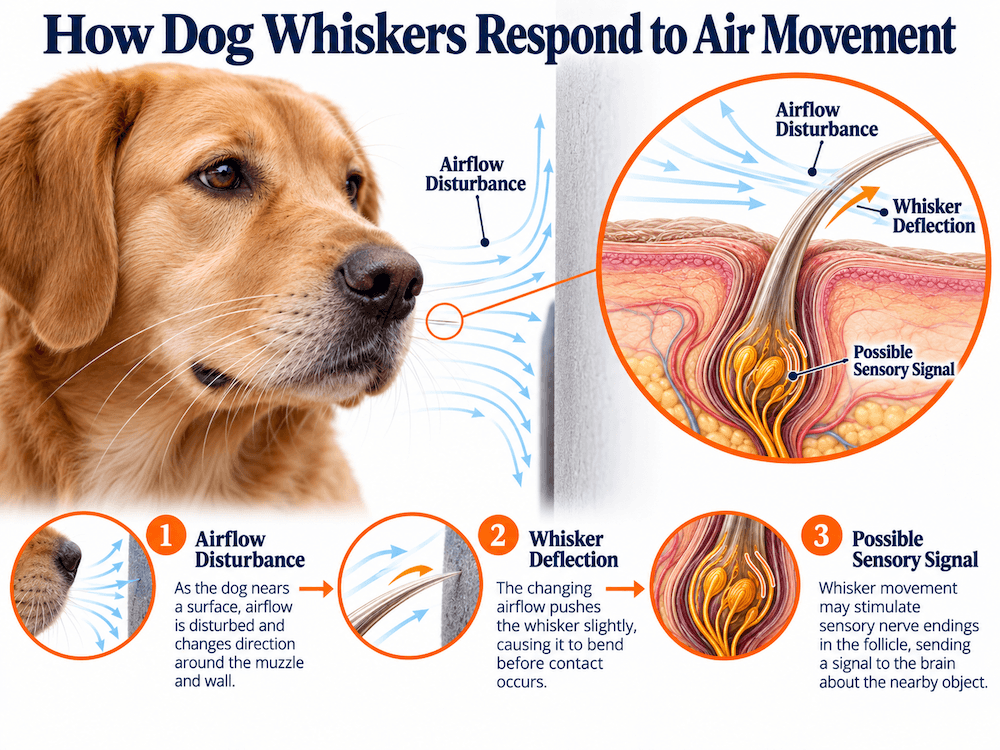
Whiskers may detect small changes in airflow when air moves around a dog’s face or is disturbed by nearby surfaces. These movements can slightly bend the whisker, stimulating its sensory follicle even without direct contact. This may give dogs additional information about nearby objects or movement, although the extent of this ability has not been established through controlled canine studies.


3. Protect the Eyes and Face From Injury
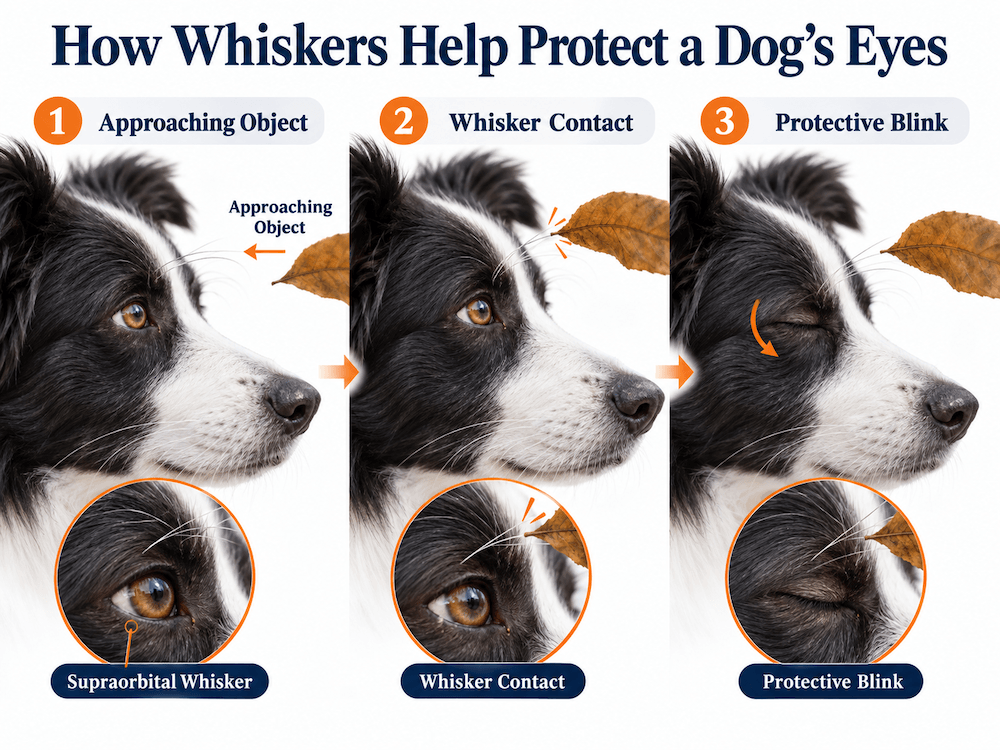
Whiskers provide a protective early-warning system when potentially harmful objects approach sensitive facial areas. Contact with whiskers above the eyes or around the muzzle can trigger a reflexive blink, helping protect the eyes from branches, debris, or other nearby obstacles. Dogs may also withdraw or turn their heads when facial whiskers encounter something unexpected.
4. Help Dogs Navigate Obstacles and Tight Spaces
Whiskers contribute to close-range spatial awareness by providing tactile feedback about objects surrounding a dog’s head. As a dog moves between furniture, explores narrow openings, or travels through unfamiliar surroundings, whisker contact can help it adjust its head position and avoid obstacles. This additional sensory information may be particularly useful when lighting is poor or a dog’s vision is impaired, although whiskers cannot replace eyesight.

5. Support Active Exploration of Unfamiliar Objects
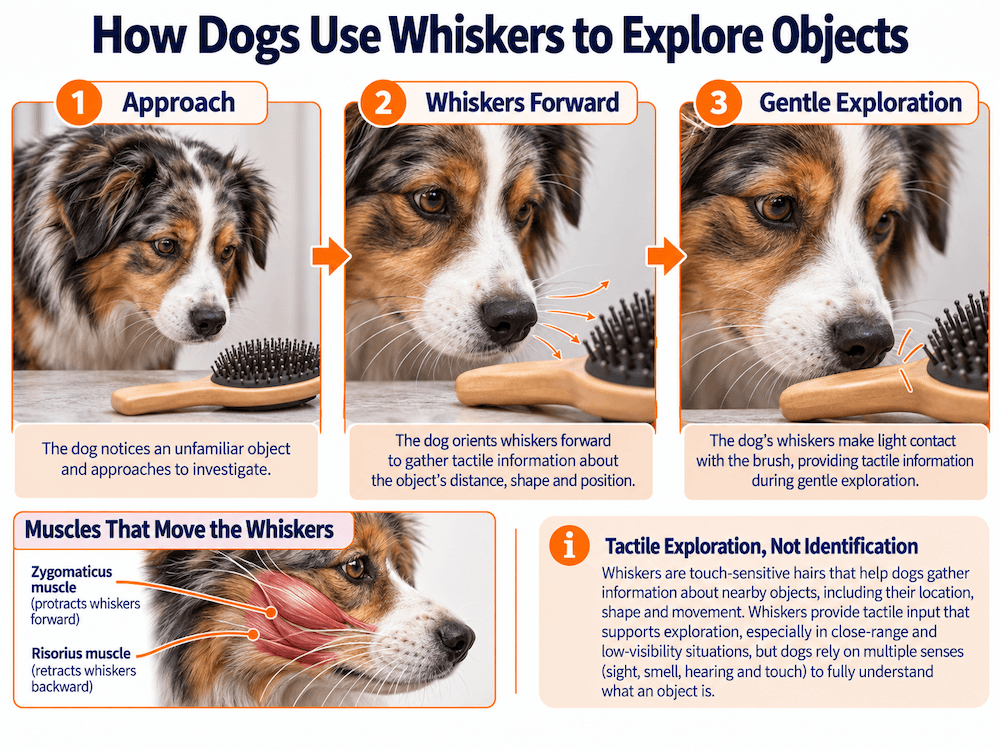
Dogs can move some of their facial whiskers forward during active tactile exploration, allowing them to investigate objects at close range. This movement is supported by specialized muscles associated with the whisker follicles, helping the hairs make contact with nearby surfaces. A dog examining an unfamiliar object may therefore gather tactile information in addition to smelling and looking at it, although how precisely dogs distinguish textures through their whiskers remains uncertain.
6. Help Locate Food and Objects Beneath the Muzzle
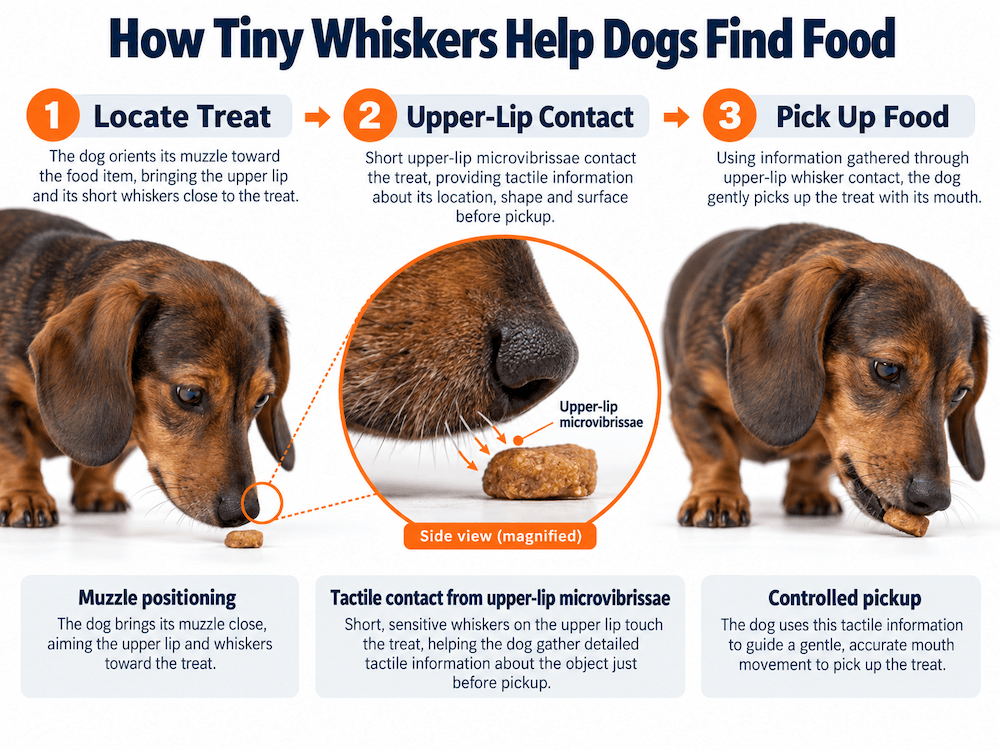
Small sensory hairs around the upper lip, sometimes called microvibrissae, help dogs investigate objects immediately beneath their noses. When a dog searches for a treat on the ground, these short whiskers may contact the food or surrounding surface before the dog picks it up. This additional tactile information is useful because the muzzle limits how clearly a dog can see objects positioned directly underneath it.
Do All Dogs Have the Same Number and Type of Whiskers?
All dogs normally develop whiskers, but their number, length, shape, and visibility vary depending on genetics, breed, age, and coat characteristics. These differences are generally normal and do not necessarily indicate how well a dog’s whiskers function.
| Factor | Typical Whisker Variation | What Owners Should Know |
|---|---|---|
| Dog size | Larger dogs may have longer, more prominent whiskers. | Length varies and does not precisely reflect body width. |
| Breed and genetics | Whisker number, thickness, and arrangement differ among dogs. | No single whisker pattern applies to every breed. |
| Curly-coated breeds | Whiskers may appear curved or hidden within facial fur. | Visibility alone does not determine sensory function. |
| Hairless breeds | Whiskers may be sparse, short, or less noticeable. | Appearance depends on the individual dog’s genetics. |
| Newborn puppies | Whiskers are present before the eyes open. | Sensory structures develop early in life. |
| Senior dogs | Whiskers may gradually change in color or appearance. | Gradual changes are not necessarily concerning. |
The important distinction is normal variation versus sudden change. Short, curved, or less visible whiskers can be perfectly normal, while unexpected widespread whisker loss, repeated breakage, or changes accompanied by skin irritation may warrant veterinary evaluation.
Can a Dog’s Whisker Position Reveal Its Mood?
Whisker movement can accompany changes in a dog’s facial expression, attention, or arousal. Some dogs direct their muzzle whiskers forward while investigating something, whereas the whiskers may appear less prominent when the face is relaxed. However, whisker position alone is not a reliable indicator of a particular emotion, and there is limited direct evidence establishing consistent emotional meanings for specific whisker movements.
When interpreting a dog’s emotional state, consider the ears, eyes, mouth, posture, movement, and surrounding situation together. A dog investigating a toy may have forward-directed whiskers without displaying fear or aggression. Whole-body language provides a more reliable interpretation than assigning a fixed meaning to an isolated facial feature.
What Happens if You Cut or Remove a Dog’s Whiskers?
Dog whiskers contain specialized sensory structures at their roots, so trimming and plucking have different consequences. Although accidental trimming is usually not a medical emergency, preserving healthy whiskers helps maintain normal tactile awareness.
Do Dog Whiskers Fall Out and Grow Back?
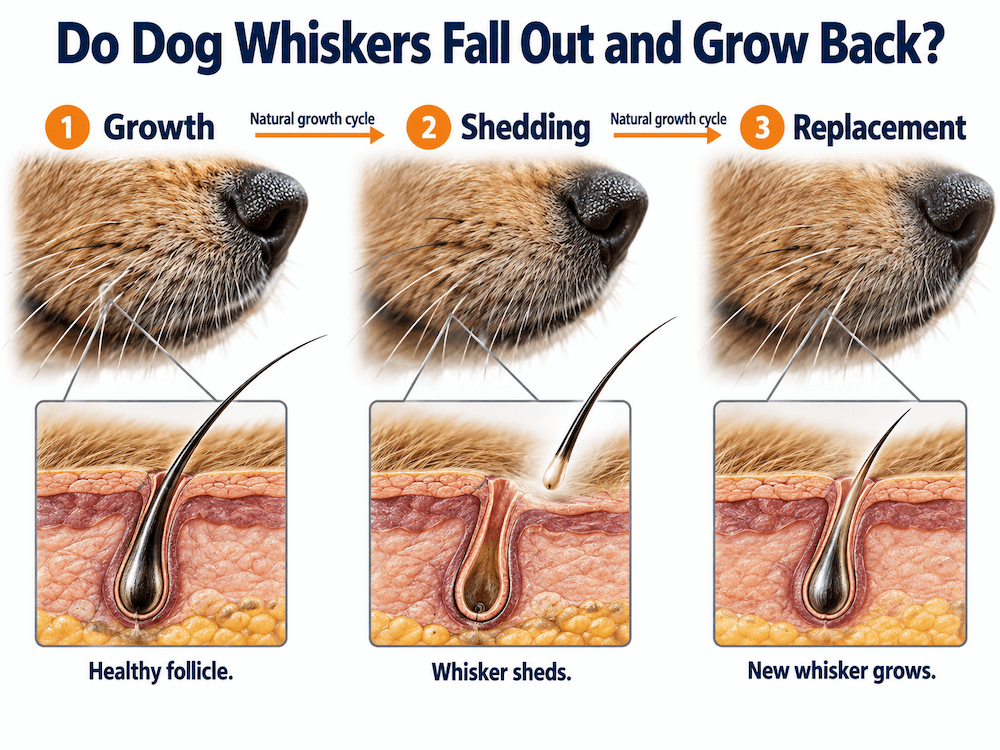
Yes, dog whiskers do naturally fall out and grow back. Like other hairs, whiskers follow a normal hair growth cycle, so it is not unusual to occasionally find a shed whisker without any other signs of a problem. In most cases, a single lost whisker is simply part of routine renewal.
Whisker regrowth usually takes several weeks because the new hair must develop from the follicle and gradually extend back to its full length. This process can vary based on the dog’s individual hair growth rate, overall health, age, and whether the follicle remained healthy after the whisker was lost. A whisker that was naturally shed or accidentally trimmed often returns over time, but repeated loss, broken whiskers, or skin irritation around the follicle deserves closer attention.
How to Protect Your Dog’s Whiskers During Grooming
Maintaining a clean, comfortable facial coat does not require sacrificing healthy whiskers. Whisker-conscious grooming focuses on cleaning and managing surrounding fur while preserving the sensory hairs whenever possible. The following approaches are particularly useful for dogs with long, curly, or easily matted facial coats.
| Grooming Situation | Helpful Approach | What to Avoid |
|---|---|---|
| Cleaning the muzzle | Gently wipe around whiskers using a soft, damp cloth. | Scrubbing against whisker growth or pulling individual hairs. |
| Trimming long facial fur | Ask your groomer to preserve visible sensory hairs. | Shaving whisker-bearing areas solely for a cleaner appearance. |
| Brushing facial hair | Use gentle strokes that follow the direction of hair growth. | Forceful brushing directly against sensitive whisker follicles. |
| Removing facial mats | Seek professional help for tight mats near whisker pads. | Cutting close to the skin with scissors. |
| Managing facial skin problems | Follow veterinarian-directed cleaning or clipping instructions. | Using unapproved chemicals or attempting to remove affected hairs. |
When Are Changes to Dog Whiskers Normal or Concerning?
Whiskers have a natural hair growth cycle, meaning that occasional shedding and replacement are expected. However, changes involving the surrounding skin or multiple whiskers deserve closer attention because they may indicate irritation, injury, or an underlying skin condition.
| Observation | Usually Less Concerning | More Concerning Signs |
|---|---|---|
| Whisker shedding | An occasional shed whisker without skin changes. | Sudden widespread whisker loss or associated bald patches. |
| Broken whiskers | One damaged hair with otherwise healthy surrounding skin. | Repeated breakage, inflammation, or extensive facial hair loss. |
| Whisker color changes | Gradual pigment changes as the dog ages. | Rapid changes accompanied by skin lesions or hair loss. |
| Skin around follicles | Smooth skin without tenderness, crusting, or discharge. | Redness, swelling, painful bumps, crusts, or pus. |
| Facial sensitivity | A brief response to unexpected whisker contact. | Persistent pain, repeated face rubbing, or reluctance to eat. |
Seek emergency veterinary care if your dog develops severe facial swelling with breathing difficulty, experiences significant facial trauma, or suffers a serious eye injury. Persistent eye closure, severe eye pain, or sudden vision changes also require urgent veterinary assessment, ideally the same day. During the examination, your veterinarian may assess the facial skin, whisker follicles, and surrounding tissues, check eye health when appropriate, and recommend diagnostic tests based on the findings.
The Science Behind Dogs’ Whiskers
Scientific studies support the sensory importance of canine whiskers, particularly in touch detection, protective reflexes, and close-range exploration. However, research on navigation, whisker trimming, and other proposed functions remains limited. The following evidence summarizes key findings and their limitations.
| Study / Source | Key Findings | Limitations / Takeaway |
|---|---|---|
| Scientific Reports (2025) | Documented touch responses, protective blinking, whisker movement, and sensory nerve structures. [1] | Small behavioral sample; supports whiskers as functional sensory organs. |
| PLOS One (2026) | Examined 44 dogs and identified complex, densely innervated whisker follicles. [2] | No evidence of breed-related sensory reduction; trimming effects remain unmeasured. |
| Veterinary Research Communications (2024) | Tested artificial whisker extensions in 14 blind dogs navigating a maze. [3] | Completion times improved, but collisions increased; benefits remain uncertain. |
| VCA Animal Hospitals | Describes whiskers as sensitive structures supporting awareness, navigation, and protection. [4] | Veterinary guidance, not a controlled study; some proposed functions need investigation. |
Frequently Asked Questions
The Bottom Line
Dog whiskers are specialized sensory hairs that play an important role in how dogs experience their surroundings. They help detect physical contact, navigate nearby obstacles, explore unfamiliar objects, and protect sensitive areas of the face. Located around the muzzle, eyebrows, cheeks, and chin, these whiskers provide valuable tactile information that complements a dog’s other senses. Although whisker length, shape, and appearance vary among dogs, their sensory function remains important. Accidental trimming is usually not harmful in the long term, but cutting or plucking whiskers unnecessarily can interfere with normal sensation or cause discomfort. Occasional whisker shedding is natural, while sudden widespread loss or associated skin irritation may require veterinary attention. By preserving your dog’s whiskers during grooming and recognizing unusual changes, you can help protect their comfort and sensory awareness.
Sources
- The canine vibrissal system as a highly innervated and functional sensory organ
- Histomorphological and ultrastructural analysis of vibrissal follicle-sinus complexes in the dog (Canis lupus familiaris)
- Supplemental vibrissal extensions as an alternative to improve the tactile sensitivity of blind dogs – a preliminary approach investigation
- Why Do Dogs Have Whiskers?