
What Kind of Dog Is the Target Dog? A Bull Terrier? (The Truth)

Canine Bible is reader-supported. We receive affiliate commissions via some of our links. Learn more.
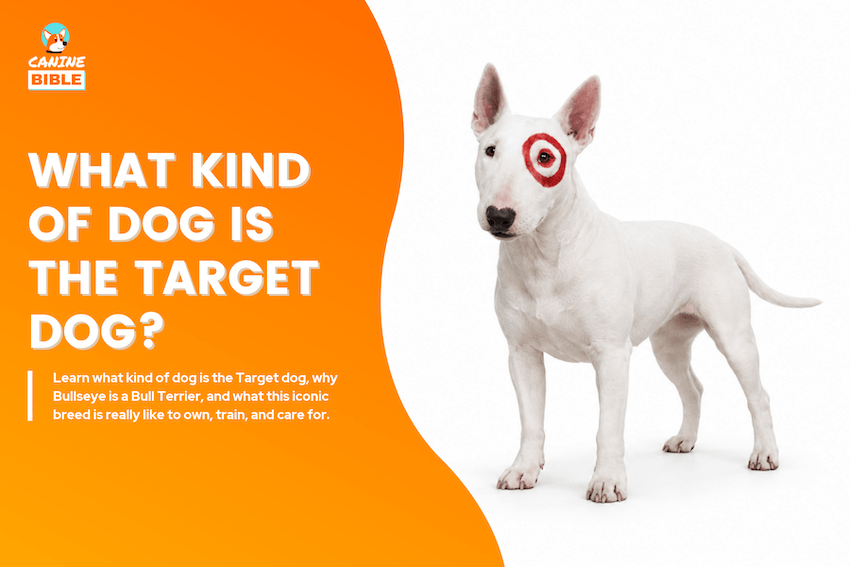
If you have ever spotted Target’s famous white dog with the red bullseye around one eye, you may have wondered what breed is behind the retailer’s instantly recognizable mascot. Its distinctive egg-shaped head, compact build, and playful appearance offer a strong clue. The Target dog, known as Bullseye, is a Bull Terrier, a breed famous for its unique head shape, muscular body, and lively personality. But Bullseye is more than just a recognizable advertising character, and the dogs portraying the mascot have an interesting history of their own. You may also wonder whether the red marking around Bullseye’s eye is natural, how many dogs have played the role, or whether Bull Terriers typically look and behave like the Target dog. The breed’s temperament, care needs, and physical traits can also be quite different from what a polished commercial mascot might suggest. Below, we’ll explore Bullseye’s breed, background, appearance, personality, and the facts behind one of America’s most recognizable canine mascots.
What Kind of Dog Is the Target Dog? History & Origin
The Target dog is Bullseye, a white Bull Terrier recognizable by the breed’s egg-shaped head, erect ears, muscular body, and the red Target symbol around the left eye. Bullseye first appeared in Target’s 1999 “Sign of the Times” campaign, which featured a white Bull Terrier with the Target logo positioned over the left eye. The character caught on quickly, moving into additional print, web, direct-mail, GiftCard, and merchandise appearances during the same period.
The mascot became even more prominent after the 2003 “See. Spot. Save.” campaign and subsequently appeared at store openings, promotional events, and red carpets. Bullseye remains part of Target’s corporate identity decades after the original campaign.
What Does the Target Dog Look Like?
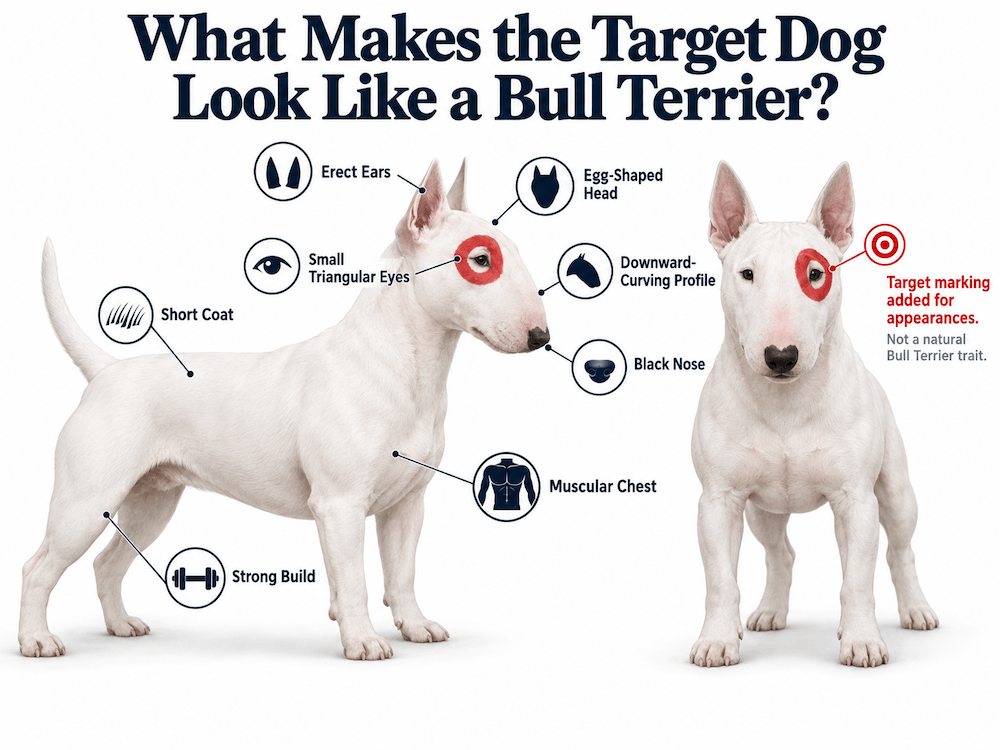
Bullseye’s appearance is largely genuine Bull Terrier anatomy rather than costume or digital alteration. The long, curved head profile, small triangular eyes, erect ears, short coat, and powerful body are all distinguishing features of the breed.


Why Does Bullseye Have a Target Around His Eye?
The red-and-white bullseye is not a natural Bull Terrier marking. For appearances, it has been applied by a professional makeup artist using removable, non-toxic vegetable-based paint. That distinction matters if you are comparing Bullseye with a pet Bull Terrier: a real dog does not naturally grow a perfectly circular Target logo around one eye.
Is Bullseye a Typical Bull Terrier?
Physically, Bullseye is a strong representation of the white Bull Terrier variety. The biggest artificial feature is the branded eye marking; personality is harder to compare because advertising presents Bullseye as a deliberately polished character rather than an ordinary household dog. Real Bull Terriers can be affectionate and entertaining but may also be energetic, independent, and strong-willed.
| Trait | Bullseye | Typical Bull Terrier |
|---|---|---|
| Breed | Bull Terrier | Bull Terrier |
| Coat | Solid white | White or colored varieties |
| Head | Distinctive egg shape | Defining breed feature |
| Eyes | Small and triangular | Characteristically small and triangular |
| Ears | Small and erect | Small and naturally erect |
| Build | Compact-looking and muscular | Powerful, muscular, and substantial |
| Personality | Portrayed as friendly and playful | Often playful, devoted, energetic, and independent |
| Eye Marking | Added Target logo | Not a natural breed marking |
The Target Dog, a Bull Terrier vs. Similar-Looking Breeds
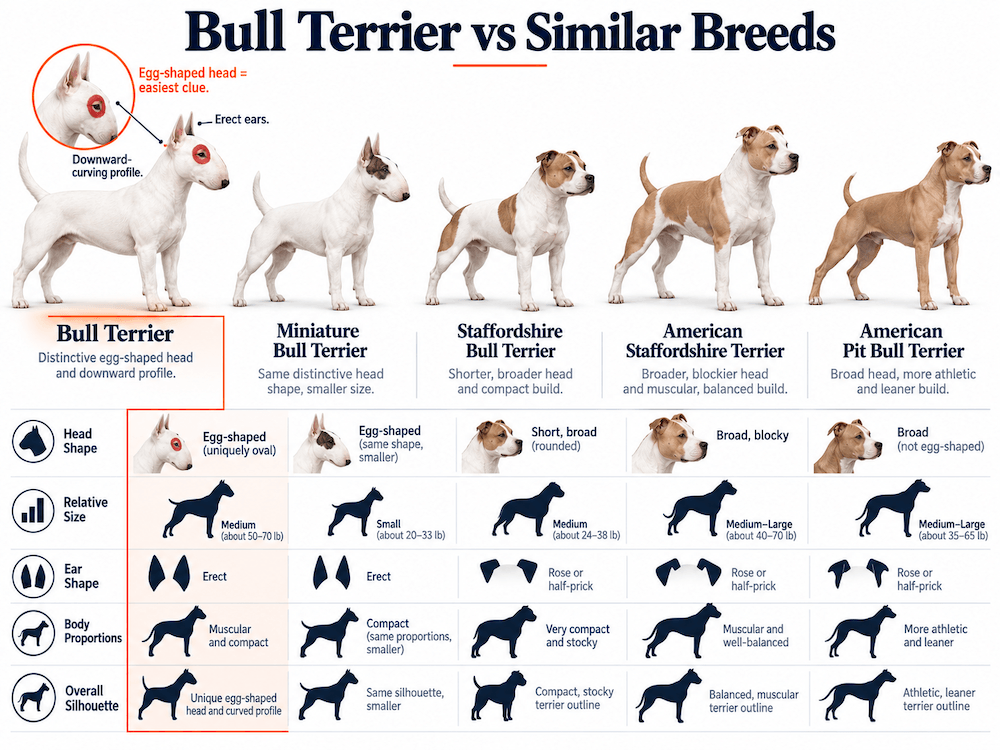
Several compact, muscular terrier and bully breeds are confused with Bull Terriers, but head shape is the easiest clue. The standard Bull Terrier and Miniature Bull Terrier share the unmistakable egg-shaped profile, while Staffordshire-type dogs have broader, more conventionally shaped canine heads.


The Bull Terrier Dog Breed: Everything You Need to Know
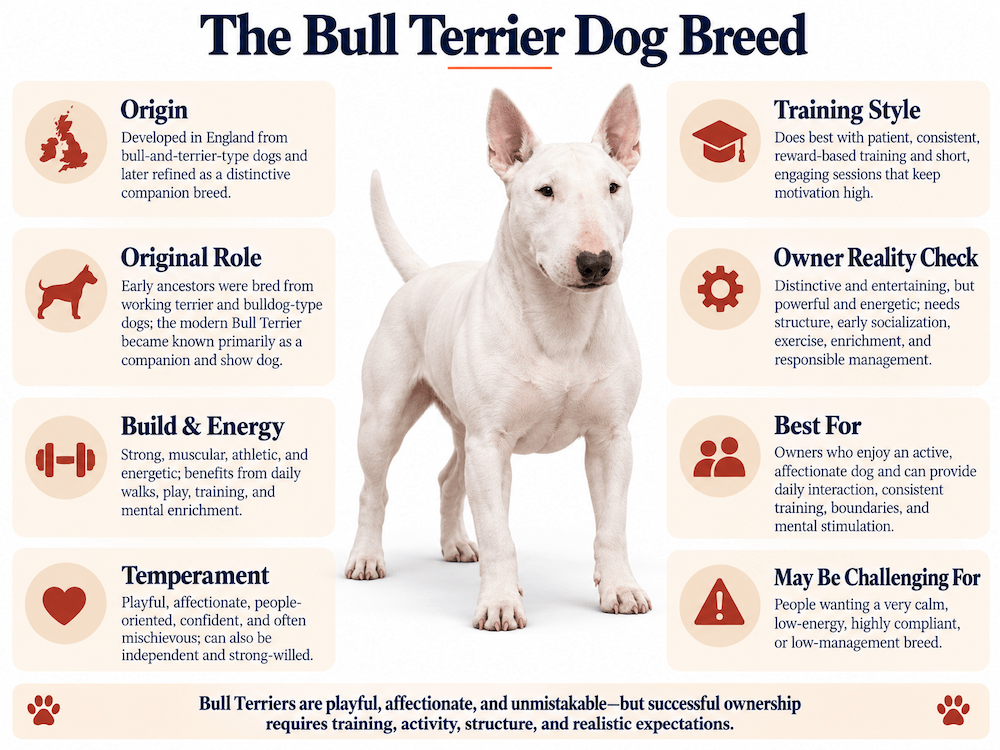
Bull Terriers developed from earlier bull-and-terrier dogs and eventually became distinctive companion and show dogs with a recognizable head shape unlike virtually any other breed. Modern adult Bull Terriers commonly stand around 21–22 inches tall and weigh about 50–70 pounds, although individual dogs vary.
They combine substantial physical strength with a playful, people-oriented personality. That combination can be extremely entertaining in the right household, but prospective owners should choose the breed because its real exercise, training, and management needs suit their lifestyle—not simply because they like Bullseye.
Is a Bull Terrier a Good Family Dog?
A well-socialized Bull Terrier can be an affectionate family companion, but suitability depends on the household and the individual dog. Their strength, enthusiasm, and independent streak mean they generally fit best with owners prepared to provide structure, interaction, exercise, and supervised introductions.
| Category | Good Fit | May Be Challenging |
|---|---|---|
| Companionship | Wants an involved, affectionate companion | Dog routinely spends long periods alone |
| Children | Can supervise respectful interactions | Expects completely hands-off management |
| Other Dogs | Can manage careful introductions | Needs guaranteed compatibility with every dog |
| Training | Enjoys consistent reward-based training | Wants effortless obedience |
| Exercise | Can provide daily activity and play | Wants a consistently low-energy dog |
| Personality | Enjoys lively, humorous dogs | Prefers an especially quiet temperament |
| Grooming | Comfortable with basic coat care | Needs a virtually non-shedding breed |
Bull Terrier Temperament & Personality
Breed tendencies are useful expectations, not guarantees. Genetics, socialization, learning history, health, age, and individual personality all influence how a particular Bull Terrier behaves.
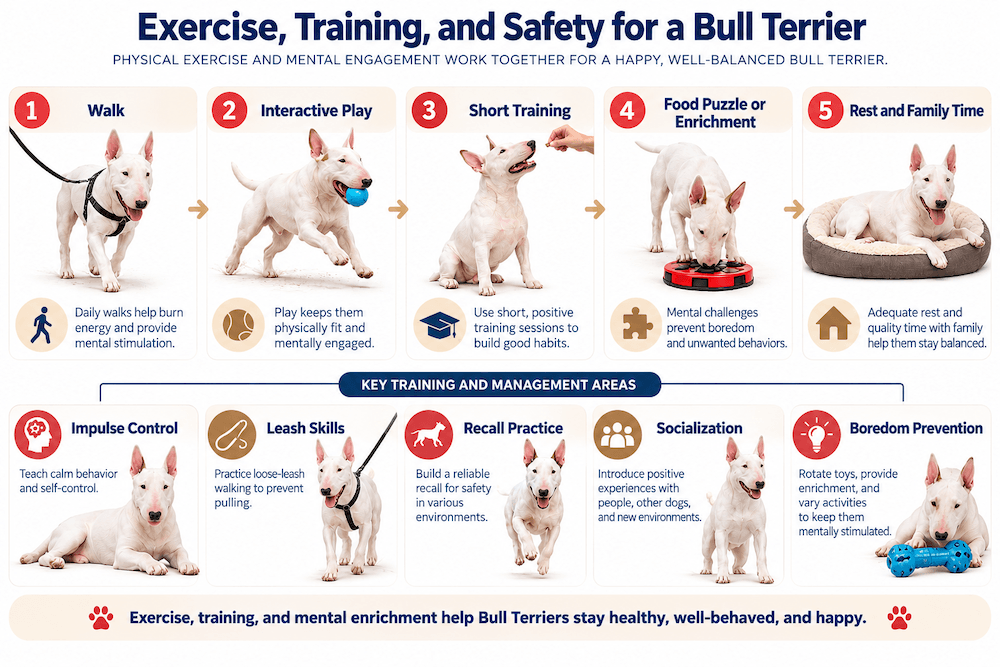
Bull Terrier Exercise, Training & Mental Stimulation
Exercise works best when it combines walking, play, training, and mental enrichment through activities like interactive dog toys, rather than relying on repetitive physical exertion alone. Short, engaging reward-based training sessions can be especially useful for a breed that may lose interest when exercises become monotonous.
Bull Terrier Health, Lifespan & Responsible Breeding
Bull Terriers can live long, active lives, but responsible breeding matters because several inherited or breed-associated conditions warrant screening. Health testing does not guarantee a disease-free puppy, but it improves the information available when breeding decisions are made.
Typical Bull Terrier Lifespan
A general expectation is around 12–13 years. A large 2024 UK dataset separately reported a median survival of about 12 years for Bull Terriers, reinforcing that lifespan is a population estimate rather than a deadline for any individual dog.
Genetics, body condition, preventive veterinary care, accidents, dental health, chronic disease, and lifestyle can all influence how long dogs live.
Important Bull Terrier Health Concerns
Not every Bull Terrier will develop these conditions, and a health concern cannot be diagnosed from breed alone.
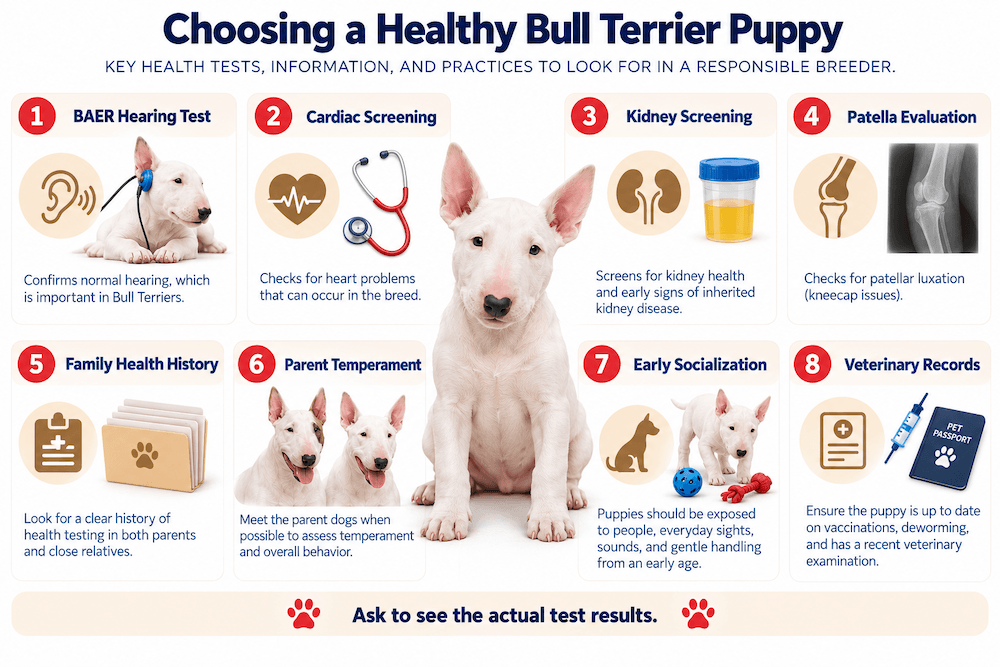
Choosing a Healthy Bull Terrier Puppy
A responsible breeder should be willing to show actual health-screening results, not simply say that the parents were “vet checked.” Hearing, cardiac, kidney, and patellar screening are particularly relevant to this breed. Temperament and puppy-rearing practices matter too. Look for puppies raised with proper puppy socialization and everyday household exposure, and ask about the health and behavior of parents and close relatives.
The Real Dogs Behind Bullseye
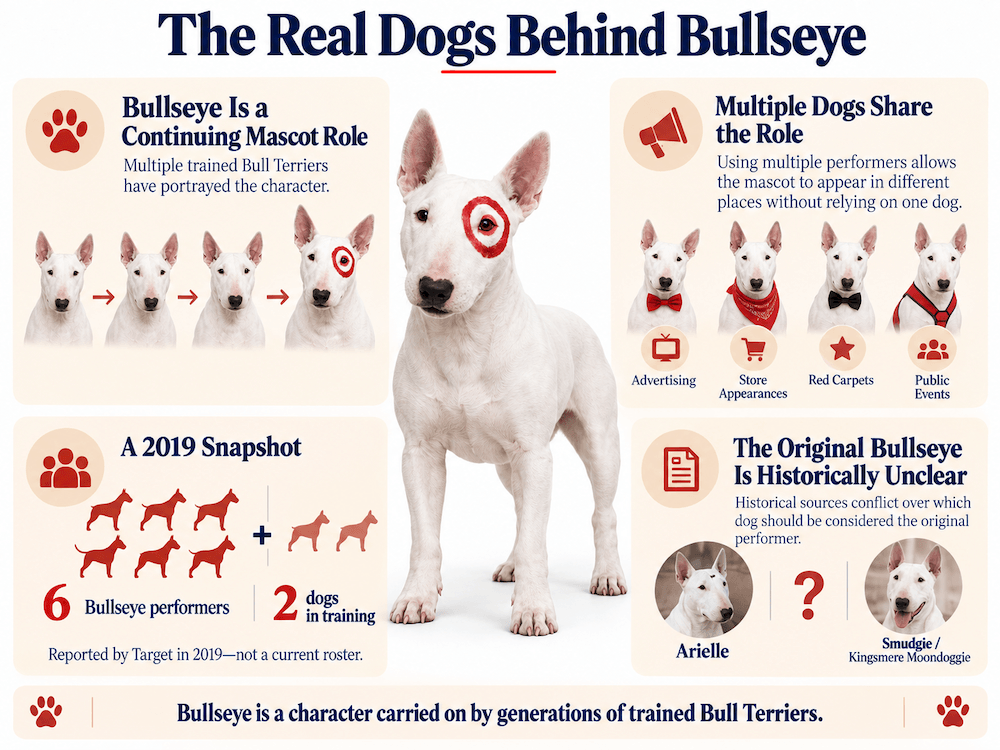
Bullseye is a continuing mascot role portrayed by multiple trained white Bull Terriers, not one unusually long-lived dog. In 2019, six dogs were reported as active performers with two more in training, though that count should not be treated as the current roster. Records about the original 1999 performer are inconsistent, with some identifying Arielle and others naming Kingsmere Moondoggie (“Smudgie”), so neither should be presented as definitively first.
How Bullseye Became a Target Icon
Bullseye’s significance goes beyond appearing in one successful commercial. After the 1999 debut, the character expanded into other advertising channels and merchandise, while the 2003 “See. Spot. Save.” campaign strengthened the association between the dog and the Target brand.
The mascot eventually appeared at events, store openings, on GiftCards, in plush form, and throughout Target’s in-store and digital branding. Newer Target-branded toys and merchandise continue to use Bullseye, showing how the character moved from an advertising device into a long-running brand identity.
Interesting Facts About Bullseye
Frequently Asked Questions
The Bottom Line
Bullseye, the famous Target dog, is a white Bull Terrier known for the breed’s unmistakable egg-shaped head, erect ears, muscular build, and playful expression. The red Target logo around Bullseye’s eye is added for appearances and is not a natural coat marking. Since debuting in 1999, Bullseye has been portrayed by multiple trained Bull Terriers rather than one dog continuously filling the role. Real Bull Terriers can share the mascot’s lively, affectionate personality, but they are also strong, energetic dogs that benefit from consistent training and daily engagement. Prospective owners should also understand the breed’s exercise, socialization, and health-screening needs before bringing one home. Bullseye may be one of advertising’s most recognizable canine mascots, but the real Bull Terrier behind the image is a distinctive breed with needs that extend far beyond its famous appearance.