What Do Dogs See? 12 Dog Vision Examples & How Their Eyesight Works


Canine Bible is reader-supported. We receive affiliate commissions via some of our links. Learn more.
Dogs see the world in fewer colors than humans, mostly in shades of blue, yellow, gray, and muted tones. They do not see only in black and white, but they also do not see the full rainbow of colors people can. What dogs lack in color detail, they make up for with strong motion detection, better low-light vision, and a wider field of view. This means your dog may notice a squirrel moving across the yard before you do, but may not easily tell a red toy from green grass. Their vision also changes with age, breed, lighting, distance, and certain eye conditions. Understanding what dogs see can help explain how they play, navigate, recognize people, react to shadows, and sometimes miss things right in front of them.
How Dogs See the World: Key Vision Facts
| Key Vision Fact | What It Means for Your Dog |
|---|---|
| Limited colors | Dogs mainly see blues, yellows, grays, and muted shades instead of the full color range humans see. |
| Not black and white | Dogs do see color, but their vision is closer to red-green color blindness in humans. |
| Motion focused | Dogs notice movement quickly, which helps them spot running animals, bouncing toys, or shifting shadows. |
| Better in dim light | Dogs often see better than people in low light, especially around dawn, dusk, and nighttime. |
| Wider view | Many dogs can see more to the sides than humans, though this depends on breed and head shape. |
| Less fine detail | Dogs may not see sharp details or distant still objects as clearly as people do. |
| Eye health matters | Cloudiness, redness, squinting, bumping into objects, or sudden vision changes should be checked by a vet. |
How Dog Eye Anatomy Shapes What They See
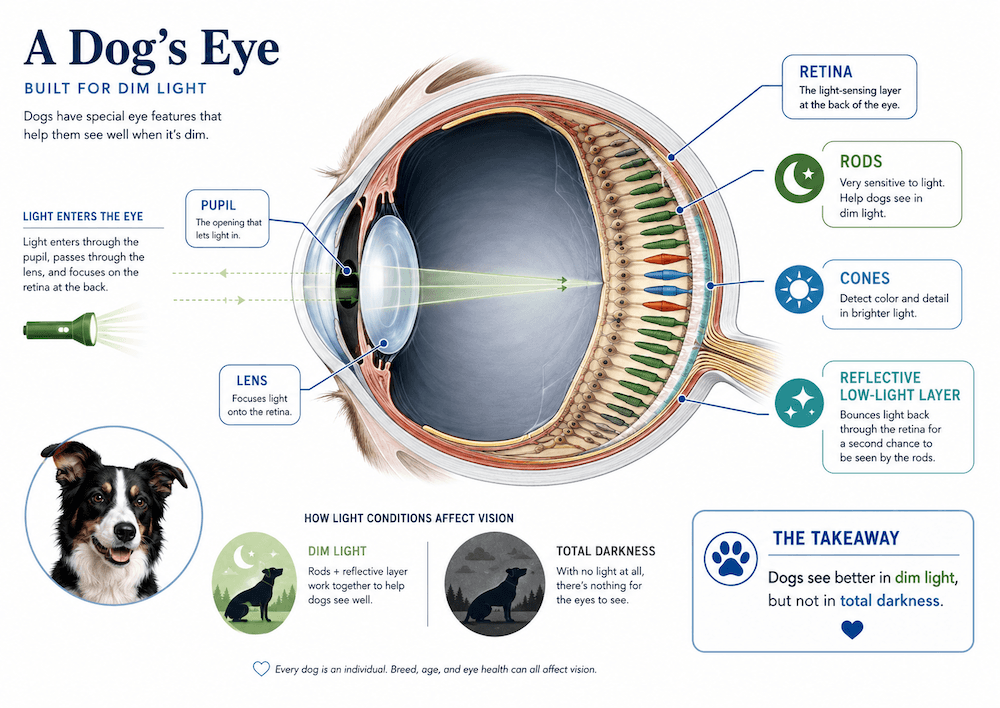
A dog’s eye is designed to gather light, focus it, and send visual information to the brain quickly. The cornea, pupil, lens, retina, rods, cones, and tapetum lucidum all help shape what a dog notices in daily life.
The retina is where light information is processed before it travels through the optic nerve. Rods support light sensitivity and quick visual detection, while cones help with color information. Dogs have a visual system that favors practical environmental awareness over human-style fine color separation.
Eye placement also matters. Dogs with different head shapes may have different visual fields, which can influence how much they see to the sides and how much both eyes overlap in front.
| Eye Part | What It Does | Why It Matters |
|---|---|---|
| Pupil | Controls how much light enters the eye. | Helps dogs adjust to changing brightness. |
| Lens | Focuses light onto the retina. | Supports clearer object and shape detection. |
| Retina | Processes light before signals reach the brain. | Turns visual scenes into usable information. |
| Rods | Help detect light changes and movement. | Support quick awareness in changing scenes. |
| Cones | Help process color information. | Give dogs a limited but useful color range. |
| Tapetum lucidum | Reflects available light inside the eye. | Helps dogs use dim light more efficiently. |
| Eye placement | Affects side vision and front overlap. | Varies with breed and head shape. |
What Dogs See Compared With Humans
Dogs and humans both use their eyes to gather light, focus images, and send visual information to the brain. The difference is in what each species is optimized to notice. Human vision is excellent for fine detail, reading, facial detail, and a broad range of color. Dog vision is more attuned to movement, low-light awareness, and environmental scanning.
This difference can affect training, play, and safety. For example, a hand signal given in a cluttered background may be less obvious than a large, clear gesture. A toy that blends into the yard may be harder to find than one with strong contrast. An aging dog may need more verbal cues, scent cues, and environmental support than they did as a puppy.
It also explains why dogs do not rely on vision alone. They combine sight with smell, hearing, touch, memory, and routine. A dog may recognize your walk, voice, scent, and posture before they clearly see your face. That multi-sensory approach is one reason many dogs adapt surprisingly well to gradual vision loss.
Dog Vision Examples
Dogs see the world in a way that is practical, not picture-perfect. Everyday situations like spotting a toy in grass, following movement, judging stairs, or noticing a person from far away can help explain why dogs sometimes react quickly to one thing but miss another. The visual examples below show how color, contrast, motion, distance, and detail can change what stands out to a dog compared with what stands out to us.


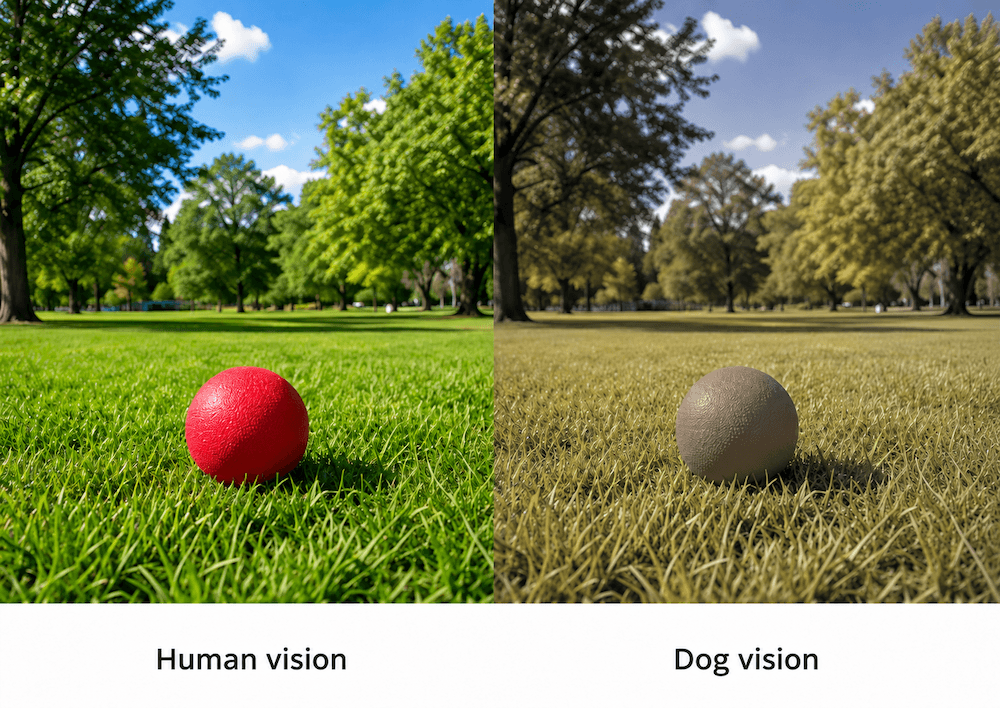
A red toy may look easy for people to spot in green grass, but it can appear more muted to dogs. For dogs, color contrast is often less helpful when red and green tones look more similar.
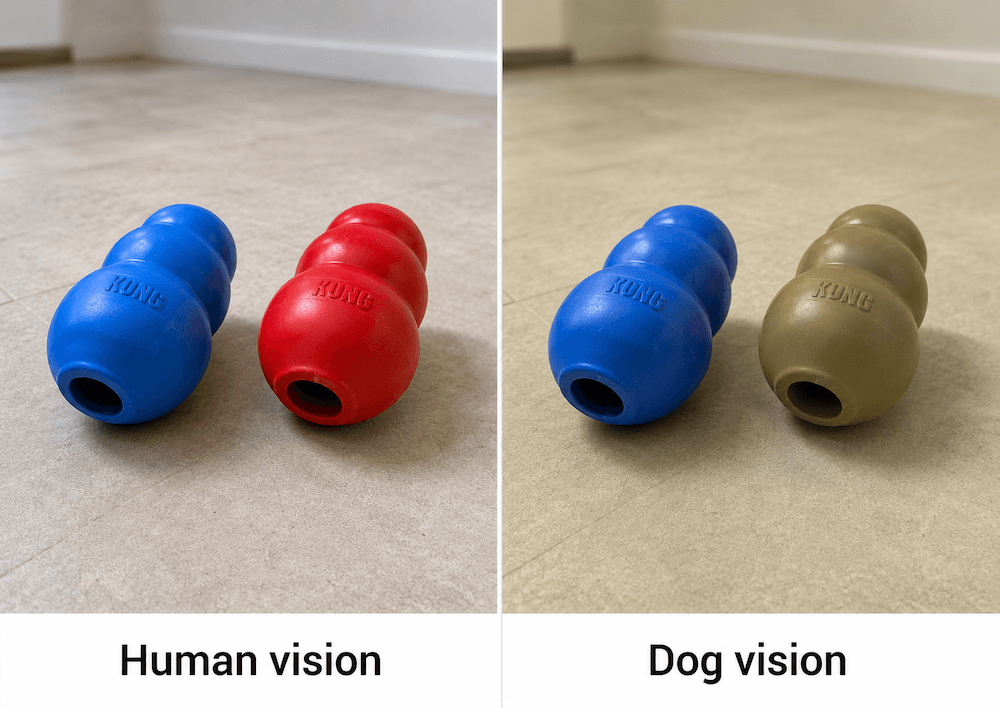
Blue toys often stand out more clearly to dogs than red toys. This is because dog color vision is strongest in the blue-yellow range.
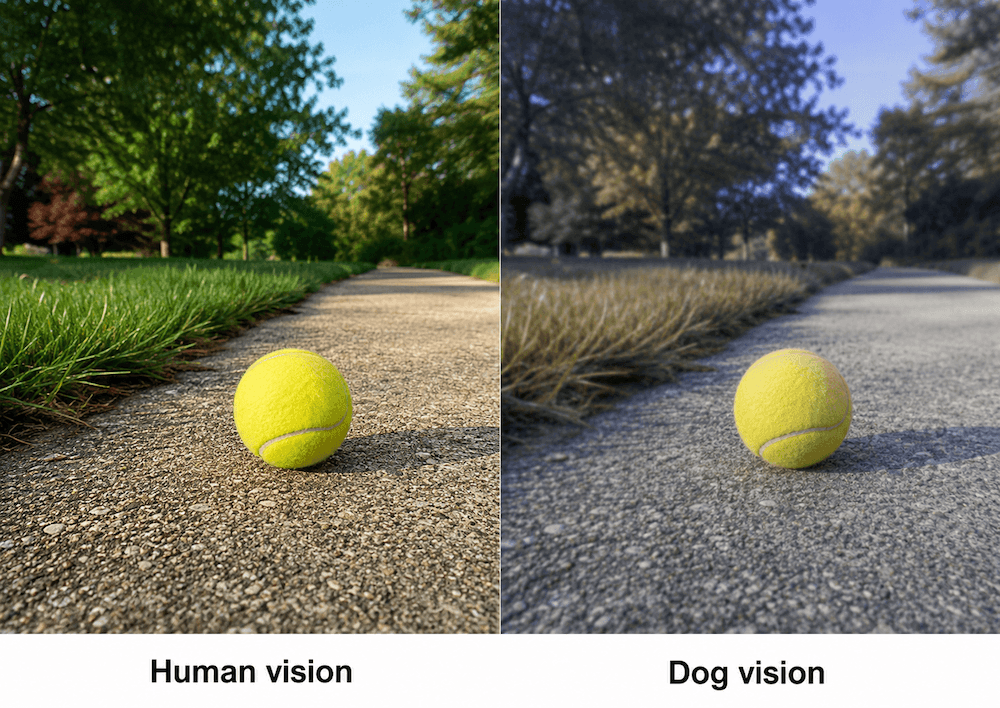
A yellow tennis ball can remain fairly visible to dogs, especially outdoors. Yellow tones are generally easier for dogs to distinguish than red or green tones.
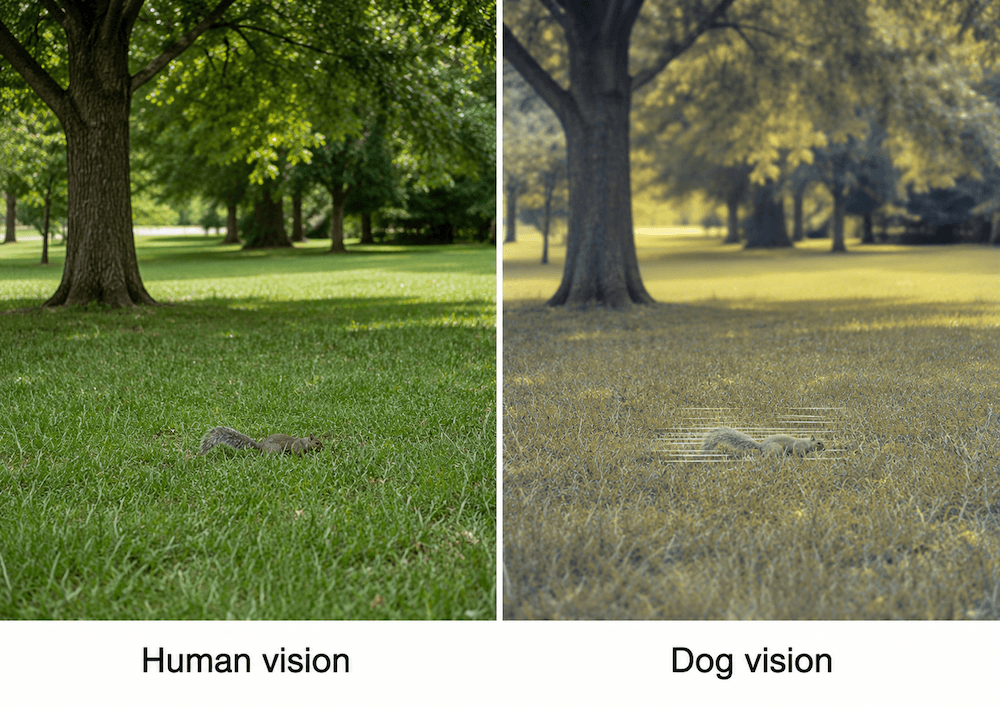
Dogs often notice movement before they notice fine visual detail. A small animal hidden in grass may become easier for a dog to detect once it moves.
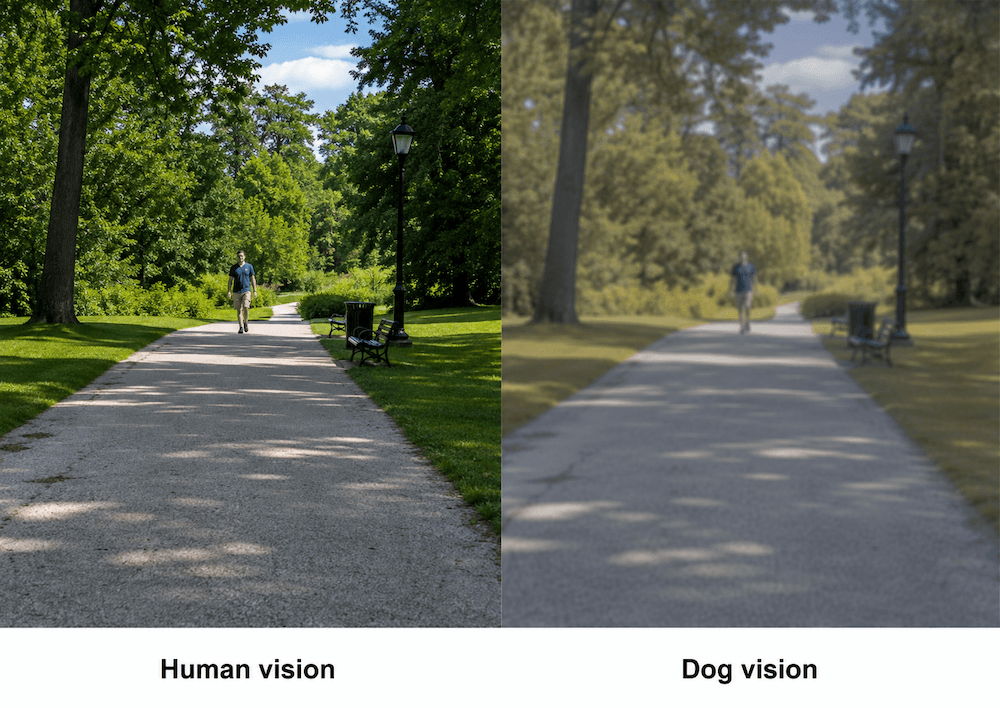
Dogs may recognize a person at a distance by shape, posture, and movement rather than sharp facial detail. Faraway objects often appear less detailed to dogs than they do to humans.
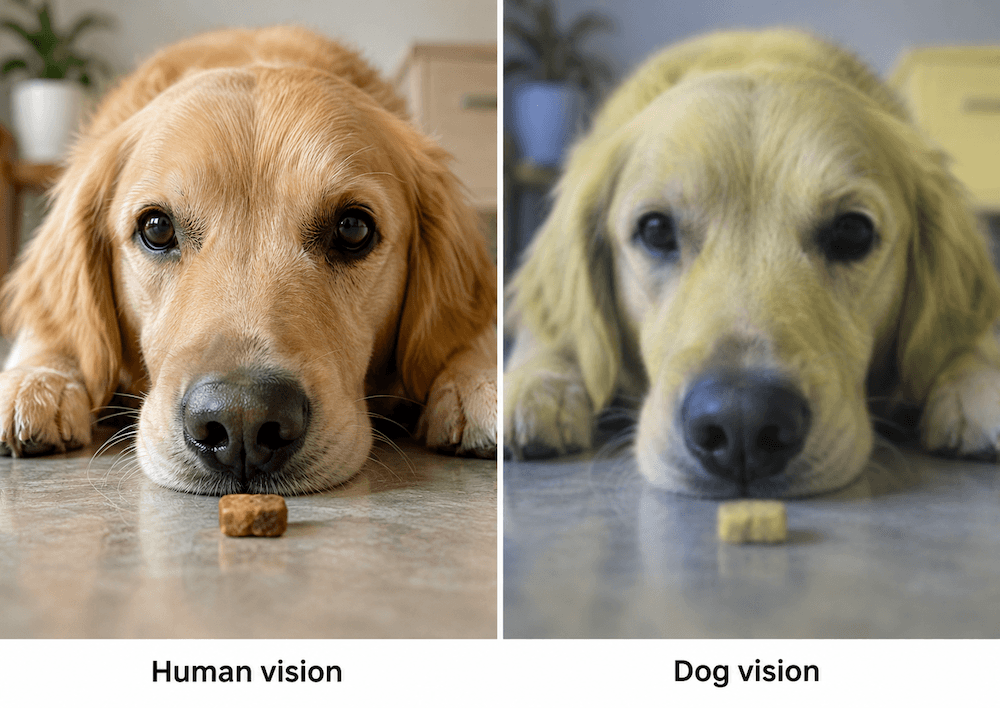
A treat placed very close to a dog’s nose may be harder to focus on visually. Dogs often rely more on smell than sight when something is right in front of them.
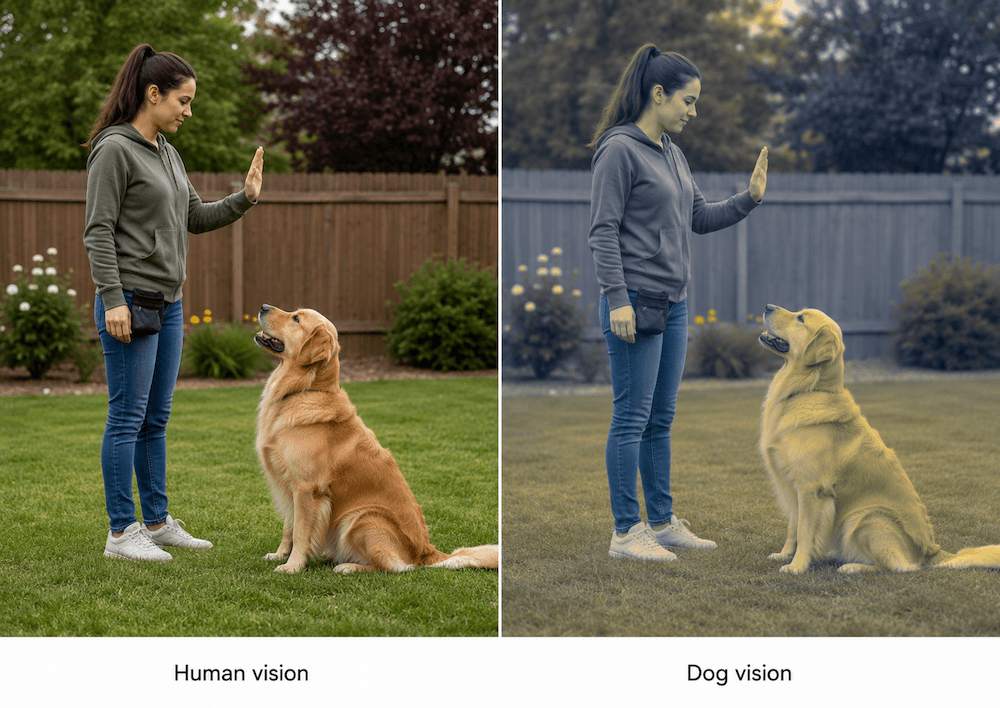
Clear hand signals can work well because dogs are often good at noticing larger movements and body shapes. Simple gestures are usually easier to read than tiny or subtle cues.
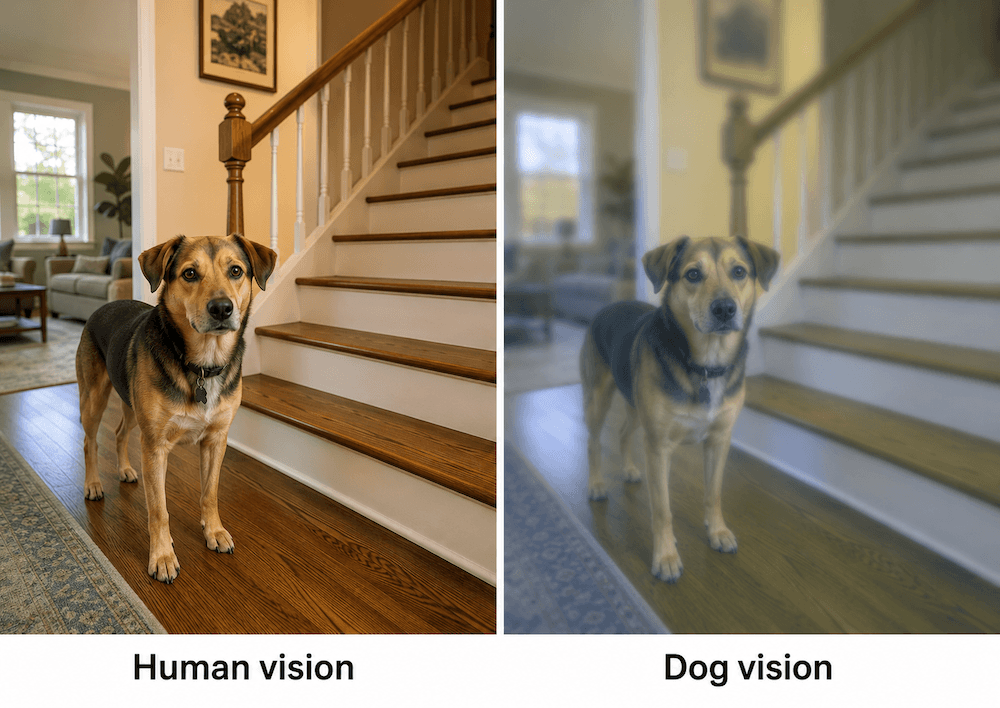
Stairs, curbs, and edges can require careful depth judgment. A dog may move more cautiously when lighting, age, or eye health makes those edges harder to read.


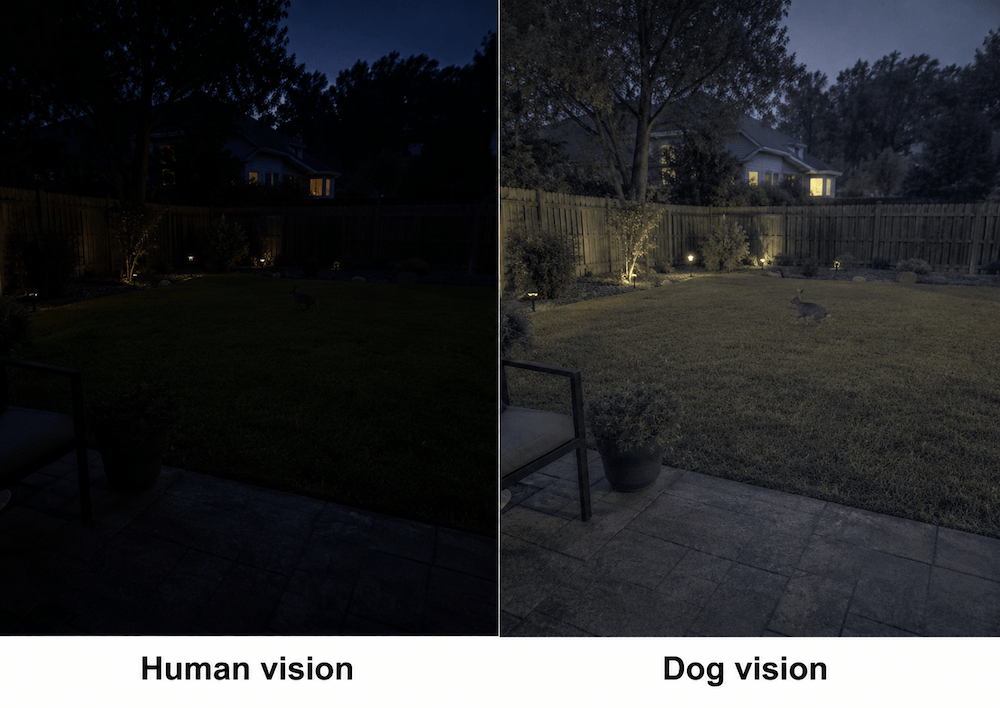
Dogs usually see better than people in dim light, but they still need some available light. Shapes and movement may be easier for them to detect at dusk or nighttime.
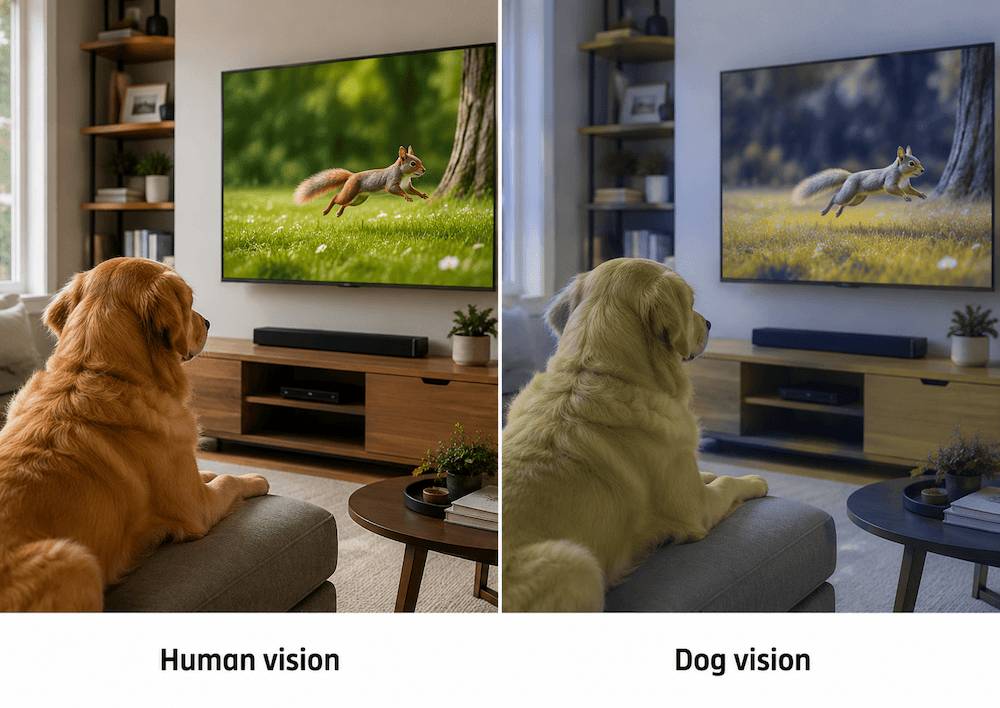
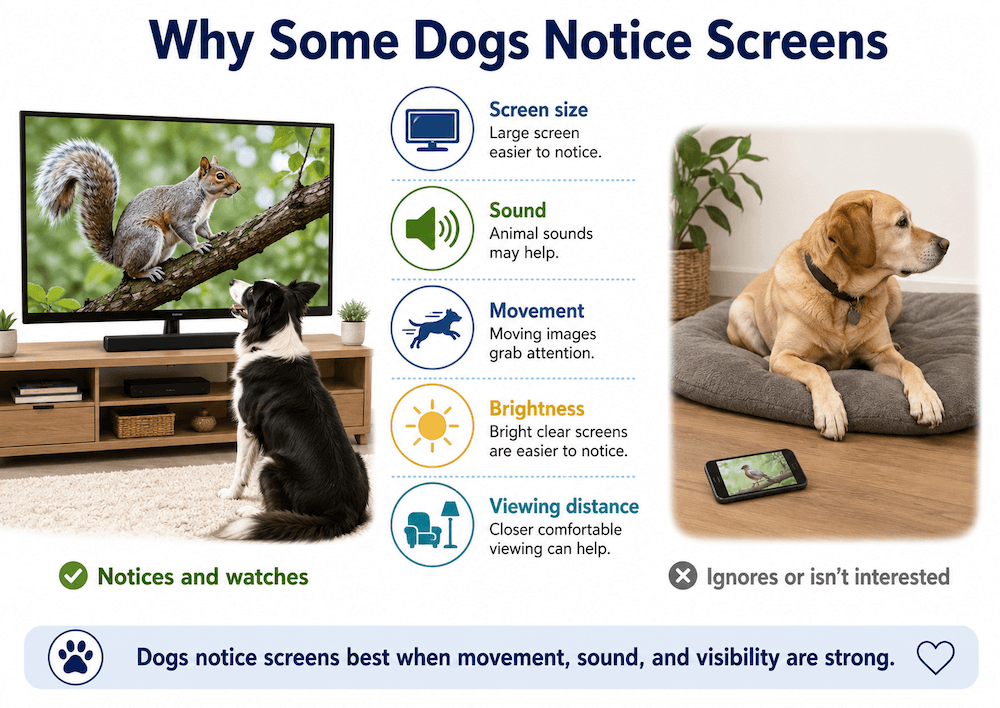
Some dogs react to TV because of movement, sound, animals, or familiar noises. Others may ignore screens if the image is too small, too flat, or not interesting enough.
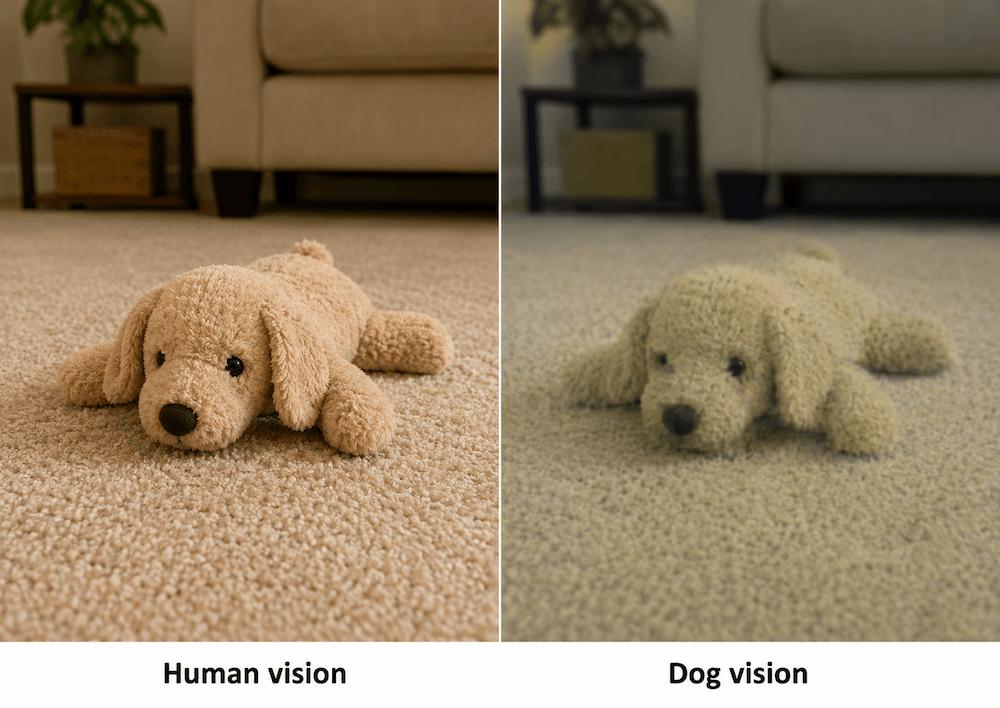
A toy that blends into a similar-colored background may be harder for dogs to notice. Contrast often matters more than color alone.
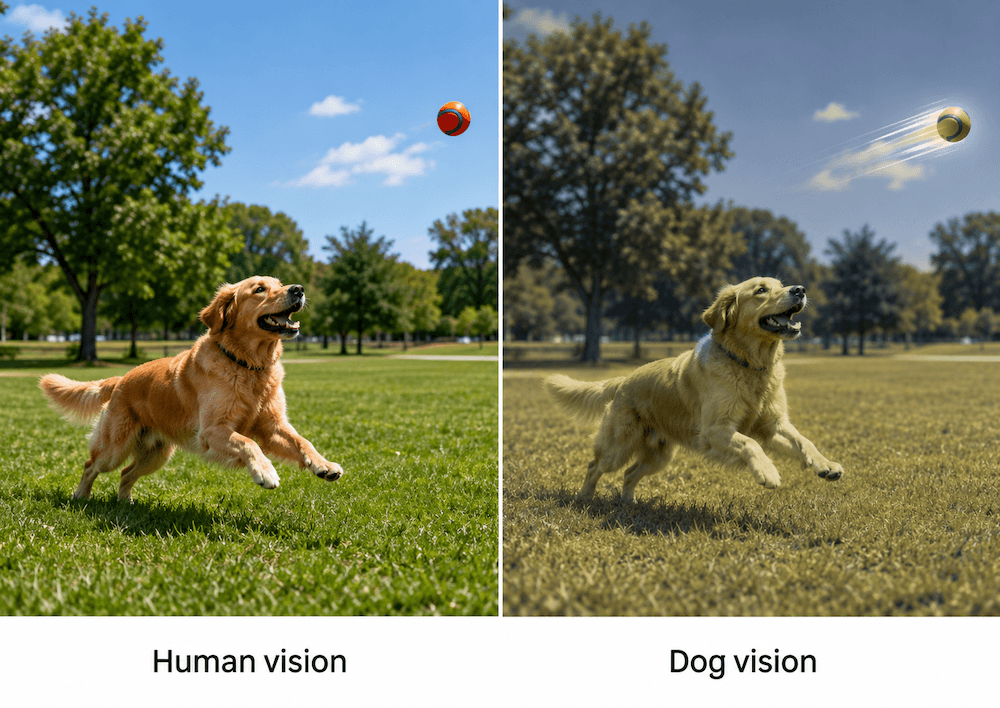
A moving toy can be easier for dogs to track than a toy sitting still. Motion is one of the strongest visual cues dogs use during play.
What Colors Can Dogs See?
Dogs see color, but their color world is smaller than ours. People typically have three types of color-detecting cone cells, which help distinguish red, green, blue, and many mixed shades. Dogs have two main color channels, so their color vision is closer to a person with red-green color blindness.
For dog owners, the practical answer is simple: blue and yellow usually stand out better to dogs than red, orange, pink, or green. A red toy may look bright and obvious to you, but to your dog it may blend more with grass, dirt, or flooring. This is one reason a dog may seem to “lose” a toy that is right in front of them, especially if the toy stops moving.
This does not mean dogs experience a dull or empty world. Color is only one part of vision. Dogs also use brightness, contrast, motion, smell, sound, memory, and body cues to understand what they are seeing. A toy’s shape, movement, scent, and location may matter more than its color.
| Human Color | How It May Look to Dogs | Practical Use |
|---|---|---|
|
Blue
|
Blue / visible
|
Good choice for toys, training markers, and objects you want your dog to notice. |
|
Yellow
|
Yellow / visible
|
Helpful for balls, discs, targets, and items used outdoors. |
|
Green
|
Yellowish-gray
|
Green toys may blend into grass, especially from a distance. |
|
Red
|
Dark gray-brown
|
Red toys can be harder to see on grass, dirt, or dark surfaces. |
|
Orange
|
Dull yellow-brown
|
May be less visible than blue or yellow, depending on the background. |
|
Pink
|
Muted beige-gray
|
Usually not as clear to dogs as blue or yellow, especially in dim light. |
|
Purple
|
Bluish-gray
|
May still be noticeable if it has strong contrast against the background. |
|
White
|
Bright neutral
|
Often easy to notice in darker settings because of brightness contrast. |
|
Brown
|
Muted brown-gray
|
Can blend into dirt, wood floors, furniture, or outdoor ground. |
|
Gray
|
Gray / neutral
|
Still useful when the object has enough brightness or movement contrast. |
Can Dogs See in the Dark?
Dogs can usually see better than people in dim light, but they cannot see in complete darkness. They still need some available light, even if it is faint. Their eyes are more sensitive to low light and movement, which helps them move around at dusk, notice nighttime motion, or find a toy in a dim room.
The eye glow you see when light hits your dog’s eyes comes from a reflective layer inside the eye called the tapetum lucidum. This layer helps bounce light back through the retina, improving vision in low-light settings. Still, better low-light vision does not mean perfect night vision.
If your dog suddenly becomes hesitant in dim areas, pauses at stairs, bumps into furniture, or seems anxious on nighttime walks, do not assume they are being stubborn. Senior dogs and dogs with cataracts or retinal disease may struggle more in low light. Nightlights, clear paths, consistent furniture placement, and non-slip mats can help make the home safer and easier to navigate.
What Dogs Notice First in Their Environment
Dogs often notice the parts of a scene that are changing, contrasting, familiar, or paired with another cue. A shifting posture, a moving hand, a bright edge, or a familiar outline may stand out before a small still object.
They also pay attention to how visual cues fit the moment. The sight of shoes near the door, a leash being lifted, or a person leaning forward may become meaningful because those visuals connect with routine, sound, scent, or body language.
This is why dogs may react differently to the same object in different settings. A coat on a chair, a person carrying a box, or a moving shadow may look unusual until the dog gathers more information.
| Visual Cue | Why It Stands Out | Everyday Example |
|---|---|---|
| Movement | Change separates objects from the background. | A hand reaches toward a treat pouch. |
| Contrast | Clear edges are easier to separate. | A pale toy sits on dark flooring. |
| Posture | Body shape helps dogs read intent. | A person bends over or turns sideways. |
| Light change | Brightness shifts can draw attention fast. | A shadow moves across the hallway. |
| Familiar outline | Known shapes are easier to interpret. | A family member appears at the gate. |
| Paired cue | Sound or scent confirms the visual clue. | Keys jingle while shoes are picked up. |
How Motion, Distance, and Detail Shape Dog Vision
Dogs do not see every part of a scene with the same level of clarity. What they notice can change depending on distance, lighting, object size, background clutter, and how much detail is available.
A familiar object may be easy to recognize in one setting but harder to read in another. A dog may also seem confident in open, familiar spaces but more unsure around new stairs, busy flooring, shadows, or faraway figures.
These factors work together in everyday life. They help explain why a dog may react quickly in one situation but seem unsure in another, even when the object or person is visible to you.
Dogs & Depth Perception
Depth perception helps dogs judge the space between nearby objects. It matters when they step off curbs, climb stairs, jump onto furniture, catch toys, or move across uneven ground.
Surfaces like open stairs, shiny floors, dark steps, rocks, or furniture edges can be harder to judge, especially in poor lighting or when a dog is moving quickly. Familiar spaces are usually easier, while new stairs, docks, benches, or jumps may make dogs more cautious.
| Situation | Vision Challenge | Helpful Owner Adjustment |
|---|---|---|
| Stairs | Edges may blend in poor lighting. | Add lighting or edge contrast. |
| Curbs | Height changes can be misread. | Pause before stepping down. |
| Furniture | Jump distance may be misjudged. | Use ramps for unsure dogs. |
| Catching toys | Speed changes affect timing. | Start with slow, short tosses. |
| Uneven ground | Surface changes require quick adjustment. | Slow the pace on rough terrain. |
Dogs & Visual Acuity
Visual acuity means how clearly a dog sees fine details. Dogs can recognize shapes and objects, but tiny, still, or low-contrast details may be harder to notice, such as a treat on a patterned rug, a dark chew on a dark blanket, or a subtle hand signal in a busy room.
| Detail Type | Why It May Be Harder | Practical Fix |
|---|---|---|
| Small treats | Tiny objects can blend into patterns. | Place treats on plain surfaces. |
| Subtle hand cues | Small motions may be easy to miss. | Use larger, consistent signals. |
| Facial detail | Faces may not be read like humans do. | Pair approach with voice cues. |
| Busy floors | Patterns can hide small objects. | Use contrast during games. |
| Still objects | No change makes them less obvious. | Add gentle movement or sound. |
Dog Motion Vision
Movement is one of the fastest ways to catch a dog’s attention because it helps objects stand out from the background. A still ball may be overlooked, but the same ball rolling a few inches can quickly become noticeable. Motion is useful for play and training, but fast or chaotic movement can also trigger chasing, pulling, barking, or jumping, so controlled movement is usually best.
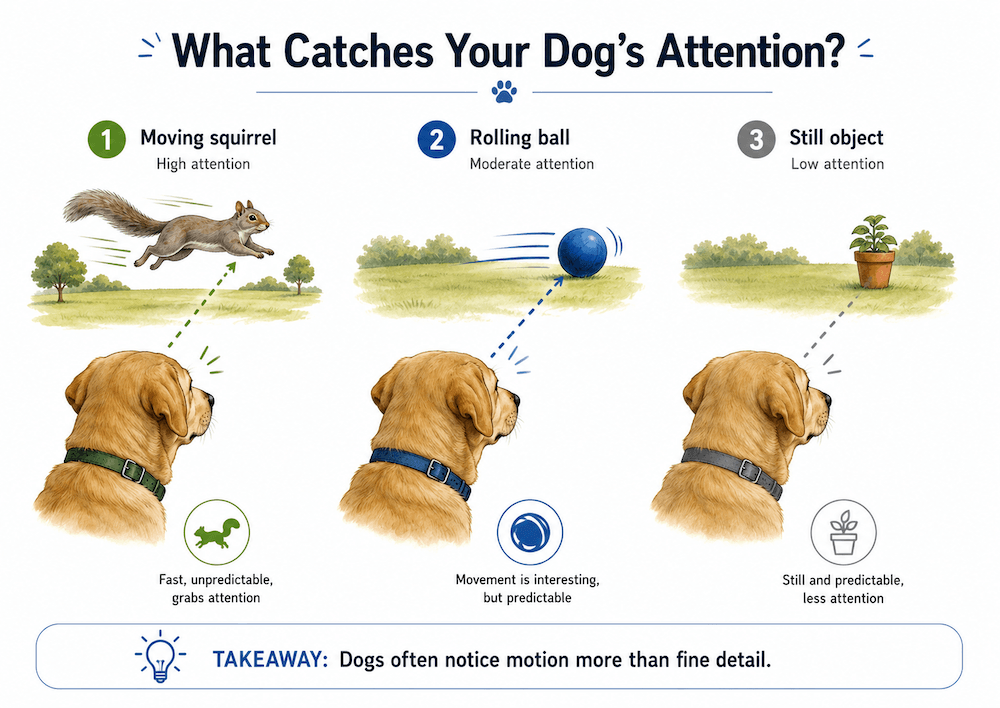
Dogs are often quicker to notice movement than still objects, which is why rolling toys, running animals, and shifting shadows can grab their attention so fast.
How Far Can Dogs See?
There is no single distance that describes how far all dogs can see because visibility depends on lighting, contrast, object size, movement, breed, head shape, age, and eye health. Dogs may detect movement far away before they can clearly recognize what it is, using other clues as the object gets closer. In general, large moving figures in open areas are easier to notice than small, still objects against trees, shadows, or busy backgrounds.
| Factor | How It Affects Distance Vision | Example |
|---|---|---|
| Movement | Moving objects are detected sooner. | A jogger is noticed before a bench. |
| Contrast | Clear outlines are easier to separate. | A white dog stands out on grass. |
| Lighting | Glare or shadows can reduce clarity. | Sunset can create confusing silhouettes. |
| Object size | Larger shapes are easier to detect. | A person is clearer than a small toy. |
| Head shape | Eye placement changes visual scanning. | Breeds may survey space differently. |
| Age | Confidence may change over time. | Senior dogs may need closer cues. |
Can Dogs See TV, Phones, and Screens?
Many dogs can see images on TVs, phones, and tablets, but not every dog finds screens meaningful. Interest depends on screen size, brightness, sound, movement, viewing distance, and image smoothness.
Animal videos often get more attention because they include body shapes, motion, and sounds that feel relevant. A dog may look at a barking dog on TV but ignore a quiet landscape video on a phone.
Some dogs walk away because the screen lacks scent, real-world depth, and direct interaction. That is normal and does not reflect intelligence, affection, or trainability.
How Dogs Use Vision With Smell and Hearing
Dogs build a picture of the world by combining sight, smell, hearing, memory, body language, and routine. Vision may tell them where something is, while scent and sound help confirm what it is.
This sensory teamwork helps dogs recognize people and locate objects. A dog may see a person’s outline, hear their voice, smell their scent, and remember their usual way of moving before deciding who they are.
Routine makes these cues even stronger. The sight of a leash, the sound of keys, and the smell near the door can all combine into one clear message: something familiar is about to happen.
| Sense or Cue | What It Adds | Real-Life Use |
|---|---|---|
| Vision | Shows location, shape, and movement. | Spots a toy across the room. |
| Smell | Confirms identity and exact location. | Finds where the toy landed. |
| Hearing | Reveals direction and activity. | Tracks footsteps before seeing someone. |
| Memory | Connects cues to past outcomes. | Recognizes the walk routine. |
| Body language | Helps interpret intent and emotion. | Reads posture during greetings. |
| Routine | Makes familiar patterns predictable. | Knows dinner signs before the bowl appears. |
What Dog Vision Means for Training and Play
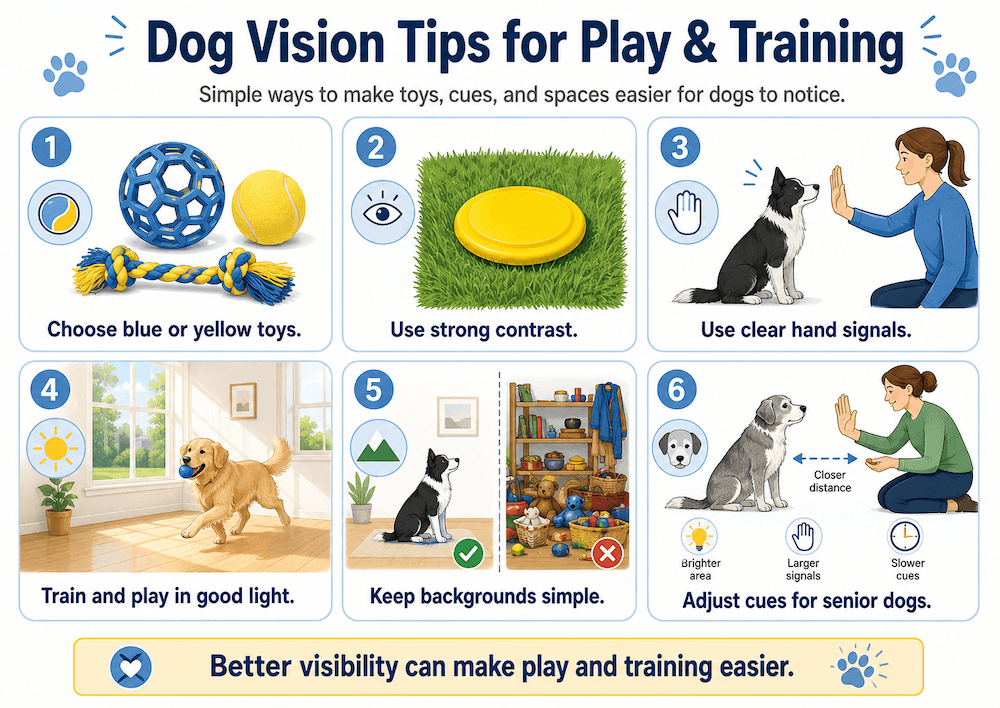
Dog vision can make training and play smoother when cues are clear, consistent, and easy to separate from the background. Use high-contrast toys, uncluttered training spaces, and good lighting when you want your dog to focus quickly.
Hand signals should be large enough to see and delivered from a consistent position. A small cue in a busy room may be less effective than the same cue given against a plain background.
Senior dogs or dogs with changing vision may need extra support, not less enrichment. Pair visual cues with voice cues, keep play areas predictable, and use bright, easy-to-find toys for confidence.
Normal Vision Quirks vs. Warning Signs
Not every odd visual behavior means something is wrong. Dogs may miss a toy because of color, lighting, distance, or lack of movement. They may bark at shadows because the shape is unfamiliar. They may hesitate in a new place because scent, sound, flooring, and lighting all changed at once.
Vision concerns become more serious when the pattern is new, repeated, painful, or paired with visible eye changes. Squinting, redness, cloudiness, pawing at the eye, unequal pupils, swelling, discharge, or sudden clumsiness are not just “vision quirks.” They can point to irritation, injury, inflammation, cataracts, glaucoma, retinal disease, or other problems that need professional care.
| What You Notice | Possible Meaning | What to Do |
|---|---|---|
| Misses red toys | Color contrast may be poor. | Try blue or yellow toys. |
| Startles at shadows | Shapes may look unfamiliar. | Improve lighting and observe patterns. |
| Hesitates at stairs | Depth or clarity may be changing. | Use lights and book a checkup. |
| Bumps into objects | Vision loss may be developing. | Call your veterinarian promptly. |
| Squints or paws | The eye may be painful. | Seek veterinary care quickly. |
| Cloudy eye | Cataracts or other disease are possible. | Schedule an eye examination. |
| Sudden blindness | This may be an emergency. | Contact urgent care immediately. |
Common Myths About What Dogs See
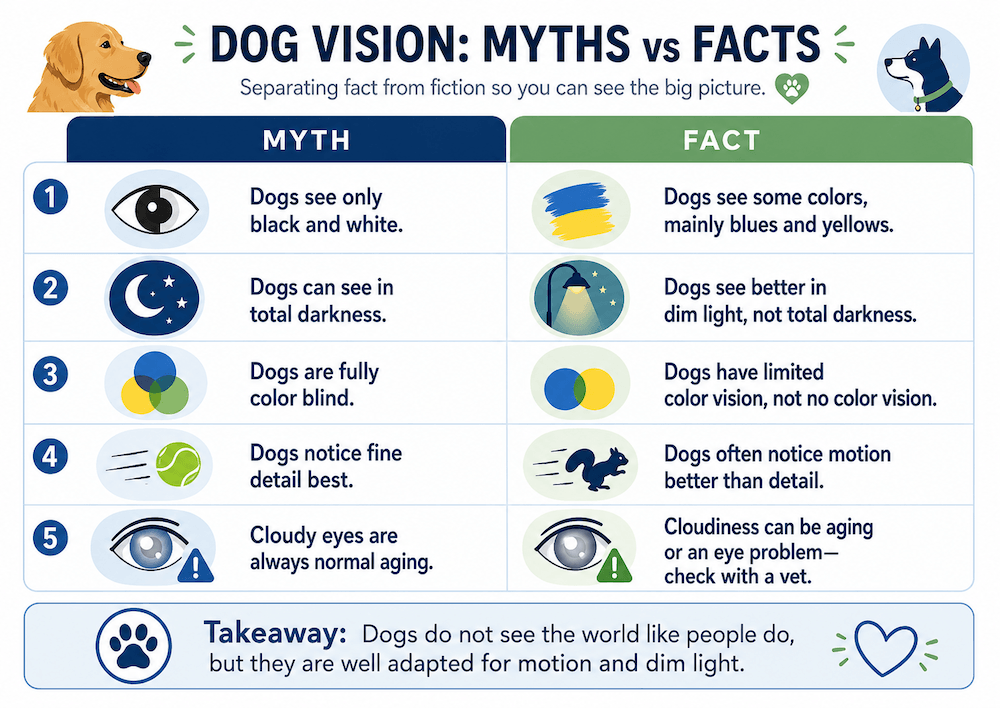
Dog vision is surrounded by a few persistent myths. The biggest one is that dogs see only in black and white. Another is that dogs have “night vision” like a camera or wild predator in total darkness. A more subtle myth is that a dog who misses something must be ignoring the owner.
What Research Says About Dog Vision
A study on canine color vision found that dogs have two cone photopigment classes, supporting the conclusion that dogs have dichromatic color vision rather than full human-like color vision. This helps explain why dogs distinguish some colors, especially in the blue-yellow range, but do not experience red-green differences the same way humans usually do.[1]
A study available through PubMed Central found that dogs can use color cues in visual discrimination tasks, meaning color can be meaningful to them when brightness is controlled. For owners, the practical lesson is that color choice can matter, but contrast, brightness, movement, and context also shape what a dog notices.[2]
The Merck Veterinary Manual explains the basic structure and function of the dog eye, including the cornea, pupil, lens, retina, photoreceptors, optic nerve, and the way the eye adjusts to light and focus. It also notes that dogs can develop many of the same eye problems people do, including cataracts and glaucoma, which is why changes in sight or eye appearance deserve attention.[3]
Cornell University College of Veterinary Medicine describes glaucoma as a condition that can begin with subtle signs such as redness and squinting but may lead to blindness without prompt care. This supports a cautious approach to painful-looking, red, cloudy, or suddenly vision-impaired eyes.
When to Call a Veterinarian About Your Dog’s Vision
Some dog vision differences are normal, but eye pain and sudden vision changes should be taken seriously. Eyes can worsen quickly, and dogs may hide discomfort until the problem is advanced. When in doubt, it is safer to call your veterinarian than to wait several days and hope it improves.
Do not use human eye drops, leftover pet medication, or home remedies unless your veterinarian specifically tells you to. Different eye problems can look similar but need very different treatment. The wrong medication can delay care or make certain eye conditions worse.
How to Support Your Dog’s Vision in Daily Life
You cannot make dogs see like humans, but you can make their world easier to navigate. Choose toys with colors and contrast your dog can see more easily. Keep training signals large, clear, and consistent. Use movement, sound, scent, and rewards instead of relying only on visual cues.
For dogs with normal vision, small choices can improve play and communication. A yellow or blue toy may be easier to find outdoors. A clear hand signal against a simple background may be easier to understand. A moving toy may be more exciting than a still one because motion naturally catches your dog’s eye.
For senior dogs or dogs with suspected vision changes, home setup becomes more important. Avoid frequently rearranging furniture, block unsafe stairs if needed, keep pathways clear, and use rugs or mats to define slippery areas. Soft verbal cues like “step,” “wait,” or “this way” can help a dog feel more secure.
Outdoor safety matters too. A dog with reduced vision may misjudge curbs, traffic, drop-offs, pools, or unfamiliar dogs. Leashes, harnesses, consistent walking routes, and calm introductions can prevent accidents. Vision support is not about limiting your dog’s life; it is about making their world more predictable and safe.
Frequently Asked Questions
The Bottom Line
Dogs see a world of limited colors, strong motion, useful contrast, and better dim-light awareness than humans. They are not fully colorblind, but blues and yellows usually stand out better than reds and greens. Their vision helps explain many everyday behaviors, from chasing moving objects to missing still toys that blend into the background. New clumsiness, cloudiness, redness, squinting, or sudden vision changes should be checked by a veterinarian. When you understand what dogs see, you can choose better toys, communicate more clearly, and support your dog’s comfort and safety at every age.