How Much Homemade Food to Feed a Dog: Feeding Charts by Weight & Life Stage

Canine Bible is reader-supported. We receive affiliate commissions via some of our links. Learn more.
Most adult dogs need homemade dog food based on calories, not cups—often about 2–3% of their ideal body weight per day when the recipe is properly balanced. The right amount depends on your dog’s size, age, activity level, body condition, and the calorie density of the ingredients. A lean, active dog may need more, while an overweight, senior, or less active dog may need less. Homemade meals can be healthy, but portion mistakes are easy when recipes vary in meat, fat, carbs, and moisture. Feeding “by sight” can lead to weight gain, nutrient gaps, or meals that look filling but fall short nutritionally. This guide explains how to estimate portions, adjust for different dogs, and know when your dog’s bowl needs a closer look. You’ll also learn why balanced recipes, calorie tracking, and regular weigh-ins matter more than a one-size-fits-all scoop.
Why Feeding Your Dog the Right Amount of Homemade Food Matters
| Key Reason | Why It Matters for Your Dog |
|---|---|
| Prevents weight gain | Homemade food can be calorie-dense, so loose portions may quickly lead to extra pounds. |
| Avoids underfeeding | Meals that look full may still fall short if the ingredients are low in calories or poorly balanced. |
| Supports nutrients | The right portion works best when the recipe also provides proper protein, fat, vitamins, and minerals. |
| Matches life stage | Puppies, adults, seniors, pregnant dogs, and active dogs often need different feeding amounts. |
| Guides adjustments | Regular weigh-ins and body condition checks help you increase or reduce food before problems build. |
| Protects digestion | Sudden large portions or rich recipes can trigger stomach upset, loose stool, or food refusal. |
| Improves safety | Dogs with medical conditions may need special calorie, fat, protein, or mineral limits from a veterinarian. |
How Homemade Dog Food Can Support Your Dog’s Health
Homemade dog food can support a dog’s health by giving owners more control over ingredients, freshness, and recipe customization. When properly balanced, it can provide high-quality protein, healthy fats, digestible carbohydrates, fiber, vitamins, and minerals in amounts that match the dog’s needs. It may also help dogs with specific sensitivities when certain ingredients need to be avoided.
However, homemade food only supports health when it is complete, balanced, and portioned correctly. Poorly planned recipes can lead to nutrient deficiencies, excess calories, digestive upset, or unhealthy weight changes. The safest approach is to use a veterinarian-approved recipe, measure portions carefully, and adjust based on your dog’s weight, body condition, stool quality, energy, and medical needs.
Feeding Homemade Food Only vs Mixing With Wet & Dry Food
Feeding homemade food only gives you the most control over ingredients, texture, freshness, and recipe customization. However, it also carries the most responsibility because the recipe must be complete and balanced every day, with the right calories, protein, fat, calcium, phosphorus, vitamins, and minerals for your dog’s life stage and health needs.
Mixing homemade food with wet or dry food can be easier because a complete commercial diet may help cover more of the nutritional foundation, especially when homemade food is used as a topper or partial meal. The key is to measure both foods by calories so you do not accidentally overfeed, dilute nutrients, or create an unbalanced diet by replacing too much of the commercial food.
Remember to ALWAYS consult with your vet before making any changes that could affect your dog’s health, nutrition, or well-being. If you can’t reach your vet, you can chat live with a registered online veterinary professional via our online vet chat or video chat support (24 hours a day, 7 days a week). Or use Chewy’s online vet services (6 a.m. – midnight ET). Additionally, at-home dog gut health tests can analyze your dog’s microbiome, offering insights into which nutrients their diet should include. Similarly, at-home dog allergy testing kits can identify ingredients that may not be suitable for your dog, enabling you to choose the right diet and care plan to support optimal digestion, nutrition, and health.


Why Cups Alone Do Not Work for Homemade Dog Food
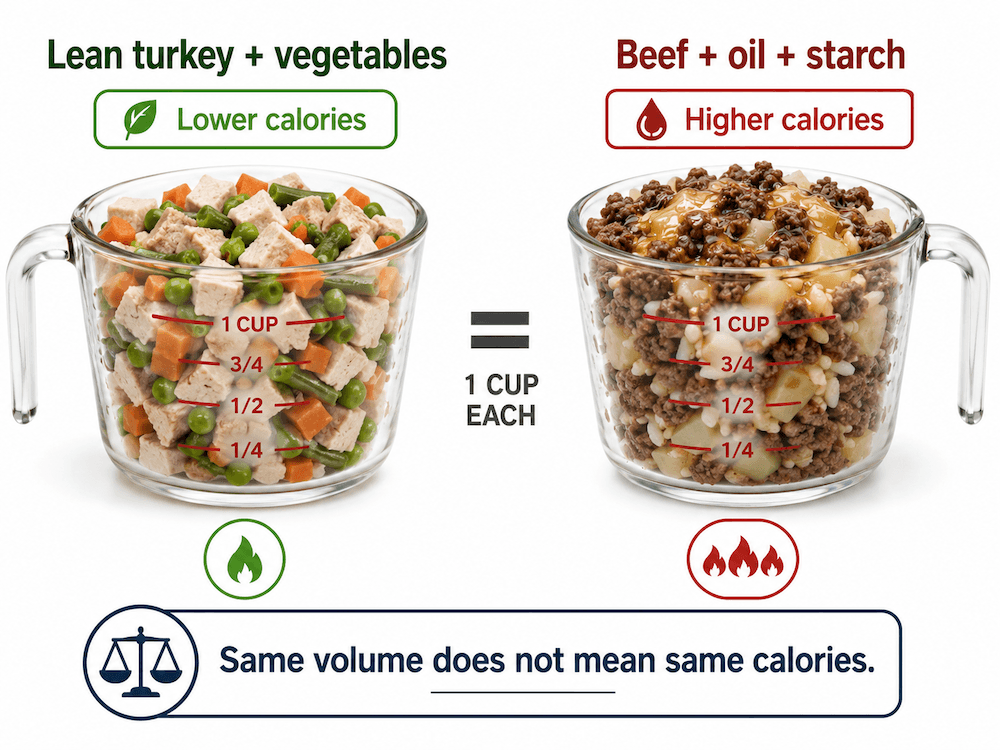
A cup of homemade dog food does not always mean the same thing. A cup of lean turkey, rice, vegetables, and broth may contain far fewer calories than a cup made with beef, egg, sweet potato, and oil. Both bowls can look similar, but one may fuel weight loss while the other may quietly add excess calories.
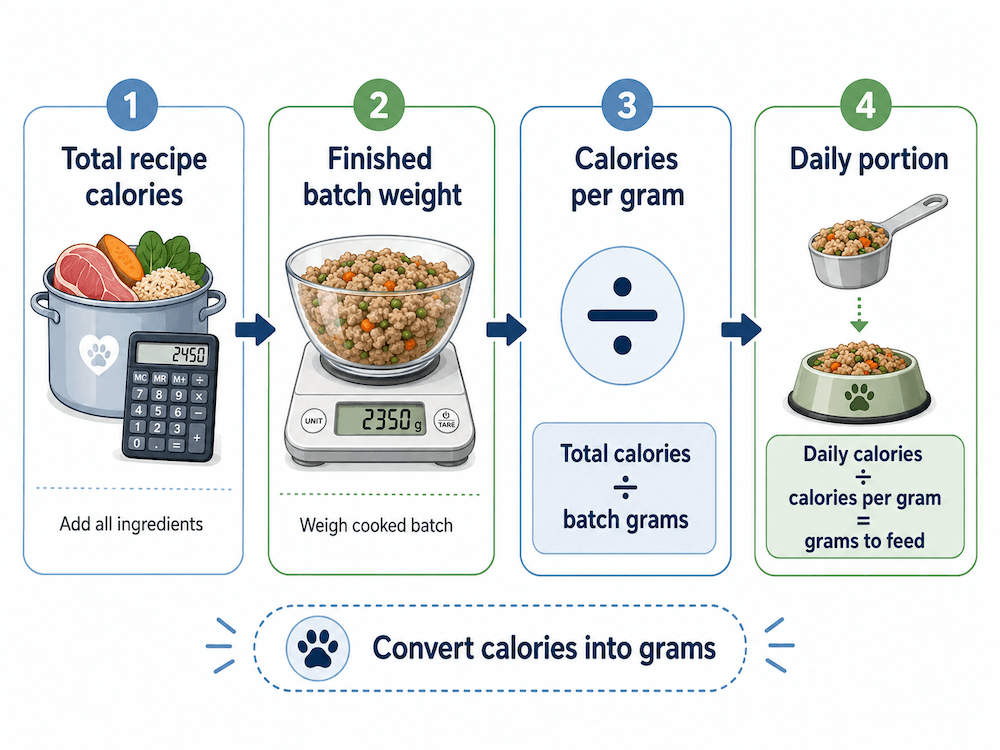
This is why homemade dog food portions should start with calories per day, then convert into cups, ounces, or grams. If your recipe does not list calories, you are guessing more than measuring. For regular feeding, a kitchen scale and a calorie-estimated recipe are much safer than relying on scoop size alone.
A helpful way to think about it: cups measure volume, calories measure energy. Your dog’s body responds to the energy, not how full the measuring cup looks.
What Changes How Much Homemade Food Your Dog Needs
Even with a good formula, dogs do not all burn calories the same way. Two dogs of the same weight may need very different portions because their age, muscle, activity, hormones, and health are different.
| Factor | How It Changes Portions | What Owners Should Do |
|---|---|---|
| Ideal weight | Portions should match the target body size. | Use ideal weight for calculations. |
| Activity level | More movement usually increases calorie needs. | Adjust for real daily exercise. |
| Age | Seniors may burn fewer calories. | Monitor weight and muscle closely. |
| Neuter status | Neutered dogs often need fewer calories. | Watch for gradual weight gain. |
| Recipe fat | Oil and fatty meats raise calories fast. | Measure added fats carefully. |
| Treats | Extras reduce meal calorie room. | Count treats in daily calories. |
| Health conditions | Some diseases require special nutrient limits. | Ask your vet before changing diets. |
Body condition matters as much as the math. You should be able to feel your dog’s ribs with light pressure, see a waist from above, and notice an abdominal tuck from the side. If those landmarks disappear, the portion is probably too high, even if the feeding calculator looked reasonable.
How to Estimate Your Dog’s Daily Homemade Food Calories
The most practical starting formula is: RER = 70 × body weight in kilograms⁰·⁷⁵. RER means resting energy requirement, or the calories your dog needs for basic body functions at rest. Most healthy adult dogs then need a multiplier above RER based on activity, neuter status, life stage, and weight goals.

For a simpler owner-friendly approach, use your dog’s ideal weight, not an overweight current weight. Then choose a starting calorie range and monitor results for two to four weeks. This is not a perfect prediction because dogs vary, but it gives you a safer starting point than filling the bowl by instinct. For an easier starting point, use our dog calorie calculator to estimate your dog’s daily calorie needs before converting those calories into homemade food portions.
The basic conversion is: daily calories needed ÷ calories in your homemade recipe = daily serving amount. If your dog needs 600 calories per day and your recipe has 300 calories per cup, your dog would start around 2 cups per day. If that same recipe has 450 calories per cup, the starting amount drops to about 1⅓ cups per day.
Estimated Daily Calories for Adult Dogs by Ideal Weight
This chart gives broad starting estimates for healthy adult dogs at different activity levels. It is not a puppy, pregnancy, lactation, disease, or weight-loss prescription, but it helps you understand the scale of daily feeding needs.
| Ideal Weight | Lower Activity | Average Adult | More Active |
|---|---|---|---|
| 5 lb | 140 calories daily. | 190 calories daily. | 230 calories daily. |
| 10 lb | 240 calories daily. | 330 calories daily. | 390 calories daily. |
| 20 lb | 400 calories daily. | 550 calories daily. | 660 calories daily. |
| 30 lb | 550 calories daily. | 740 calories daily. | 890 calories daily. |
| 50 lb | 800 calories daily. | 1,090 calories daily. | 1,310 calories daily. |
| 70 lb | 1,030 calories daily. | 1,400 calories daily. | 1,690 calories daily. |
| 90 lb | 1,240 calories daily. | 1,700 calories daily. | 2,030 calories daily. |
These numbers are starting points, not guarantees. Some dogs maintain weight on much less than expected, especially neutered, indoor, senior, or obesity-prone dogs. Others need more because they are young adults, intact, highly active, working, underweight, or naturally lean.
How to Convert Calories Into Cups, Ounces, or Grams
Once you know your dog’s estimated daily calories, the next step is finding the calorie density of the homemade recipe. The best recipe gives calories per batch, calories per gram, or calories per cup. Without that number, measuring homemade food is mostly guesswork.
Here is the cleanest method: weigh the full finished batch, estimate the total recipe calories, then divide total calories by total cooked weight. For example, if a batch contains 3,000 calories and weighs 1,500 grams after cooking, it has 2 calories per gram. A dog needing 500 calories per day would receive about 250 grams daily from that batch, before treats or extras.
If you prefer cups, measure how many level cups the finished batch makes. A 3,000-calorie batch that makes 10 cups has 300 calories per cup. A dog needing 600 calories per day would start at 2 cups daily, usually split into two meals.
How Much Homemade Food to Feed a Dog (By Life Stage)
How much homemade food to feed a dog depends on four main things: ideal body weight, age, activity level, and the calorie density of the recipe. There is no single “cups per day” amount that works for every dog, because homemade meals can vary widely in calories depending on the meat, fat, starch, vegetables, moisture, and added oils. The best way to size meals is to estimate your dog’s daily calorie needs first, then convert that number into the right amount of homemade food using the recipe’s calories per cup, ounce, or gram.
Puppy Homemade Food Feeding Chart
| Age | Typical Weight | Estimated Cups Daily | Meals Per Day | Feeding Notes |
|---|---|---|---|---|
| 8–12 weeks | 3–10 lb | About 1/2 to 2 cups daily | 4 meals | Use a puppy-specific balanced recipe. |
| 3–4 months | 5–20 lb | About 1 to 3 1/2 cups daily | 3–4 meals | Weigh weekly because growth is fast. |
| 4–6 months | 8–35 lb | About 1 1/2 to 4 1/2 cups daily | 3 meals | Adjust as growth rate begins to slow. |
| 6–9 months | 10–55 lb | About 1 1/2 to 5 1/2 cups daily | 2–3 meals | Large breeds need careful calorie control. |
| 9–12 months | 12–75 lb | About 1 1/2 to 6 cups daily | 2 meals | Small breeds may near adult portions. |
Important: Cup amounts are estimates only and assume a cooked homemade recipe with about 300 calories per cup. Adjust based on your puppy’s calorie needs, growth rate, body condition, recipe density, and veterinary guidance.
Adult Dog Homemade Food Feeding Chart
| Adult Dog Size | Typical Weight | Estimated Cups Daily | Meals Per Day | Feeding Notes |
|---|---|---|---|---|
| Toy adult dog | 3–10 lb | About 1/3 to 1 cup daily | 2 meals | Measure carefully because small dogs overeat easily. |
| Small adult dog | 10–25 lb | About 1 to 2 1/4 cups daily | 2 meals | Adjust portions based on weight and activity. |
| Medium adult dog | 25–50 lb | About 2 1/4 to 3 2/3 cups daily | 2 meals | Use calories if the recipe is rich or dense. |
| Large adult dog | 50–80 lb | About 3 2/3 to 5 1/3 cups daily | 2 meals | Monitor body condition to avoid overfeeding. |
| Giant adult dog | 80+ lb | About 5 1/3+ cups daily | 2 meals | Feed by calories for better portion control. |
Important: Cup amounts are estimates only and assume a cooked homemade recipe with about 300 calories per cup. Adjust based on your dog’s calorie needs, body condition, recipe density, and veterinary guidance.
Senior Dog Homemade Food Feeding Chart
| Senior Dog Size | Typical Weight | Estimated Cups Daily | Meals Per Day | Feeding Notes |
|---|---|---|---|---|
| Toy senior dog | 3–10 lb | About 1/4 to 3/4 cup daily | 2 meals | Measure closely because small seniors gain weight easily. |
| Small senior dog | 10–25 lb | About 3/4 to 1 3/4 cups daily | 2 meals | Adjust for activity, treats, and body condition. |
| Medium senior dog | 25–50 lb | About 1 3/4 to 3 cups daily | 2 meals | Watch muscle condition, not weight alone. |
| Large senior dog | 50–80 lb | About 3 to 4 1/2 cups daily | 2 meals | Reduce gradually if activity has slowed. |
| Giant senior dog | 80+ lb | About 4 1/2+ cups daily | 2 meals | Use calories for better senior portion control. |
Important: Cup amounts are estimates only and assume a cooked homemade recipe with about 300 calories per cup. Adjust based on your senior dog’s calorie needs, body condition, muscle condition, recipe density, and veterinary guidance.
Pregnant Dog Homemade Food Feeding Chart
| Pregnancy Stage | Typical Weight | Estimated Cups Daily | Meals Per Day | Feeding Notes |
|---|---|---|---|---|
| Weeks 1–5, small dog | 3–20 lb | About 1/3 to 1 3/4 cups daily | 2 meals | Feed near normal adult portions early on. |
| Weeks 1–5, medium dog | 21–50 lb | About 1 3/4 to 3 2/3 cups daily | 2 meals | Avoid overfeeding during early pregnancy. |
| Weeks 6–7, small to medium dog | 3–50 lb | About 1/2 to 4 1/2 cups daily | 2–3 meals | Increase gradually as calorie needs rise. |
| Weeks 6–7, large dog | 51–80 lb | About 4 to 6 cups daily | 2–3 meals | Adjust by body condition and litter size. |
| Weeks 8–9, small to medium dog | 3–50 lb | About 3/4 to 5 cups daily | 3–4 meals | Use smaller meals as belly space decreases. |
| Weeks 8–9, large or giant dog | 51+ lb | About 5 to 7+ cups daily | 3–4 meals | Feed by calories for safer late-pregnancy control. |
| Final days before birth | Varies by breed | Offer small measured meals | 3–4 meals | Call your vet if appetite loss is prolonged. |
Important: Cup amounts are estimates only and assume a cooked homemade recipe with about 300 calories per cup. Pregnant dogs need complete, balanced, veterinarian-guided recipes because calorie, calcium, phosphorus, and nutrient needs change quickly.
Feeding Homemade Dog Food & Treats Correctly
Feeding Homemade Dog Food & Treats Correctly
Homemade dog food should make up the main part of your dog’s daily calories only when it is complete and balanced. Treats, toppers, and extras should stay limited to avoid weight gain and nutrient imbalance.
Balance
This includes your dog’s properly portioned homemade meals made with the right balance of protein, carbohydrates, fats, vitamins, and minerals.
Treats, chews, table scraps, toppers, and extra snacks should stay limited so they do not replace essential nutrients or add too many calories.
Important: Homemade dog food should be based on a complete and balanced recipe. Dogs with allergies, medical conditions, weight problems, or special life-stage needs may require a feeding plan from a veterinarian or veterinary nutritionist.
This feeding chart shows how daily calories can be divided between complete homemade dog food and treats, so it is easier to estimate both cups per day and a reasonable treat limit for your dog.
| Dog Size or Stage | Activity Level | Daily Calories | Homemade Meal Calories Target (90%) |
Treat Calories Limit (10%) |
Approx. Homemade Food Amount | Meals Per Day |
|---|---|---|---|---|---|---|
| Small Adult Dog | Low | 250–450 kcal | 225–405 kcal | 25–45 kcal | About 1–1 1/2 cups/day | 2 meals |
| Small Adult Dog | Moderate | 450–650 kcal | 405–585 kcal | 45–65 kcal | About 1 1/2–2 1/3 cups/day | 2 meals |
| Medium Adult Dog | Low | 650–900 kcal | 585–810 kcal | 65–90 kcal | About 2 1/3–3 1/4 cups/day | 2 meals |
| Medium Adult Dog | Moderate | 900–1,200 kcal | 810–1,080 kcal | 90–120 kcal | About 3 1/4–4 1/3 cups/day | 2 meals |
| Large Adult Dog | Low | 1,200–1,500 kcal | 1,080–1,350 kcal | 120–150 kcal | About 4 1/3–5 1/2 cups/day | 2 meals |
| Large Adult Dog | Moderate | 1,500–1,900 kcal | 1,350–1,710 kcal | 150–190 kcal | About 5 1/2–7 cups/day | 2 meals |
| Senior Dog | Low | May need 10–20% fewer calories | Based on reduced calorie target | Keep treats very limited | Adjust by body condition | 2 meals |
| Puppy or Pregnant Dog | Growth or reproduction | Needs vary widely | Use growth-stage calorie needs | Limit extras carefully | Follow a vet-approved recipe | 3–4 meals |
Important: This chart assumes treats stay around 10% of daily calories and that the homemade dog food averages roughly 250 calories per cup. Homemade recipes can vary greatly in calories and nutrients, so always adjust portions based on your recipe’s calorie count, your dog’s body condition, and guidance from your veterinarian or a veterinary nutritionist.
How to Transition Your Dog to Homemade Food
Transition your dog to homemade food gradually over about 7 days by mixing small amounts of the homemade recipe into their current meals, then increasing the homemade portion every few days. This gives your dog’s digestive system time to adjust and helps reduce the risk of soft stool, gas, appetite changes, vomiting, or stomach upset.
Dogs with sensitive stomachs may need a slower 10–14-day transition, especially if the homemade food has new proteins, higher fat, or more fiber than their previous diet. Make sure the recipe is complete and balanced, and track calories carefully so you do not accidentally overfeed. If your dog is on a medical diet or develops worsening symptoms during the switch, follow your veterinarian’s instructions closely.
| Transition Stage | Food Mix | What to Do | What to Watch For |
|---|---|---|---|
| Days 1–2 | 75% old, 25% homemade | Add a small balanced portion. | Soft stool, gas, or vomiting. |
| Days 3–4 | 50% old, 50% homemade | Increase if digestion is normal. | Loose stool or appetite changes. |
| Days 5–6 | 25% old, 75% homemade | Measure by calories, not volume. | Energy, stool, and thirst. |
| Day 7+ | 100% homemade | Feed the full calculated portion. | Weight and body condition. |
| Sensitive stomachs | 10–14 day transition | Increase more slowly. | Pause if upset appears. |
| Mixed feeding | Homemade plus kibble | Subtract kibble calories first. | Accidental overfeeding. |
| Medical diets | Vet-directed recipe | Follow exact instructions. | Worsening symptoms. |
When to Ask a Veterinarian About Homemade Dog Food Amounts
Veterinary help is important when homemade food becomes more than a simple adult maintenance diet. Dogs with kidney disease, pancreatitis history, bladder stones, heart disease, diabetes, food allergies, gastrointestinal disease, pregnancy, lactation, or growth needs may require very specific calorie and nutrient targets. In these cases, the question is not only “how much food,” but also “how much protein, fat, minerals, fiber, sodium, calcium, phosphorus, and moisture.”
You should also ask for help if your dog is gaining or losing weight despite measured portions. Unexplained weight change can happen when the recipe calories are wrong, treats are underestimated, activity has changed, or an underlying health problem is present. A diet history, body condition check, and basic exam can prevent months of guessing.
Call sooner if your dog has vomiting, diarrhea, weakness, appetite loss, rapid weight loss, bloating, severe itching, excessive thirst, or a sudden behavior change after a diet change. These signs do not always mean the homemade food caused the problem, but they do mean the plan needs a closer look.
Helpful Tips for Feeding Homemade Dog Food in the Right Amount
The best feeding plan is measurable, repeatable, and easy to adjust. These tips help you turn homemade feeding from a rough bowl estimate into a safer daily routine.
| Tip | Why It Helps | How to Apply It |
|---|---|---|
| Use a scale | Grams are more consistent than cups. | Weigh each meal after batch cooking. |
| Log recipes | Small ingredient swaps change calories. | Record meats, oils, starches, and supplements. |
| Measure oils | Added fat raises calories quickly. | Use measuring spoons, not free-pouring. |
| Split meals | Routine meals support digestion. | Feed adults once or twice daily. |
| Track treats | Treats can distort portion plans. | Subtract treat calories from meals. |
| Review monthly | Needs shift with weight and activity. | Recheck body shape and weight regularly. |
Mistakes That Can Make Homemade Dog Food Portions Unsafe
Most portion problems happen because the food amount looks reasonable but is not nutritionally predictable. These mistakes are common, especially when owners rotate ingredients or use recipes from multiple places.
| Mistake | Why It Causes Problems | Safer Approach |
|---|---|---|
| Guessing cups | Volume hides calorie differences. | Use calorie-based portions instead. |
| Skipping supplements | Meat and rice are incomplete. | Use a balanced recipe plan. |
| Changing ingredients | Swaps alter calories and nutrients. | Recalculate after meaningful changes. |
| Ignoring treats | Extras can cause weight gain. | Budget treats into daily calories. |
| Overfeeding puppies | Growth diets need careful balance. | Use veterinary-formulated puppy recipes. |
| Cutting portions sharply | Nutrient intake may drop too low. | Use supervised weight-loss calories. |
What to Monitor After Changing Your Dog’s Homemade Food Amount
After changing portions, watch your dog’s weight, waistline, stool, appetite, energy, coat, and water intake. A successful feeding amount keeps your dog’s weight stable or moving slowly toward the goal while stool stays normal and energy remains steady. Use photos from the side and above every few weeks because gradual weight change can be hard to notice day by day.
For maintenance, weigh small dogs every one to two weeks and larger dogs at least monthly if possible. If you are actively helping your dog gain or lose weight, check more often and keep a simple feeding log. Record the recipe, daily grams or cups, treats, activity, stool notes, and weight.
If your dog reaches an ideal body condition, do not stop monitoring completely. Activity changes, aging, neutering, illness, and treat habits can all change calorie needs over time. Homemade feeding works best as a living plan that you review regularly, not a fixed amount that never changes.
What Research Says About Homemade Dog Food Amounts & Balanced Nutrition
The American Animal Hospital Association describes RER as 70 × body weight in kilograms⁰·⁷⁵ and MER as RER multiplied by a life-stage factor, while also noting that calorie intake should be adjusted by monitoring body weight and body condition. This supports using formulas as a starting point, then refining the amount based on the individual dog rather than treating a calculator as final.
The World Small Animal Veterinary Association’s nutrition tools emphasize body condition scoring, muscle condition scoring, calorie recommendations, diet history, and nutrition assessment as routine parts of veterinary care. For homemade food, that matters because the feeding amount should be evaluated alongside body shape, recipe details, treats, and the dog’s overall health.
The Merck Veterinary Manual explains that energy needs are not a simple linear function of body weight and can vary with activity, life stage, lean body mass, age, environment, and breed. This supports the article’s main point that two dogs of the same weight may need different homemade food portions.[1]
A Scientific Reports analysis of home-prepared recipes found that none of the evaluated dog and cat diets supplied all assessed nutrients at recommended levels, and many had multiple nutrients below recommendations. This does not mean all homemade food is unsafe, but it does show why portion size alone is not enough; the recipe must also be properly formulated and consistently prepared.[2]
Frequently Asked Questions
The Bottom Line
Feeding homemade dog food works best when the portion is based on calories, balance, and your dog’s ideal body condition, not guesswork or cup size alone. The right amount can change with age, weight, activity level, recipe ingredients, treats, and health needs. Homemade meals can be a healthy option, but only when they are complete, properly portioned, and adjusted over time. Start with a calorie estimate, measure each batch consistently, and watch your dog’s weight, stool, energy, and body shape. Puppies, seniors, pregnant dogs, overweight dogs, and dogs with medical conditions need extra care and veterinary guidance. With the right recipe and regular monitoring, homemade feeding can become a safe, practical way to support your dog’s long-term health.