Dog Fish Oil Dosage Calculator: How Much to Give & Charts

Canine Bible is reader-supported. We receive affiliate commissions via some of our links. Learn more.
Fish oil can be a useful source of the long-chain omega-3 fatty acids EPA and DHA, but finding the right amount for a dog is not as simple as reading the number on the front of the bottle. A capsule labeled “1,000 mg fish oil,” for example, may provide only a fraction of that amount as EPA and DHA. Our Dog Dish Oil Dosage Calculator helps you estimate an EPA+DHA amount based on your dog’s weight and translate that amount into the capsules, liquid, pumps, or chews provided by your specific product. This guide also covers dosage-by-weight references, label reading, formulas, side effects, safety considerations, and situations where veterinary guidance is especially important.
Always contact your veterinarian or a pet poison control service if your dog may have ingested too much fish oil. If you can't reach your vet, you can chat live with a registered online veterinary professional via our online vet chat or video chat support (24 hours a day, 7 days a week). Or use Chewy's online vet services (6 a.m. - midnight ET).
How Much Fish Oil Should I Give My Dog?
The amount of fish oil a dog needs depends primarily on body weight, EPA+DHA concentration, diet, and why the supplement is being used. There is no single fish oil dose that is appropriate for every dog.
For adult maintenance, a commonly cited nutritional reference for combined EPA+DHA is: EPA + DHA per day = 30 × body weight (kg)^0.75
This is based on metabolic body weight rather than simply multiplying the dog's kilograms by 30. It is a nutritional reference, not an instruction to automatically add that amount as a supplement if your dog's regular food already provides EPA and DHA. Therapeutic use is different. Studies in dogs with osteoarthritis, cardiovascular disease, skin disease, lipid disorders, and other conditions have used substantially different EPA and DHA intakes, so medical dosing should be individualized rather than copied from a general fish oil chart.
EPA + DHA Matter More Than Total Fish Oil
“Fish oil” describes the oil itself. For dosing purposes, the more useful numbers are usually the amounts of eicosapentaenoic acid (EPA) and docosahexaenoic acid (DHA). For example, an illustrative 1,000 mg fish oil capsule might contain:


- 180 mg EPA
- 120 mg DHA
- 300 mg combined EPA+DHA
For a dosage calculation, the important number would be 300 mg, not 1,000 mg. This distinction matters because EPA and DHA concentrations can vary widely between products. Recent analysis of canine fish-oil supplements also found considerable variation in EPA/DHA content and some differences between analyzed concentrations and label claims.
Does the Reason for Giving Fish Oil Change the Dose?
Yes. A dog receiving omega-3s as part of routine nutrition is not necessarily using the same amount as a dog receiving them as part of an osteoarthritis or cardiovascular treatment plan. Research has evaluated different EPA and DHA amounts for dermatologic disease, osteoarthritis, cardiovascular conditions, dyslipidemia, cognitive support, and other problems. Evidence and optimal doses also vary between conditions.
If fish oil is being used to manage a diagnosed condition, use the target provided by your veterinarian rather than selecting a disease dose yourself.
Dog Fish Oil Dosage Chart by Weight
The following chart shows the adult-maintenance EPA+DHA reference calculated as 30 × body weight (kg)^0.75. These numbers describe estimated total dietary EPA+DHA intake and should not automatically be added on top of what your dog's food already provides.
| Dog Weight | Weight in kg | Adult EPA+DHA Reference |
|---|---|---|
| 5 lb | 2.3 kg | About 55 mg/day |
| 10 lb | 4.5 kg | About 93 mg/day |
| 20 lb | 9.1 kg | About 157 mg/day |
| 30 lb | 13.6 kg | About 213 mg/day |
| 40 lb | 18.1 kg | About 264 mg/day |
| 50 lb | 22.7 kg | About 312 mg/day |
| 60 lb | 27.2 kg | About 357 mg/day |
| 70 lb | 31.8 kg | About 401 mg/day |
| 80 lb | 36.3 kg | About 444 mg/day |
| 100 lb | 45.4 kg | About 524 mg/day |
Important: This chart is a nutritional reference, not a disease-treatment chart, and not necessarily the amount you need to add as a supplement. Check how much EPA+DHA your dog's existing food provides and consult your veterinarian before using higher therapeutic amounts.
Fish Oil Strength Comparison
The total amount of oil on the front label can be misleading. Always look for the individual EPA and DHA values.
| Example Product | EPA | DHA | EPA+DHA Used |
|---|---|---|---|
| 1,000 mg fish oil | 180 mg | 120 mg | 300 mg |
| Concentrated capsule | 400 mg | 250 mg | 650 mg |
| Liquid oil | Check label | Check label | Add EPA + DHA per mL |
| Salmon oil pump | Check label | Check label | Add EPA + DHA per pump |
The capsule values above are examples only. Use the actual EPA and DHA values from your product.


Fish Oil Dosing by Goal
The reason for giving fish oil affects how the amount should be determined.
chart
Fish oil is usually an adjunct rather than a replacement for established medical treatment. For canine osteoarthritis, for example, omega-3 supplementation has supportive evidence, but therapeutic quantities used in clinical management are higher than basic maintenance references and should be incorporated into the dog's overall treatment plan.
Fish Oil Dosage Guidelines for Dogs
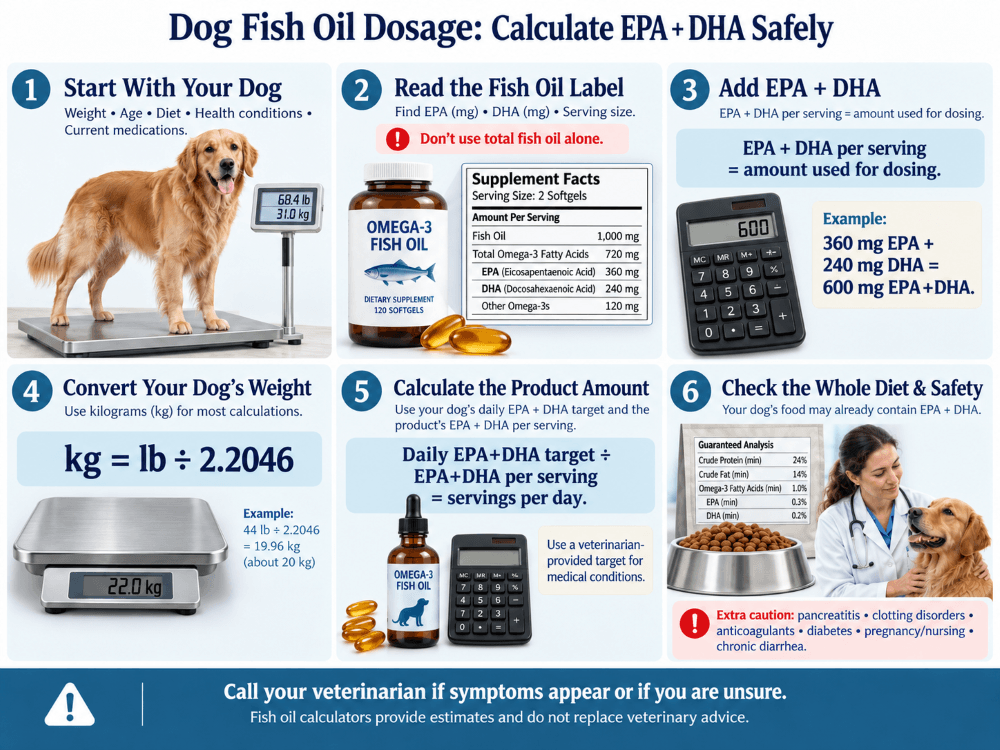
A useful fish oil calculation has two separate parts: determining how much EPA+DHA is appropriate, then determining how much of a particular product supplies that amount. The calculator can handle the arithmetic, but understanding the numbers on the bottle helps prevent some of the most common dosing mistakes.
Calculate EPA and DHA Together
If the label lists EPA and DHA separately, add them: EPA+DHA per serving = EPA per serving + DHA per serving
For example:
- EPA: 360 mg
- DHA: 240 mg
- Combined EPA+DHA: 600 mg
If the bottle says one serving is two capsules, those 600 mg apply to two capsules, not one. Each capsule would provide 300 mg combined EPA+DHA.
Account for EPA and DHA Already in Your Dog's Food
Fish oil supplements are only one possible source of EPA and DHA. Some complete dog foods, particularly veterinary joint diets and other therapeutic formulas, already provide substantial long-chain omega-3 fatty acids. Adding a supplement without considering the food can increase total intake far beyond what you intended. Check the diet's nutritional information or ask the manufacturer or veterinarian for EPA+DHA content if it is not clearly listed.
General Nutrition and Therapeutic Dosing Are Different
An adult-maintenance nutritional reference should not be confused with a therapeutic amount used for a specific disease. Clinical studies have used widely varying EPA and DHA doses depending on the condition being studied. A recent review found different ranges in research involving canine dermatologic disease, osteoarthritis, cardiovascular disease, dyslipidemia, cognition, and other conditions, which is one reason a single “medical fish oil dose” is not appropriate for every dog.
Do Not Use a Safe Upper Limit as a Target Dose
Veterinary references describe an upper safe limit for EPA+DHA that is substantially higher than the adult-maintenance reference. That number is a ceiling used in safety assessment, not an ideal daily target. More fish oil is not automatically better. Higher amounts add more fat and calories and may increase the chance of adverse effects or interactions.
Factors That Can Affect Your Dog's Fish Oil Results
Several details can change the amount your dog actually receives or whether supplemental fish oil is appropriate.
| Factor | Why It Matters | What Owners Should Check |
|---|---|---|
| Body weight | Weight affects EPA+DHA calculations. | Use a current, accurate weight. |
| Reason for use | Therapeutic targets differ from maintenance needs. | Know whether use is nutritional or medical. |
| Current diet | Food may already provide EPA and DHA. | Check the food's nutrient information. |
| Product strength | EPA+DHA varies widely between oils. | Read EPA, DHA, and serving size. |
| Health history | Some conditions require extra caution. | Check for pancreatitis, GI, or clotting issues. |
| Medications | Fish oil may interact with some treatments. | Review all drugs and supplements. |
| Body condition | Fish oil adds fat and calories. | Include it in the overall diet plan. |
Dogs taking anticoagulants or certain anti-inflammatory medications, and dogs with clotting disorders, diabetes, diarrhea, or a history of pancreatitis deserve additional caution before supplementation.
Common Fish Oil Dosing Mistakes to Avoid
Most fish oil errors come from reading the wrong number on the label or overlooking another source of omega-3s.
| Mistake | Why It Matters | Better Approach |
|---|---|---|
| Using total fish oil mg | Total oil is not the EPA+DHA dose. | Add the EPA and DHA amounts. |
| Ignoring serving size | The label may list multiple capsules per serving. | Check the amount per capsule, mL, or pump. |
| Wrong units | lb, kg, mL, and teaspoons are different units. | Convert units before calculating. |
| Ignoring the diet | Food may already supply EPA+DHA. | Count dietary omega-3 intake first. |
| Copying another dog's dose | Weight and health needs differ. | Calculate for your individual dog. |
| Treating estimates as exact | Medical dosing needs individual guidance. | Use a vet-directed therapeutic target. |
| Ignoring symptoms | Side effects may require evaluation. | Contact a veterinarian if symptoms appear. |
| Using the safety ceiling | A maximum level is not a target dose. | Use the appropriate nutritional or vet target. |
Fish Oil Safety Guidelines for Dogs
Fish oil is widely used in dogs, but “natural” does not mean risk-free. The amount, product quality, existing diet, medical history, and other medications all matter.
Possible Fish Oil Side Effects
Mild side effects can include:
More concerning problems can include unusual bruising or bleeding, pancreatitis, allergic reactions, appetite loss, and neurologic signs such as incoordination or seizures. Stop giving the supplement and contact your veterinarian if your dog develops significant or persistent symptoms.
When to Contact a Veterinarian
Call your veterinarian promptly if your dog develops:
A mild soft stool after starting a supplement is different from repeated vomiting, abdominal pain, or marked weakness. When you are unsure how serious a reaction is, contact your veterinarian rather than relying only on the calculator.
Dogs That Need Extra Caution
Ask a veterinarian before starting fish oil if your dog:
Fish oil can interact with other supplements and medications, so your veterinarian should know everything your dog receives—including nonprescription products.
Choosing a Fish Oil Product
A useful product label should tell you exactly how much EPA and DHA the dog receives per capsule, teaspoon, milliliter, pump, chew, or other serving. Look for:
Product quality and concentration are not identical across brands. A 2025 laboratory analysis of canine fish-oil supplements found wide variation in EPA and DHA concentrations and several cases where measured EPA or DHA did not closely match label claims. Fish oils are also prone to oxidation, so follow the manufacturer's instructions for refrigeration, light protection, and storage after opening.
What to Do If Your Dog Gets Too Much Fish Oil
If your dog accidentally receives more fish oil than intended, do not give additional doses until you know what was consumed and have appropriate guidance. Gather the following information:
Contact your veterinarian if your dog consumed a large or unknown amount, swallowed an entire bottle's contents, has an important medical condition, takes interacting medication, or develops symptoms. Seek urgent veterinary care for repeated vomiting, severe abdominal pain, collapse, significant weakness, abnormal bleeding, breathing difficulty, facial swelling, or neurologic signs.
Do not induce vomiting unless a veterinarian or animal poison-control professional specifically tells you to. If your dog swallowed the bottle, foil, plastic, cap, or other packaging, mention that as well because the packaging may pose a separate obstruction or injury risk.
Special Considerations for Certain Dogs
How to Calculate Fish Oil Dosage for Dogs Manually
If you want to check the calculator's math, start with your dog's weight and the EPA+DHA concentration of the product.
Step 1: Convert Pounds to Kilograms
- If your dog's weight is in pounds:
- Weight in kg = weight in lb ÷ 2.2046
- For example:
- 44 lb ÷ 2.2046 ≈ 20 kg
Step 2: Find EPA and DHA on the Label
- Suppose the product provides:
- EPA: 400 mg per serving
- DHA: 300 mg per serving
- Add them together:
- 400 mg + 300 mg = 700 mg EPA+DHA per serving
Step 3: Determine the Appropriate EPA+DHA Target
- For an adult-maintenance nutritional reference:
- EPA+DHA (mg/day) = 30 × body weight (kg)^0.75
- For treatment of a medical condition, use the target your veterinarian has provided rather than selecting a therapeutic target from a generic chart. If your veterinarian provides a standard body-weight target:
- Daily EPA+DHA = body weight (kg) × prescribed mg/kg/day
- If the target is expressed using metabolic body weight:
- Daily EPA+DHA = prescribed mg/kg^0.75 × body weight (kg)^0.75
Pay close attention to the units. mg/kg/day and mg/kg^0.75/day are different calculations.
Step 4: Convert the Target Into Product Servings
- Once you know the target:
- Servings per day = daily EPA+DHA target ÷ EPA+DHA per serving
If the result is an awkward fraction of a capsule or chew, do not assume the product can safely or accurately be split. A lower-strength liquid or different formulation may make dosing easier.
Example Calculation
- Suppose a 44-pound dog weighs approximately 20 kg and the veterinarian has recommended 700 mg combined EPA+DHA per day. The supplement provides:
- 400 mg EPA per serving
- 300 mg DHA per serving
- 700 mg combined EPA+DHA
- Calculation:
- 700 mg target ÷ 700 mg per serving = 1 serving per day
If one labeled serving equals two capsules, the dog would receive two capsules, not one. This example demonstrates the arithmetic only. 700 mg/day is not a universal recommendation for every 44-pound dog.
Dog Fish Oil Dosage Infographic
Frequently Asked Questions
The Bottom Line
A useful dog fish oil dosage calculator should calculate the amount of EPA + DHA your dog receives—not simply the number of milligrams of fish oil printed on the bottle. Weight is an important part of the calculation, but the correct amount also depends on your dog's food, the strength of the supplement, medical conditions, medications, and the reason fish oil is being used. For routine nutrition, use a conservative nutritional reference and count EPA+DHA already present in the diet. For arthritis or another diagnosed condition, use a veterinarian-provided therapeutic target.
If you are also adjusting your dog's food intake, weight, or overall nutrition plan, a dog calorie calculator, dog feeding calculator, dog BMI calculator, or dog CBD oil dosage calculator can help put supplement calories and body weight into context.